


The Upper Level ISEE Verbal Reasoning section is composed of two parts – synonyms and sentence completions. You will have 20 minutes to answer 20 Synonym Questions and 20 Sentence Completion Questions. These questions test your knowledge of vocabulary and your ability to apply that knowledge.
(Skip this how-to guide and go straight to practicing – free log-in required)
For Synonyms, you must know the definition of the word in all capital letters as well as the definition of each answer choice.
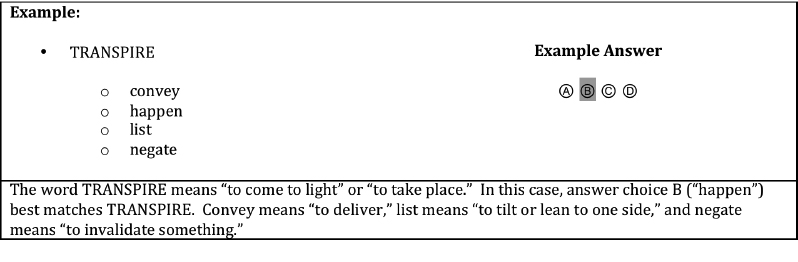
Systematic Approach to Synonym Questions
With 20 capitalized words and 4 answer choices paired with each capitalized word, you must potentially define 100 vocabulary words on the Synonyms portion of the ISEE’s Verbal Reasoning section. You do not receive any context for these words.
Plus, it is likely several of the Synonyms questions will be words that do not appear among the 1200+ words found on Piqosity. Thus, you need a systematic approach to answering every question, whether you recognize the word or not.
 For example, if you are asked to find the synonym for the word “ANTITHESIS,” follow the approach:
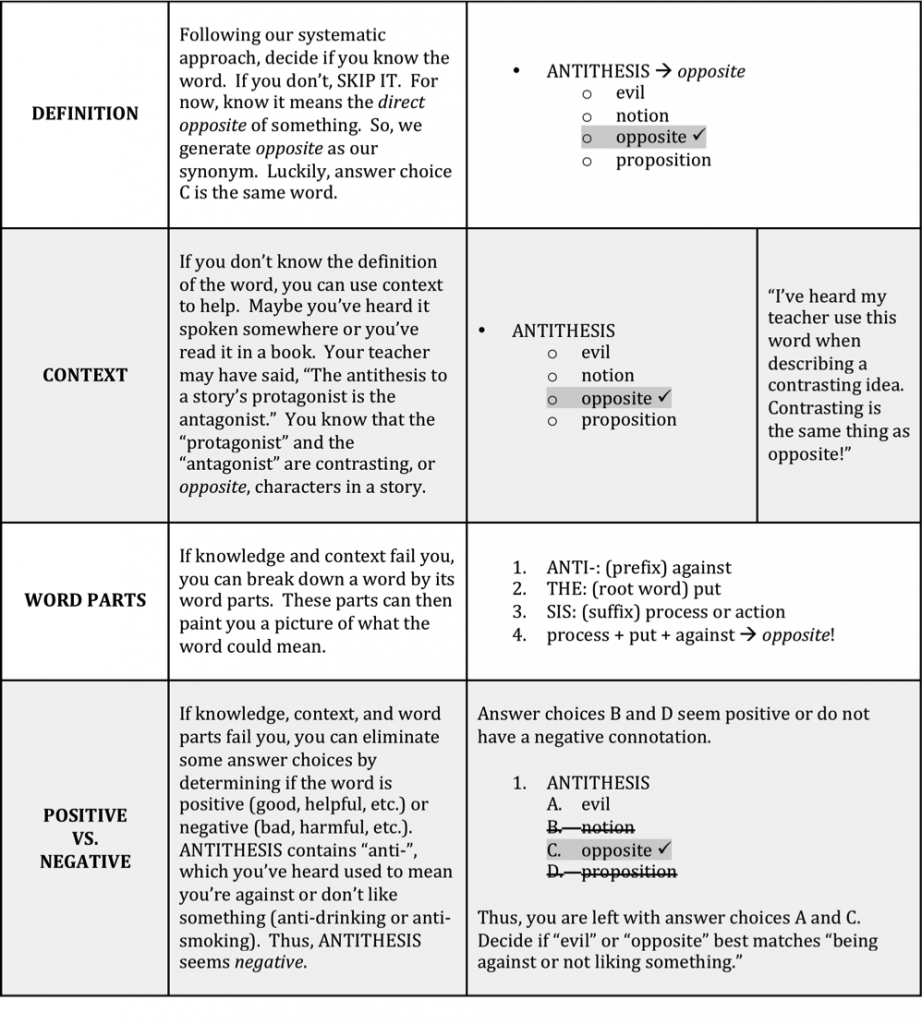
It is important to note that a positive word does not necessarily mean “good”, and a negative word does not necessarily mean “bad”. Think about context. A positive word can be a word where the action is moving towards something, such as “ascend”. A negative word can be a word where the action is moving away from something, such as “descend”. In the same sense, entering a room is positive while exiting a room is negative.
Basically, a word is positive if it moves forward or toward something, adds or increases, is the primary focus of the sentence, or compliments something.
A word is negative if it moves back or away from something, takes away or decreases, is the secondary focus of the sentence, or contrasts something. There are more aspects to positive and negative words, but you will get a better feeling for these aspects after studying more words.
Word Parts
Big words are kind of like math problems. To understand advanced math, you must understand the basics and the many rules and properties that accompany these basics. Words begin with their parts: prefixes, suffixes, and root (or stem) words.
Roots are the basic building blocks of words. All words contain a root, but the root itself is not the word; it must contain a prefix, a suffix, or some mixture of the two.
Prefixes attach to the beginning of the word and alter its meaning or create a new word.
Suffixes attach to the end of the word and alter its meaning, make it grammatically correct, or create a new word.
For example, the word “amorphous” contains the prefix “a-,” the stem “morph,” and the suffix “-ous.” The prefix “a-” means “not,” the stem “morph” means “shape,” and the suffix “-ous” means “possessing” or “full of.” Thus, the word parts for “amorphous” state it means “possessing no shape.”
Be careful not to mix up the stem “morph” with the actual word “morph.” Morph means “to change or transform.” You then might confuse the definition of “amorphous” to be “no change,” which is very different from the true definition of “amorphous.” It is always changing shape, much like an amoeba.
Table of Popular Prefixes
| Prefixes (beginning) | Meaning | Examples |
| a, in, im, ir, il, un, non | not | amoral; imperfect; illegitimate |
| ab, dis, di, se | away, apart | abnormal; distant; segregate |
| ad, ac, ag, at | to, against | aggressive; attract |
| anti, ant, contra, ob, | against | antithesis; contrast; obstruct |
| an | without | anarchy |
| ante, pre | before | antecedent; preface |
| bene | well | beneficial; benefactor |
| bi | two | bifocal; biannual; binary |
| circum, peri | around, about | circumvent; perimeter |
| com, con, col, syn, sym | together, with | compact; collide; symmetry |
| de | from, down | descend; deformed |
| dom | home, rule | dominate; domain; domicile |
| ex, e | out, from | exit; emit |
| extra | beyond, outside | extraterrestrial |
| in, im | in, into | inside; imbibe; imbed |
| inter | between | interface; international |
| intra, intro | within | introduction; intramural |
| mal | bad | malcontent; malformed |
| mis | wrong | mistake; misinformation |
| omni | all | omnipotent; omnipresent |
| per | through | pervasive; permeate |
| post | after | posthumous; postulate |
| poly | many | polygon; polygamy |
| pro | forward, for | proposal; proactive |
| re | again, back | reinforce; redemption |
| semi | half | semiannual; semicircle |
| sub | under | subversive; submerge |
| super | above | superficial; superimpose |
| sur | on, upon | surmount; surpass |
| trans | across, beyond | transition; transparent |
Table of Popular Stems/ Roots
| Stems/Roots (body) | Meaning | Examples |
| ag, ac | do | agenda; action |
| agri | farm | agriculture |
| aqua, aque, hydr | water | aquatic; aqueous; hydrate |
| auto | self | autonomous |
| biblio | book | bibliography |
| bio | life | biography; biology |
| cad, cas | fall | cadence; cascade |
| cap, cep, cept | take | captive; accept |
| capit | head | capital; capitulate |
| ced, cede, ceed, cess | go | access; succeed; secede |
| celer | speed | accelerate |
| chrom | color | polychromatic |
| chron | time | chronology; chronic |
| cide, cis, sec, sect | cut | suicide; dissect; incision |
| clude, clud, clus | close, close | inconclusive; preclude |
| cog, cogn | knowledge of | cognitive; recognize |
| ded | give | dedicate |
| duce, duct | lead | deduction; reduce |
| flect, flex | bend, turn | reflect; reflex; deflect |
| graph, gram | picture, writing | demographic; diagram |
| greg | group, gather | aggregate; gregarious |
| gress, grad | move | graduate; progress |
| junct | join | conjunction; injunction |
| lect, leg | read, choose | lecture; legible |
| logue | speech, speaking | monologue; dialogue |
| logy | study of | necrology; theology |
| mis, miss, mit | send | missive; emit |
| plac | please | placate |
| sequ, secu | to follow | sequence; consecutive |
| tain | hold | obtain; detain; retain |
| vene, vent | come | intervene; invention |
| volve, volu | roll, turn | evolve; evolution |
Table of Popular Suffixes
| Suffixes (end) | Meaning | Examples |
| able, ible | capable of | liable; applicable; reversible |
| age | place, thing, idea | adage; storage; blockage |
| al, ic | pertaining to | coincidental; medic |
| ance, ary, ence | relating to | significance; functionary |
| ate | an action of | placate; medicate; obligate |
| cy | the quality of | candidacy, theocracy |
| er, or | one who | professor; teacher; maker |
| ion | the act or state of | complication |
| ious | full of | pious; zealous; egregious |
| ive | having the quality of | festive; plaintive |
| ly | to do with the quality of | comically; quietly |
| ment | the result of | fulfillment; compliment |
| ness | the quality of being | calmness; emptiness |
| ty | condition of being | quantity; quality |
Let’s Practice
Piqosity allows you to take free practice quizzes and receive analysis of your performance including details on question difficulty level and a comparison to how your peers did on the same question. You can use questions already on Piqosity or upload your own.
The sample quiz below includes 20 synonym questions, 2 of which are easy, 2 of which are hard, and 16 of which are of medium difficulty. If you want to simulate actual timing, you should limit yourself to 20 minutes.
—
This How-To Guide is excerpted from “Upper Level ISEE Prep Guide with 6 Full-Length Practice Tests, 3rd Edition” by Stephen Hayes and the Staff of General Academic. You can buy it on Amazon for about $50.


[…] Synonym Questions on the Upper Level ISEE […]