


The ACT is a college-readiness exam administered to roughly 1.4 million students across the United States and internationality each year. Last year, the ACT massively changed its test, making it align much more closely with the SAT, which underwent a major overhaul in 2023. Both of the new tests are shorter, largely digital, and give students more time per question than previous iterations did. We’ve done previous breakdowns of the new ACT based on specification documents and other available information, but now that the ACT has released two official practice tests on their website, we can do a much more thorough analysis of the changes, especially the content changes, on the new ACT. This article delves into what is tested on the English section of the ACT, and offers students tips for acing this portion of the test!
Format Changes on the ACT
Before we broach the subject of content changes, however, let’s briefly refresh the major format changes of the new ACT. Overall, there are fewer questions per section, fewer questions per passage (in the English and Reading sections), and shorter passages. The Science section, once considered emblematic of the ACT’s reputation as the “STEM” test, is now optional; students can decide whether or not they want to take it. The same is true for the Essay section. The result is a much shorter test that is more in line with competitors like the SAT.
New ACT 2025 Format
| Test Section | Number of Questions | Time Limit (minutes) | Time Per Question (seconds) |
| English | 50 | 35 | 42 |
| Math | 45 | 50 | ~67 |
| Reading | 36 | 40 | ~67 |
| Science (optional) | 40 | 40 | 60 |
| Essay (optional) | 1 | 40 | n/a |
| Totals: | 131 + 41 optional | 125 + 80 optional | n/a |
But the real question on everyone’s mind is: how the content of the ACT has changed along with the new format? Although we have been given some hints as to what these changes might be in the specification documents released for the new format, the best strategy is to examine official tests, which is what we do below. Up until now, this has been a hard ask since there has only been one officially released digital practice test, largely made up of recycled material. Now, however, the ACT has released another digital practice test.
This article analyzes these two official practice tests in order to determine everything that’s tested on the English section of the ACT.
English Section of the New ACT
Out of the three required sections, the English Test has gotten the largest facelift. Previously, there were five passages, each about 320 words and with 15 attached questions. There are now two different lengths of passages–shorter passages have five attached questions, while the longer passages have 10 questions.
Passage Length & Difficulty on the New ACT English Section
Officially, the ACT gives no word on how many of each passage type will appear on the test, but these numbers are consistent between the two released practice tests, implying that all tests will likely follow the same distribution of passages. On both of the released tests, there are six passages in all, two short ones and four long ones. The order in which these passages appears changes across the tests, meaning that is likely to continue on the actual tests as well.
Let’s take a closer look at the breakdown of how many words this means a student can expect to see across the six passages.
Official ACT English Passages
| Test | Average Word Count (10-Question Passages) | Average Word Count (5-Question Passages) | Average Word Count (15-Question Passages) | Total Words Per Test | Average Flesch-Kincaid Score |
| Practice Test 1 | 322 | 196 | N/A | 1,677 | 11.65 |
| Practice Test 2 | 359 | 186 | N/A | 1,787 | 10.08 |
| 2021-2022 Released ACT Test (old format) | N/A | N/A | 323 | 1,613 | 10.57 |
The longer passages have an average of 340 words, while the shorter passages have an average of 186 words. This means that on average, students can expect to read about 1,700-1,800 words across an entire English section. This translates to about six pages of an average book, and is slightly longer than the old English test, where students could expect to read roughly 1,600 words.
Another thing to consider is the complexity of passages. In the table above, we measured the Flesch Kincaid grade level score average for each passage. This is a readability score that considers average length of sentences as well as average syllables per word in order to assign a grade level to a text.
The passages largely range from an 8th grade reading level to a 12th grade reading level, with the average being just shy of an 11th grade level. This is almost exactly in-line with previous English sections. For example, the English section on the 2021-2022 released ACT had an average Flesch Kincaid score of 10.57, or almost exactly halfway between a 10th and 11th grade reading level.
Format of Questions on the New ACT English Section
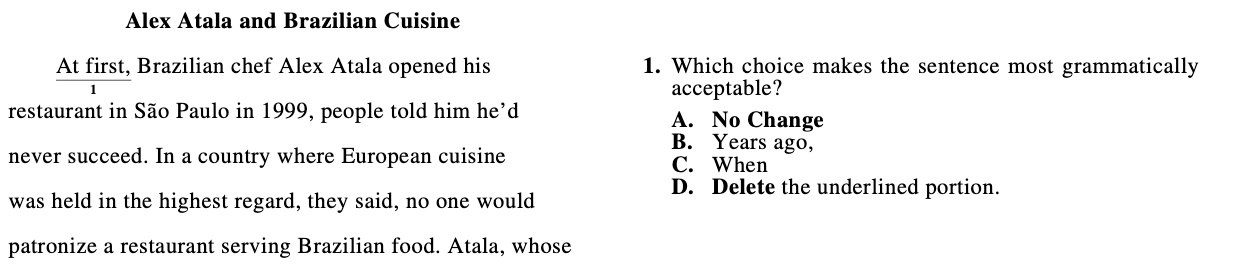
Unlike the passages, the format of English questions on the new ACT has remained largely unchanged. If a student takes the new, enhanced ACT online, almost all questions will correspond to an underlined portion of the passage. When a student clicks a new question, the corresponding line or phrase will be highlighted and the passage will automatically scroll so students can see it.
This is different from the old paper-and-pencil test where students had to keep track of question numbers that appeared beneath the underlined text. Although the spacing of the printed passage was designed so every question was beside its related text, this change will likely make it easier for students to keep track of where they are and to quickly read the corresponding text. Overall, this means that students will have more time to actually answer questions!
Old Format:
New Format:
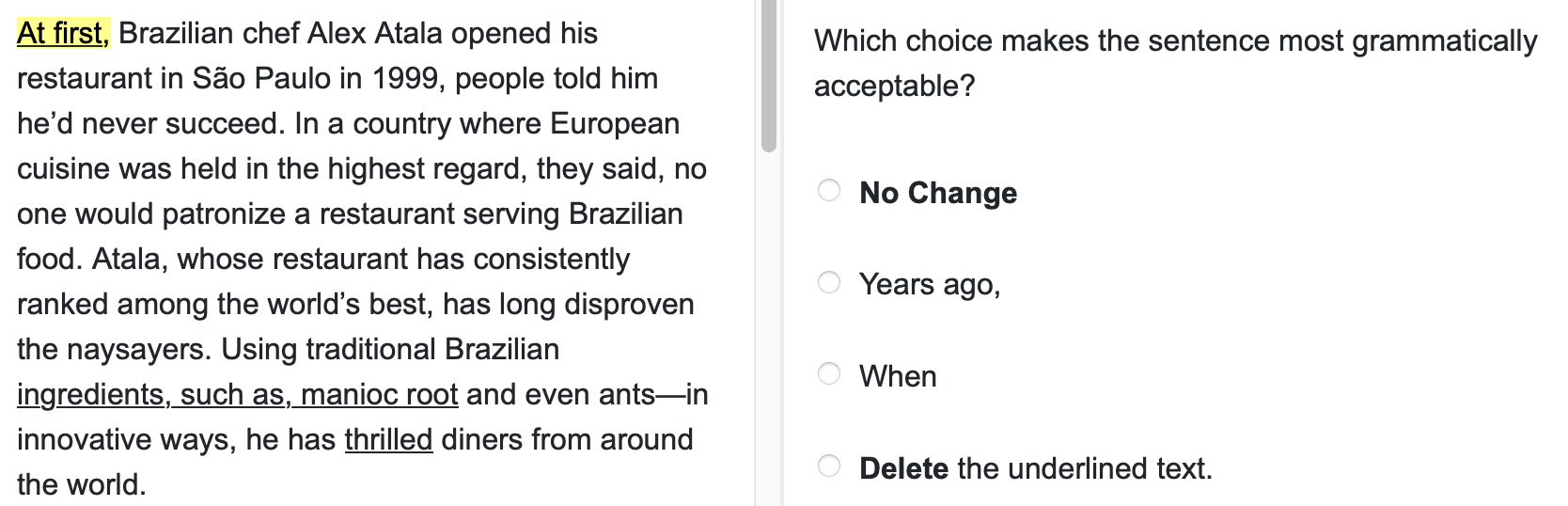
The answer options will almost always present students with three options that could be swapped in for the underlined text (the first answer option will read “No Change,” indicating that the best option is how the text currently appears in the passage). Students have to select the option that makes the text grammatically correct, or which best serves some other purpose indicated in the question.
The most important thing to note about this style of questions is that it means that it can be hard to read the passage straight through in the same way students might read a reading passage straight through, since they will be encountering grammatical and other issues that might make it hard to follow.
In light of this, we recommend that students DON’T read the whole passage to begin with as they might for reading. Instead, they should read through the passage AS they work questions. This way, by the time they get to the final questions of the passage, which often relate to the passage as a whole, they will be able to effectively answer questions about the passage’s main ideas, arguments, and organization.
Reporting Categories of Questions on the New ACT English Section
And finally, let’s analyze what types of questions we’re actually seeing on the tests. The ACT officially sorts each English question into one of three reporting categories:
- Production of Writing (POW) — Organization and Purpose questions
- Knowledge of Language (KLA) — Tone and Word Choice questions
- Conventions of Standard English (CSE) — Grammar questions
In their released specs, the ACT provided ranges for these reporting categories. The table below shows the previous ranges, the ranges specified in the specs of the new test, and then the average percentage that these questions appear on the two released practice tests.
ACT English Section Reporting Categories
| Reporting Category | Percentage of Questions on Old Test | Percentage of Questions on New Test (Officially) | Average Percentage on Practice Tests |
| Production of Writing | 29-32% | 38-43% | 41.5% |
| Knowledge of Language | 15-17% | 18-23% | 20.5% |
| Conventions of Standard English | 52-55% | 38-43% | 38% |
(Note that one passage in each of these tests is experimental and unscored, and the ACT doesn’t publish reporting categories of these questions. In these cases, we’ve analyzed the questions and sorted them ourselves).
The ranges on the two released practice tests are in-line with the reported ones in the specifications. Interestingly, on both tests, there were more POW questions than CSE ones. This makes sense; one of the main reported changes on the new ACT is fewer grammatical questions. This change aligns the English section of the ACT closer to the Reading & Writing section of the SAT, which has an average of fewer than 15 grammar questions per test.
Question Content on the New ACT English Section
Now that we have an understanding of the general spread of the overall question categories, let’s get into what we’re actually seeing being tested on these tests. We’ll break down the test reporting category by reporting category and look at the questions that appear in each one.
Production of Writing
- Organization, Unity, and Cohesion: ~7 questions per test
- Purpose and Emphasis: ~7 questions per test
- Transition Words and Phrases: ~3 questions per test
- Additions and Subtractions: ~3 questions per test
Overall, almost half the questions on these tests fell into this category. This is a significant change from previous tests, and shows that the ACT is becoming much more concerned with overarching English/writing concerns (how a text is working, how to edit it appropriately), rather than low-level grammar ones.
What do Production of Writing Questions Test on the English Section of the ACT?
Production of Writing questions are always about logic–what sentence logically follows another, what information makes the most sense in a given context, what details a writer should emphasize in order to get certain ideas across, etc.
It’s very important to understand how ideas relate to one another and to understand how ideas are developed across an entire text. For example, let’s take a closer look at an Organization, Unity, and Cohesion question:
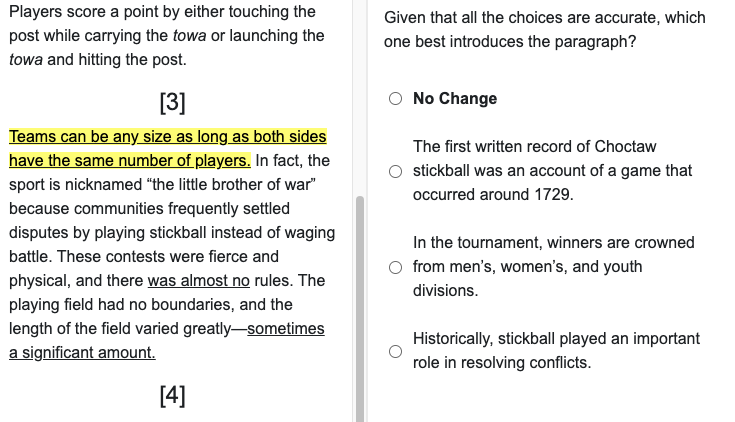
This question requires students to read the paragraph in question, and then select the introductory sentence that best introduces those ideas. Most of the paragraph is about how stickball was used as an almost diplomatic substitute for traditional war; disputes were solved by teams playing each other in brutal showdowns. Most of the answer options here deal with details about stickball that are ultimately unrelated to the focus of the paragraph: the size of teams, the divisions that played, and the first recorded game. Only the fourth answer option: “Historically, stickball played an important role in resolving conflicts” relates to the rest of the paragraph, so it must be our correct answer.
Unlike other categories of questions, the “question stem,” or the portion of text that actually asks the question is vitally important in POW questions. For grammar questions regardless of the skill being tested, this stem is always the same, but here, it not only asks students specific questions, it also can give them helpful hints that will help direct them to the correct answer. For example, let’s look at a typical Purpose and Emphasis question:
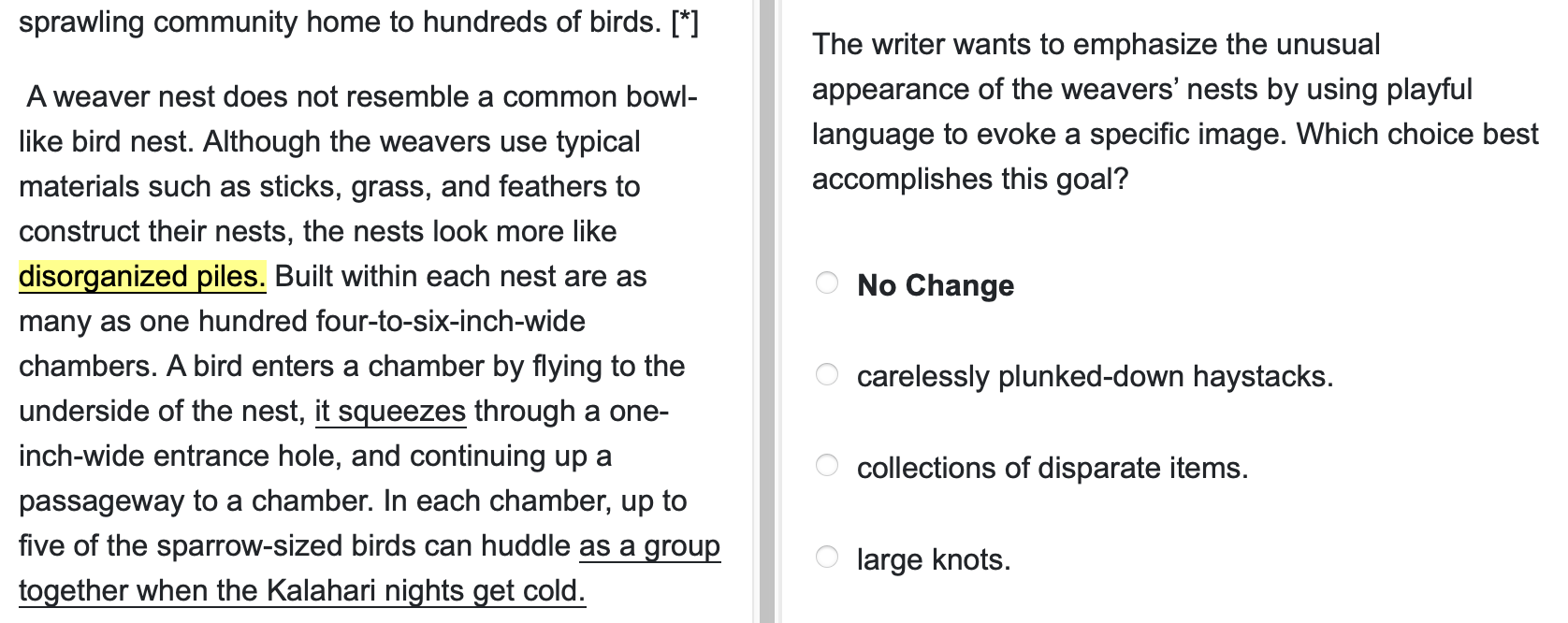
Here, the question asks students not only to select the answer option that emphasizes “the unusual appearance of the weavers’ nests,” it also asks them to choose the one that does so using “playful language to evoke a specific image.”
Almost all of the answer options could fulfill the first half this brief, so instead, students should focus on identifying the one that uses “playful language.” Three out of four options are fairly straightforward, almost clinical in how they describe the nests. Only the second one “carelessly plunked-down haystacks” has descriptors that are not strictly needed (“carelessly plunked-down”), but rather included to give readers a sense of the chaotic nature of the nests. Compare this to the functional descriptions in the other options: “large,” “disparate,” “disorganized”.
Topics to Study for Production of Writing Questions
- Logical progression of a text: It’s important to understand how texts develop. Read widely–newspaper articles, opinion pieces, etc. Track how the author develops their arguments and main ideas.
- How ideas relates to one another: In order to fully understand texts, you have to not only grasp the information imparted, but also understand its relationship to other ideas and information. Do two pieces of information work together to point you to the same conclusion? Do they contradict one another?
- Identifying main ideas: Work on summarizing the main ideas of a text or a portion of text, discarding details and extraneous information. This will help students figure out of the focus of a paragraph or a text as a whole.
- Author’s purpose and intention: Try to identify the text’s argument and the evidence used to support it. Ask yourself, “why was this paragraph/sentence/detail included?”
Knowledge of Language
- Redundancy: ~5 questions per test
- Style, Tone, & Word Choice: ~5 questions per test
Similar to some of the trends that will be noted in the CSE section, the KLA category has changed slightly to be less reflective of subjective skills. On previous iterations of the ACT, some KLA questions would ask students to generally improve the readability of sentences or make them less awkward. None of these questions remain–instead, we see many more “redundancy” questions, which set students the narrower and less subjective task of reducing words while maintaining clarity and meaning.
What do Knowledge of Language Questions Test on the English Section of the ACT?
As the name of this category implies, these question focus largely on how well students know and can utilize language skills. This includes knowledge of vocabulary words, connotations and formality/informality of words and phrases, as well as rewording sentences or portions of sentences to be less wordy and redundant.
Let’s first consider a Style/Tone question. These questions ask specifically about the style of the essay or its tone. Usually, students are tasked with “maintaining the essay’s tone” as is the case in the question below.
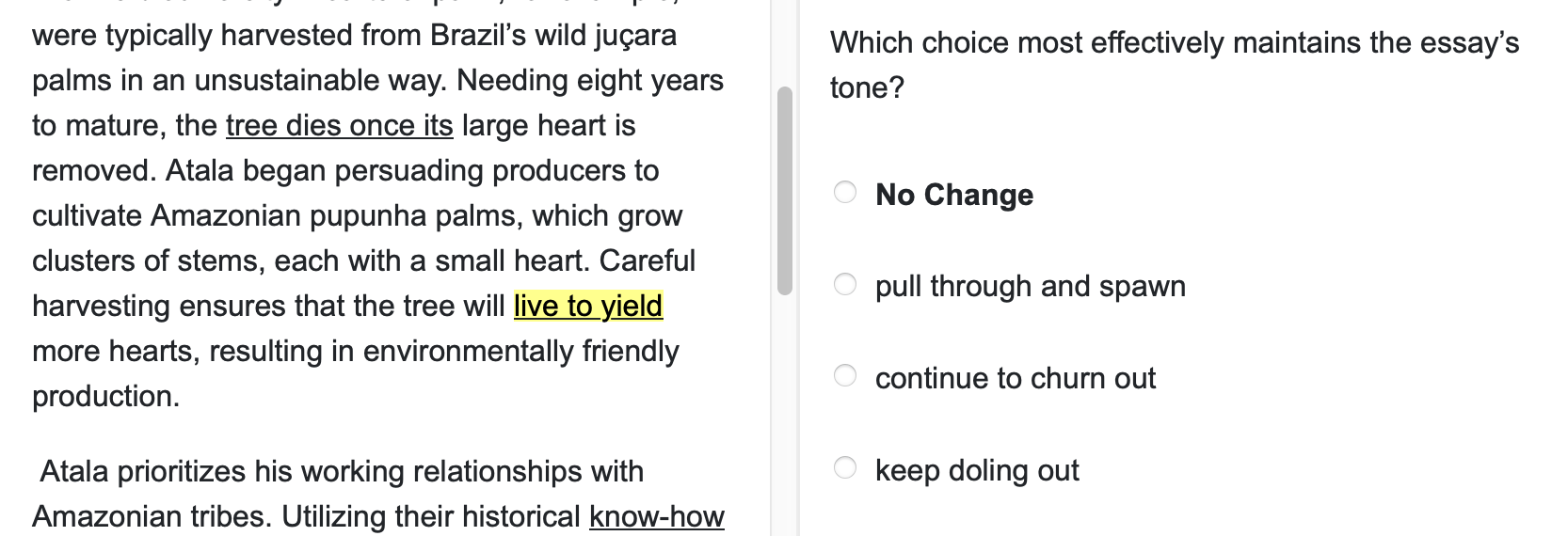
The most important thing for students to do with these questions is to determine whether the piece is casual or more formal. There are many clues that will allow us to place the passage on the informal-formal scale. First, is it conversational? Does it sound like a something someone might say in conversation–are the sentences short and easy to follow? Are personal pronouns (“I”) used? Is the vocabulary used relatively simple? If you answer yes to any of these questions it is likely the passage is more informal. On the other hand, if it uses detached or clinical language, doesn’t have any first person pronouns, and has long words/sentences, it’s likely the passage has a more formal tone.
Once you’ve identified the tone, see which answer option matches best with it. Here, the passage seems to be fairly formal. Bearing that in mind, let’s consider the answer options. “Pull through” is fairly casual phrasing, as is “churn out.” “Doling out” is perhaps a little less casual, but the entire phrase “keep doling out” seems a little too conversational. This leaves only “live to yield” which is the correct answer.
Now, let’s take a look at a redundancy question. These can always be identified by the question stem: “Which choice is least redundant in context?”
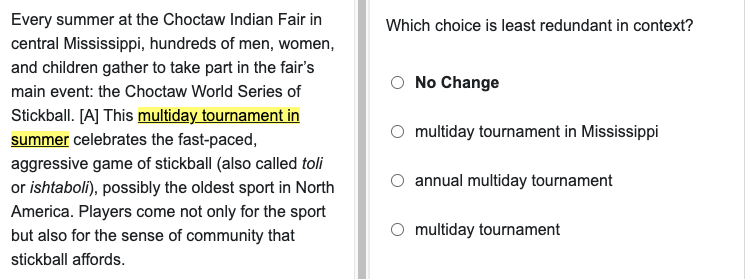
The trick with these questions is to eliminate all the answer options that repeat information imparted elsewhere in the text. Here, we already know that the tournament takes place in Mississippi, and happens in the summer, and that it occurs annually (look at the first sentence in the paragraph). The only new piece of information here is “multiday,” so all that needs to be said is “multiday tournament.”
At least two out of three times, the correct answer to a redundancy question is the shortest option; however, this isn’t always the case! Be careful, sometimes the shortest answer option will delete important text! But, if you have to guess, going with the shortest answer option is a good strategy.
Topics to Study for Knowledge of Language Questions
- Vocabulary: Performing well on this category requires a strong working vocabulary that goes beyond merely knowing the definitions of words; you also have to know their connotations and their level of formality.
- Minimizing words: Practice editing sentences down to contain as few words as possible. How much needs to be said in order to get the same point/information across?
- Identifying tone/style of writing: Ask yourself: “who is the intended audience?” If the piece is distant, clinical, or technical sounding, it probably means that the author is writing for a specific, formal audience. On the other hand, if the writing is conversational, makes use of personal anecdotes and “I” pronouns, then it’s likely that the author is writing for an informal or more general audience.
Conventions of Standard English
- Punctuation: ~7 questions per test
- Clauses and Phrases: ~5 questions per test
- Pronouns: ~3 questions per test
- Subject-Verb Agreement: ~2 questions per test
- Verb Tense: ~2 questions per test
- Conjunctions: ~1 questions per test
This category of questions is the one that the ACT English section is most known for–the “grammar” questions. As can be see from the list above, these questions test a wide variety of grammar skills. Although the English Section of the new, enhanced ACT has fewer CSE questions than the old one did, these questions still make up a large portion of the test, roughly 40% of questions.
What do Conventions of Standard English Questions Test on the English Section of the ACT?
Traditionally, ACT grammar questions have been harder than SAT ones for a few specific reasons. The first is that while SAT questions almost always test only one discrete skill, ACT questions are far more likely to mix skills together. This means that in order to identify a correct answer, students will sometimes need to have an understanding of more than one grammar rule. For example, in order to answer an SAT question correctly you might only need to match a plural noun with a plural verb, whereas in the ACT, a similar question might ask you to match a plural noun with a plural verb and to correctly conjugate the verb based on the rest of the sentence.
For example, in order to answer this question correctly, students have to not only rephrase the highlighted text so it creates an independent clause, but they also have to know that they need a comma to separate the subordinate clause that opens the sentence.
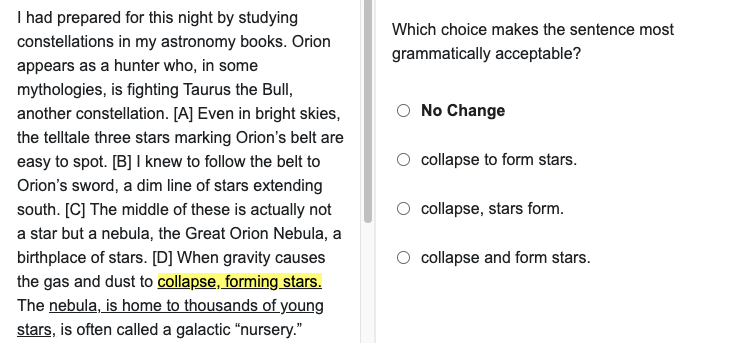
Overall, these practice tests, especially the second released one, seem to be moving away from this style of question. Although we still see more skill-mixing than on the SAT, these questions usually don’t require the synthesis of different grammar rules as much as did previous ACT English sections.
Another reason the ACT grammar section has traditionally been seen as more difficult has to do with the ACT’s tendency to test more subjective grammar concepts, like parallelism. These are concepts that, if they are not adhered to, don’t technically make a sentence grammatically incorrect, but instead just make it worse. On these practice tests though, there were none of these types of questions.
Topics to Study for Conventions of Standard English Questions
Unsurprisingly, these questions cover a large array of skills. While we can’t go over each of them in-depth here, we will a few of the more important ones.
Clauses:
- Independent Clauses: all sentences must have at least one, standalone, independent clause (a clause with a subject/verb pair)!
- Ex: the puppy played in the yard.
- Linking Independent Clauses: independent clauses can be linked by a colon, semicolon, or a comma and coordinating conjunction (and, or, so, etc.). Otherwise. they need to be separated into two sentences.
- Ex: The puppy played in the yard, and we laughed.
- Subordinate Clauses: these are clauses that might initially appear to be independent, but are “subordinated” by a word or phrase like “when,” “if,” “since,” etc. They can be linked to independent classes either with a comma (if the subordinate clause appears first) or with no punctuation (if the independent clause appears first).
- Ex: When the puppy played in the yard, we laughed. vs. We laughed when the puppy played in the yard.
Phrases:
- Prepositional Phrases: these generally don’t have to offset from the text by any punctuation.
- Ex: He tossed the ball through the window.
- Appositive Phrases: these are phrases that rename or further describe a noun. These need to be offset from the rest of the text by commas.
- Ex: Ms. Hutson, the ninth grade English teacher, asked the class to quiet down.
- Restrictive vs. Nonrestrictive phrases: if a phrase contains information that is essential to the sentence (meaning that if that phrase were removed, the sentence would cease to make sense, or its meaning would be drastically altered), this is called a restrictive phrase, and DOES NOT need to be offset by any punctuation. If a phrase contains information that is inessential to the sentence, then it is considered nonrestrictive and it must be offset from the rest of the text by commas, dashes, or parentheses.
- Ex: I laughed so hard that I snorted through my nose. vs. The joke, which was about cats, wasn’t that funny,
- Helpful hint: if a phrase begins with “that” it is almost always restrictive, but if it begins with “which,” it is almost always nonrestrictive.
- Ex: I laughed so hard that I snorted through my nose. vs. The joke, which was about cats, wasn’t that funny,
- Dangling Modifiers: if sentences open with certain modifying phrases, these phrases must immediately be followed by the subject of the sentence–and this subject be what is being “modified.”
- Incorrect: Running down the street, the backpack fell off my shoulder. – This sentence is incorrect because the subject, “backpack” does not align with who/what is doing the action in the modifying phrase.
- Corrected: Running down the street, I felt my backpack slip off my shoulder. – Now this is correct because the subject, “I,” aligns with who/what is performing the action in the modifying phrase.
Nouns/Verbs:
- Subject-Verb Agreement: subjects and verbs must agree with one another in number. This means that a plural subject must have a plural verb. A singular subject must have a singular verb.
- Ex: All the students were excited for summer. vs. The whole school was excited for summer.
- Pronouns/Antecedents: pronouns are general nouns that can fill in for specific nouns. Pronouns always refer back (or forward!) in a text to an “antecedent” or a more specific noun. In order for a pronoun to be correct, it must match number and sometimes gender with the antecedent.
- Ex: Callie, Thomas, and Frankie went to the store where they saw one of their classmates.
- Verb Tense: most of the time, all verbs in a sentence should have the same tense. Sometimes, tenses will mix in a single sentence, especially if two different time periods are being discussed; it’s always important to pay attention to context clues to know which tense to use.
- Ex: Veronica heard that class is canceled if teachers are more than 15 minutes late.
- Helpful hint: if something is being discuss that generally happens, or happens on a continuing basis, we use the present tense! (Ex: My birthday is on May 25th.)
- Ex: Veronica heard that class is canceled if teachers are more than 15 minutes late.
Commonly Mistaken Words:
- Its vs. It’s: interestingly, no fewer than four questions across the two tests were at least partially dependent on knowing the difference between “its” and “it’s”–an easy and important skill for students to learn! “It’s” is a contraction of “it is,” while “its” is a possessive pronoun.
- Ex: I hate that book; it’s so long and boring! vs. The dog chased its own tail.
- Then vs. Than: “then” is a time word, signifying that something happened after something else. “Than” is used to indicate a comparison between two different things.
- Ex: We finished our homework, and then we went outside to play. vs. Maya is taller than her younger brother.
Piqosity Updates to the English Section of the ACT
At Piqosity, we’re committed to always giving students the best study materials possible. Based off this analysis of the official ACT practice tests as well student feedback, we’ve significantly updated all of our 12 Enhanced ACT full-length practice tests to reflect the changes. This ensures that when students take a Piqosity test, they’re getting as close to the real thing as possible. Some of our updates to the English sections of our ACT practice tests include:
- Minimizing “subjective” question types: while some subjective questions remain (for example, style and tone questions), the majority of these questions have been removed. To match this, Piqosity has entirely or partially removed a number of question subtopics that have traditionally tested these more subjective skills, like parallelism and awkwardness.
- Minimizing grammar questions that test more than one skill: similar to subjectivity, there are still some grammar questions on the ACT that test student’s on two different grammar rules rather than one, but these have decreased. Piqosity has shifted our content to match this as well; focusing instead on grammar questions that test a single, distinct skill.
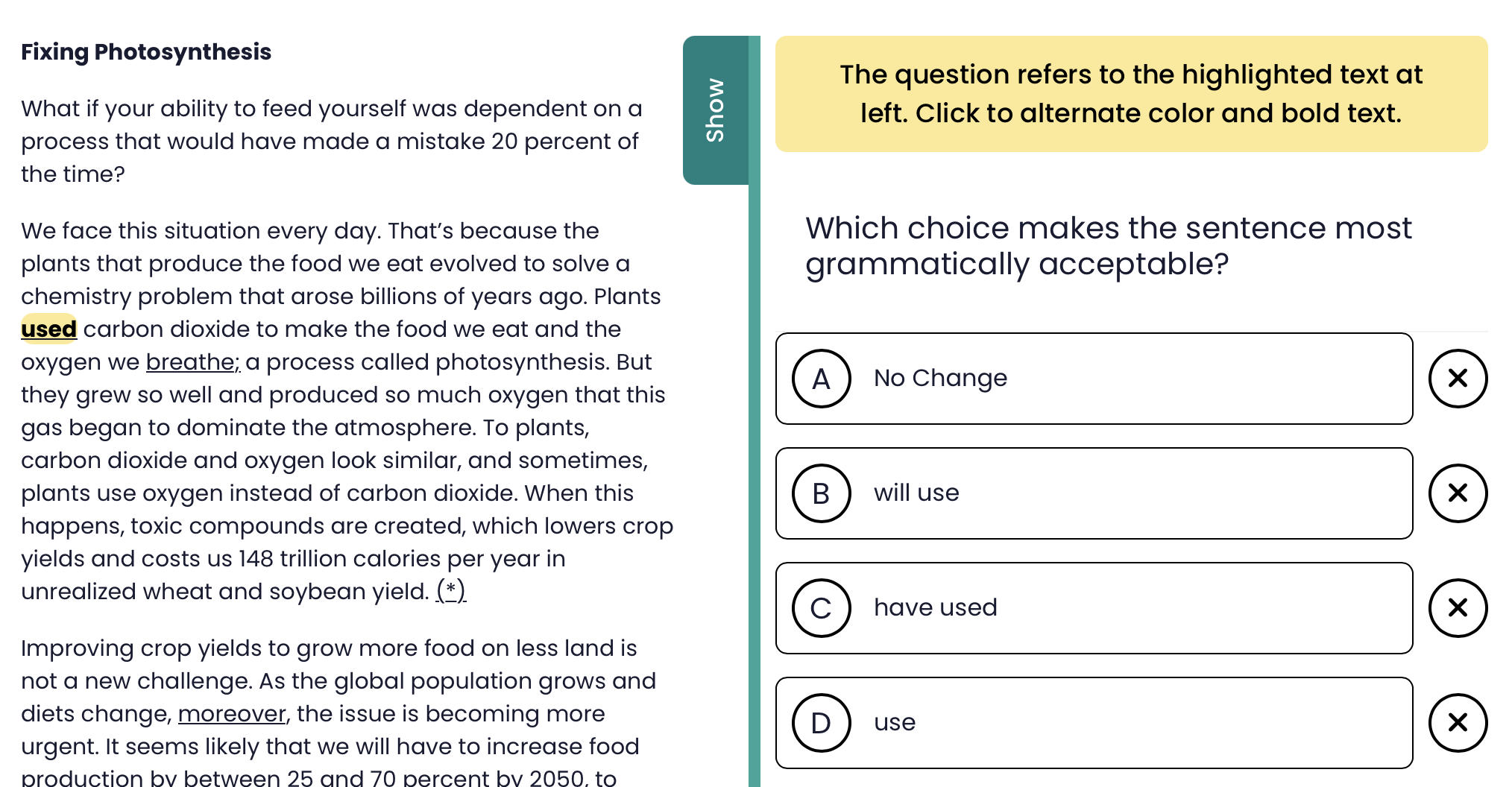
- Software updates to better reflect online ACT format: Piqosity ACT tests have gotten a facelift so that the English and Reading sections more closely reflect the view that students will see when they take the official test online. Like the official ACT, the passage text that corresponds to a question will be automatically scrolled to and highlighted as a student clicks on the question. See below for an example English question on a Piqosity practice ACT:


Leave A Comment
You must be logged in to post a comment.