


The ACT is a college-readiness exam administered to roughly 1.4 million students across the United States and internationality each year. Last year, the ACT massively changed its test, making it align much more closely with the SAT, which underwent a major overhaul in 2023. Both of the new tests are shorter, largely digital, and give students more time per question than previous iterations did. We’ve done previous breakdowns of the new ACT based on specification documents and other available information, but now that the ACT has released two official practice tests on their website, we can do a much more thorough analysis of the changes, especially the content changes, on the new ACT. This article delves into what is tested on the Science section of the ACT, and offers students tips for acing this portion of the test!
Format Changes on the ACT
Before we broach the subject of content changes, however, let’s briefly refresh the major format changes of the new ACT. Overall, there are fewer questions per section, fewer questions per passage (in the English and Reading sections), and shorter passages. The Science section, once considered emblematic of the ACT’s reputation as the “STEM” test, is now optional; students can decide whether or not they want to take it. The same is true for the Essay section. The result is a much shorter test that is more in line with competitors like the SAT.
New ACT 2025 Format
| Test Section | Number of Questions | Time Limit (minutes) | Time Per Question (seconds) |
| English | 50 | 35 | 42 |
| Math | 45 | 50 | ~67 |
| Reading | 36 | 40 | ~67 |
| Science (optional) | 40 | 40 | 60 |
| Essay (optional) | 1 | 40 | n/a |
| Totals: | 131 + 41 optional | 125 + 80 optional | n/a |
But the real question on everyone’s mind is: how the content of the ACT has changed along with the new format? Although we have been given some hints as to what these changes might be in the specification documents released for the new format, the best strategy is to examine official tests, which is what we do below. Up until now, this has been a hard ask since there has only been one officially released digital practice test, largely made up of recycled material. Now, however, the ACT has released another digital practice test.
This article analyzes these two official practice tests in order to determine everything that’s tested on the Science section of the ACT.
Science Section of the New ACT
Out of all of the sections, the Science has certainly changed the least with the new testing format. There’s the same number of questions and passages; the only real formatting difference is that students now have a little more time to complete the section.
It’s hard to determine from only these tests what the future is for the Science section of the ACT, but evidence seems to suggest that the ACT is seriously considering phasing out this section entirely, even as an optional add-on for students. There is no official word on this, but it is discussed in greater detail later in this article.
Despite the uncertainty of the future of the Science section, let’s consider the content tested.
Passage Length & Difficulty on the New ACT Science Section
Unlike other passage-based sections of the ACT (English and Reading), there is not an official number of passages on the Science section, nor a set number of questions attached to passages. There are always 40 questions, and passages typically have 5-7 attached questions, meaning that Science section typically consists of between 6-7 passages.
Traditionally, we’ve seen six passages as the most common configuration, but it’s important to note that both of the released practice tests have seven passages. This tells us that perhaps the ACT is moving more toward that number of passages. This means that students will do fewer questions per passage, but have to look at more passages overall.
Official ACT Science Passages
| Test | Average Words per Passage | Words per Test | Average Flesch Kincaid Score |
| Practice Test 1 | 319 | 2,233 | 8.57 |
| Practice Test 2 | 305 | 2,137 | 9.51 |
| 2021-2022 Released ACT Test (old format) | 221 | 1,331 | 10.38 |
(Note: As stated above, both released ACT practice tests have seven Science passages while the 2021-22 released test only has six. This likely accounts for some of the number discrepancies seen above, especially in terms of the total words per test.)
In the practice tests, we’re seeing a slight increase in words per passage, about 312 across the two practice tests, compared to 221 on the 2021-22 released test. This increase in words is perhaps evened out by a slight decrease in Flesch Kincaid scores: 9.04 on the practice tests from 10.38 on the previously released test. The total words students are expected to read across a the passages of a Science section is about 2,185, which translates to about seven pages of a traditional book.
Types of Passages Encountered on the Science Section of the ACT
Like the Reading and English sections of the ACT, the Science section has a few specific genres of passage that students are likely to encounter. Although questions of any reporting categories can be found in any passage, passages in certain genres tend to favor certain categories over others.
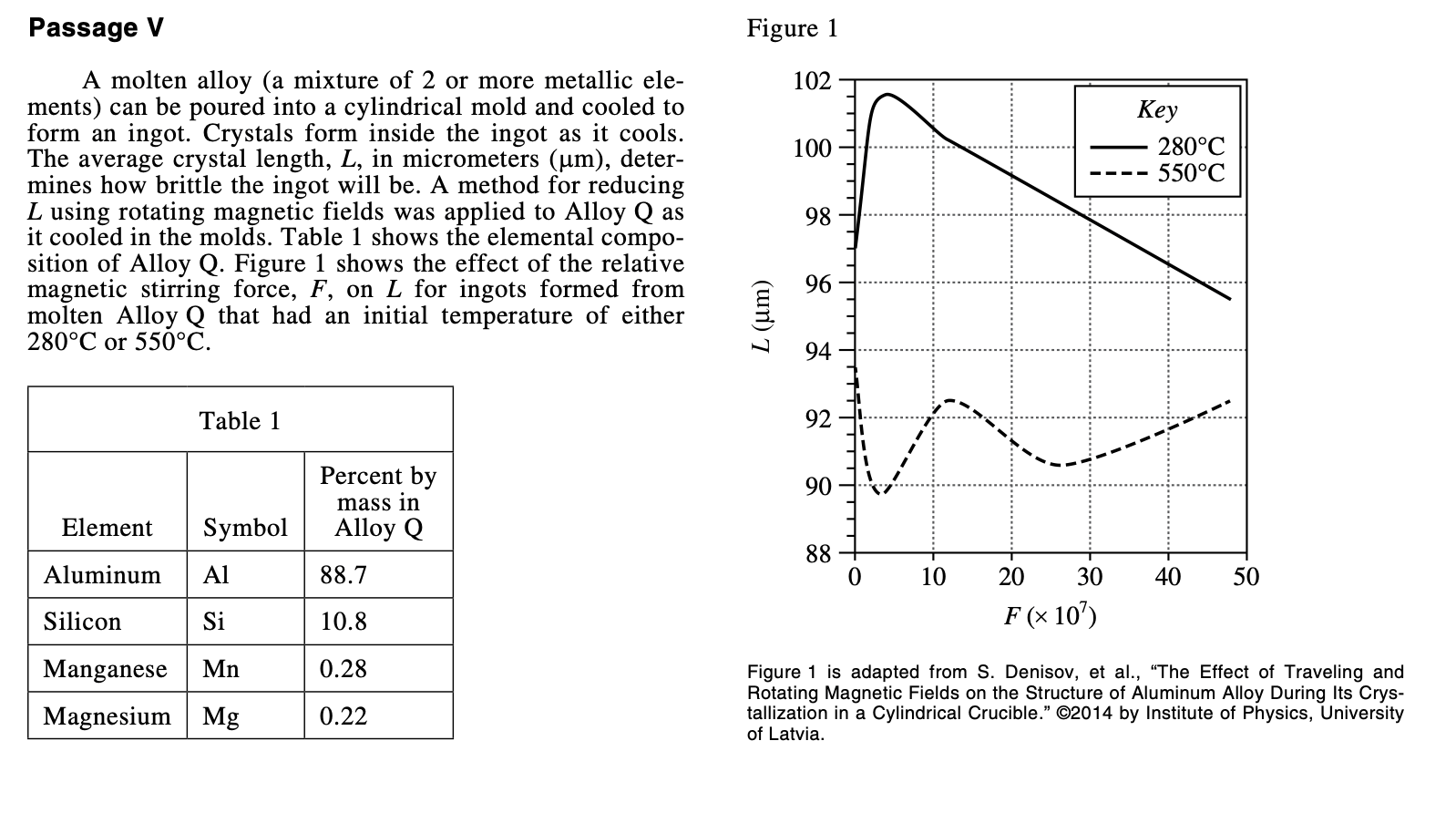
Data Representation
This is the most common kind of passage. These passages prioritize data representations (charts, tables, graphs, etc.) over everything else. Although there is always a passage that provides context to the data representations, many of the attached questions have to do with reading and interpretation of data found within the charts, rather than text from the passage itself. These passages tend to favor IOD questions.
Below is an example of Data Representation passage from the first practice test:
Conflicting Viewpoints
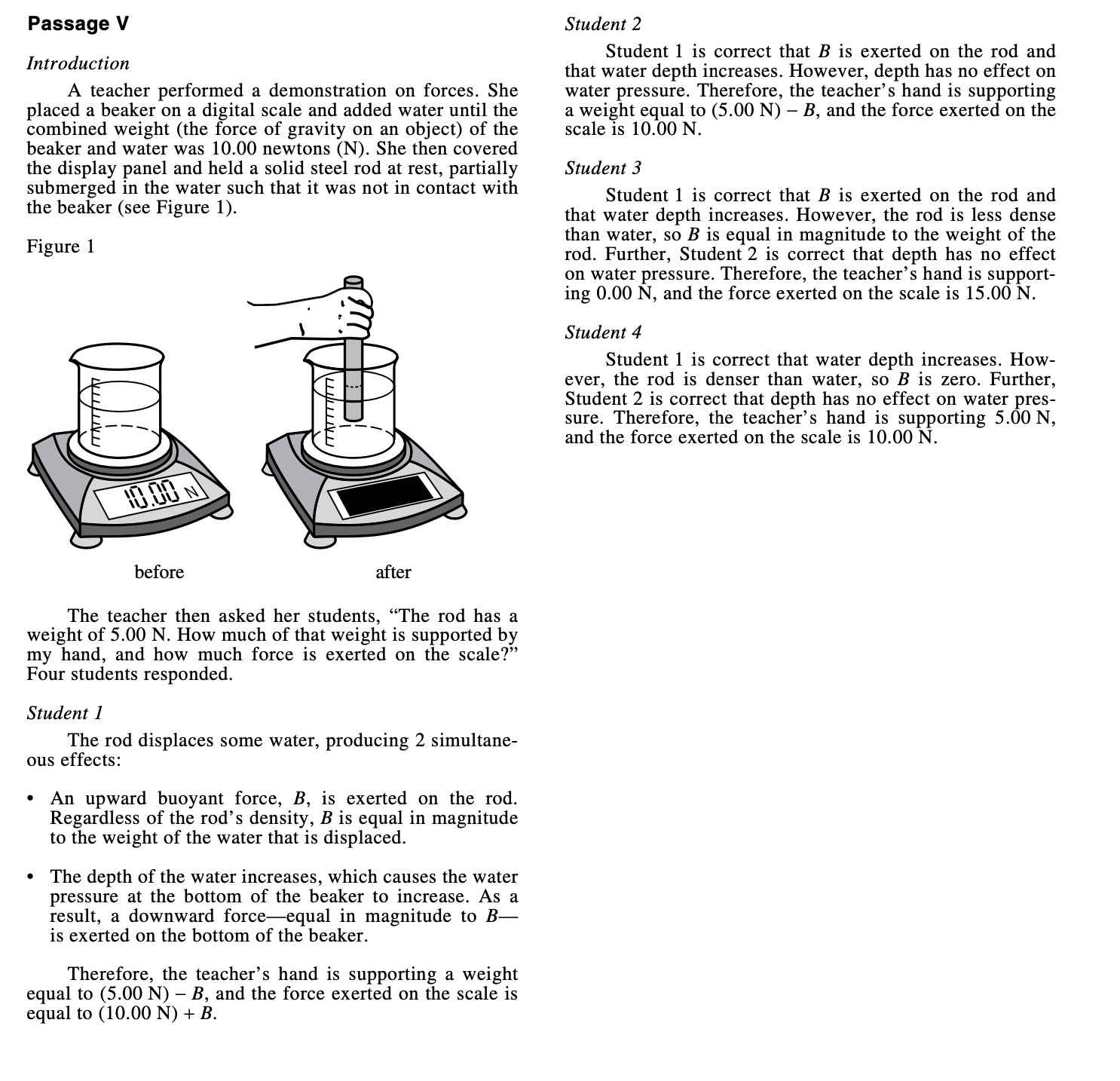
These passages always present 3-4 different viewpoints, often hypotheses, of what will happen in some scenario, or explanations of some phenomena. Although they might be accompanied by figures, they rarely contain significant data representations. In order to answer the attached questions, students instead have to understand the perspectives being represented as well as their relation to one another. These passages tend to favor EMI questions.
Below is an example of a Conflicting Viewpoints passage from the second practice test:
Research Summaries
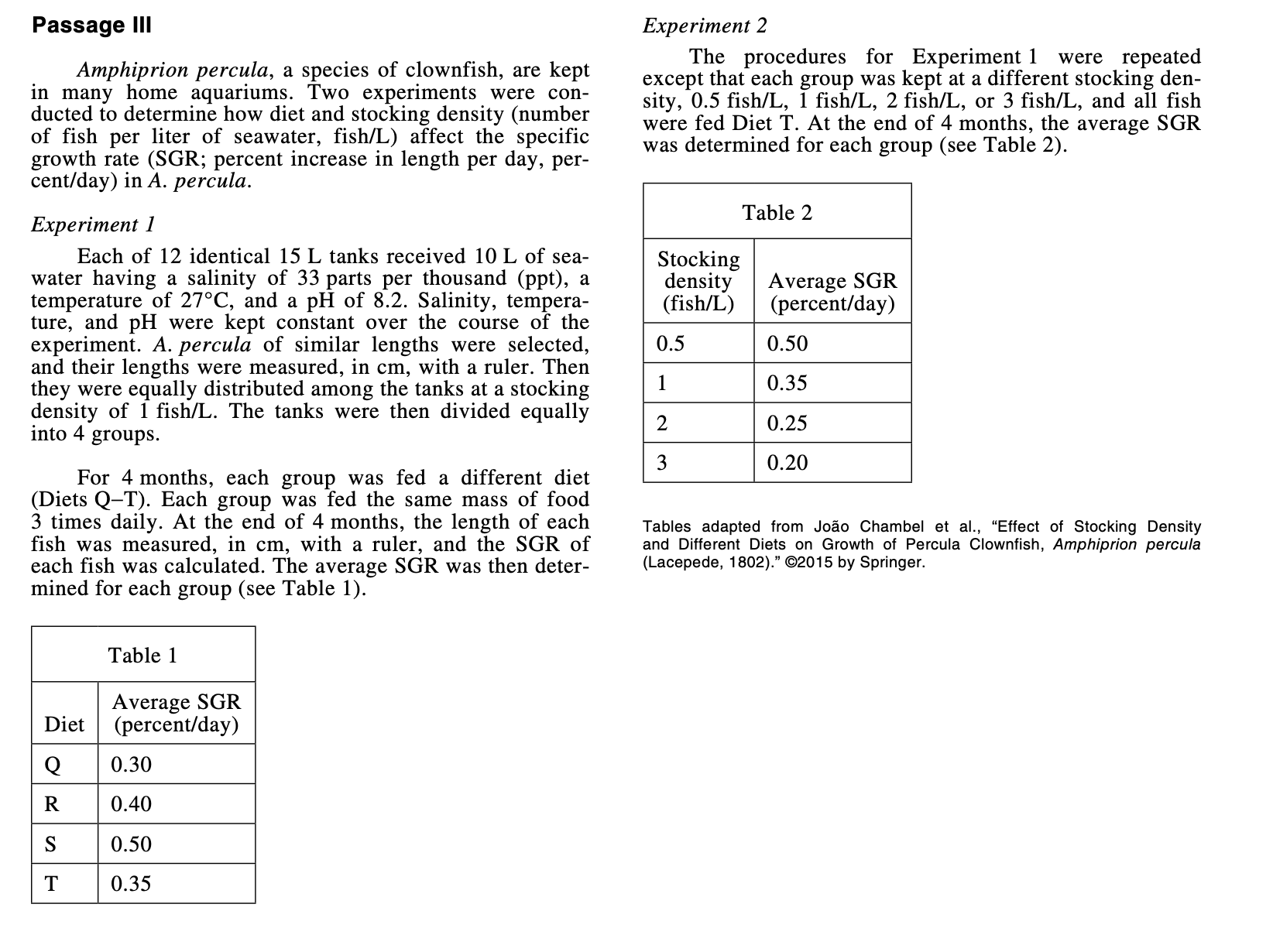
These passages document experiments or studies with multiple trials. Often, some variable is changed between trials. Students will often have to understand the mechanics of the experiment or study’s setup, the function of different elements, and how changes to certain variables affect the resulting data. These passages tend to favor SIN and IOD questions.
Below is an example of a Research Summary passage from the first practice test:
Reporting Categories on the New ACT Science Section
There are officially three different reporting categories that questions on the Science section of the ACT fall into:
- Interpretation of Data (IOD) — questions dealing with the reproduction or analysis of data found in diagrams and charts
- Scientific Investigation (SIN) — questions dealing with the design and modification of experiments
- Evaluations of Models, Inferences, & Experimental Results (EMI) — a broad category that includes making conclusions and predictions and evaluating the validity of scientific information
As is the case with the other ACT test sections, while these reporting categories haven’t changed, the percentages of the questions found in each on the tests have shifted slightly with the new ACT format. Below is a graph charting these changes.
ACT Science Section Reporting Categories
| Reporting Category | Percentage of Questions on Old Test | Percentage of Questions on New Test | Average Percentage of Questions on Practice Tests |
| Interpretation of Data | 40-50% | 36-47% | 43% |
| Scientific Investigation | 20-30% | 17-31% | 28% |
| Evaluation of Models, Inferences, and Experimental Results | 25-30% | 22-36% | 29% |
(Note: the six questions attached to the experimental passage on each practice test have been excluded from this count.)
As is the case with the format of the section, the content of the Science section of the ACT has largely remained the same. As can be seen in the table above, there have been slight changes to possible ranges of each of the reporting categories, though the actual percentage of each reporting category seen across the two practice test also falls within the old ranges as well. This tells us that students who were prepared for the old Science section are almost certainly prepared for this one.
Interpretation of Data
Of the Science section reporting categories, IOD is generally considered the easiest. It largely includes questions related to simple reading comprehension and analysis of the information in the passage and attached charts. Some of the skills tested include:
- Reading Charts: these are often basic questions, simply asking students to reproduce data from the charts.
- Analysis: a little more intensive, with these questions students have to make simple interpretations based on data from the charts. It should be noted that more intensive analysis–things like forming conclusions and determining whether or not something is consistent with a hypothesis, are found in other reporting categories.
- Calculations: sometimes, students are asked to perform simple math calculations with numerical data from the charts.
- Trends: these questions involve students noticing trends in the data presented in the charts.
Let’s take a look at some of these questions, starting with a Reading Charts question:
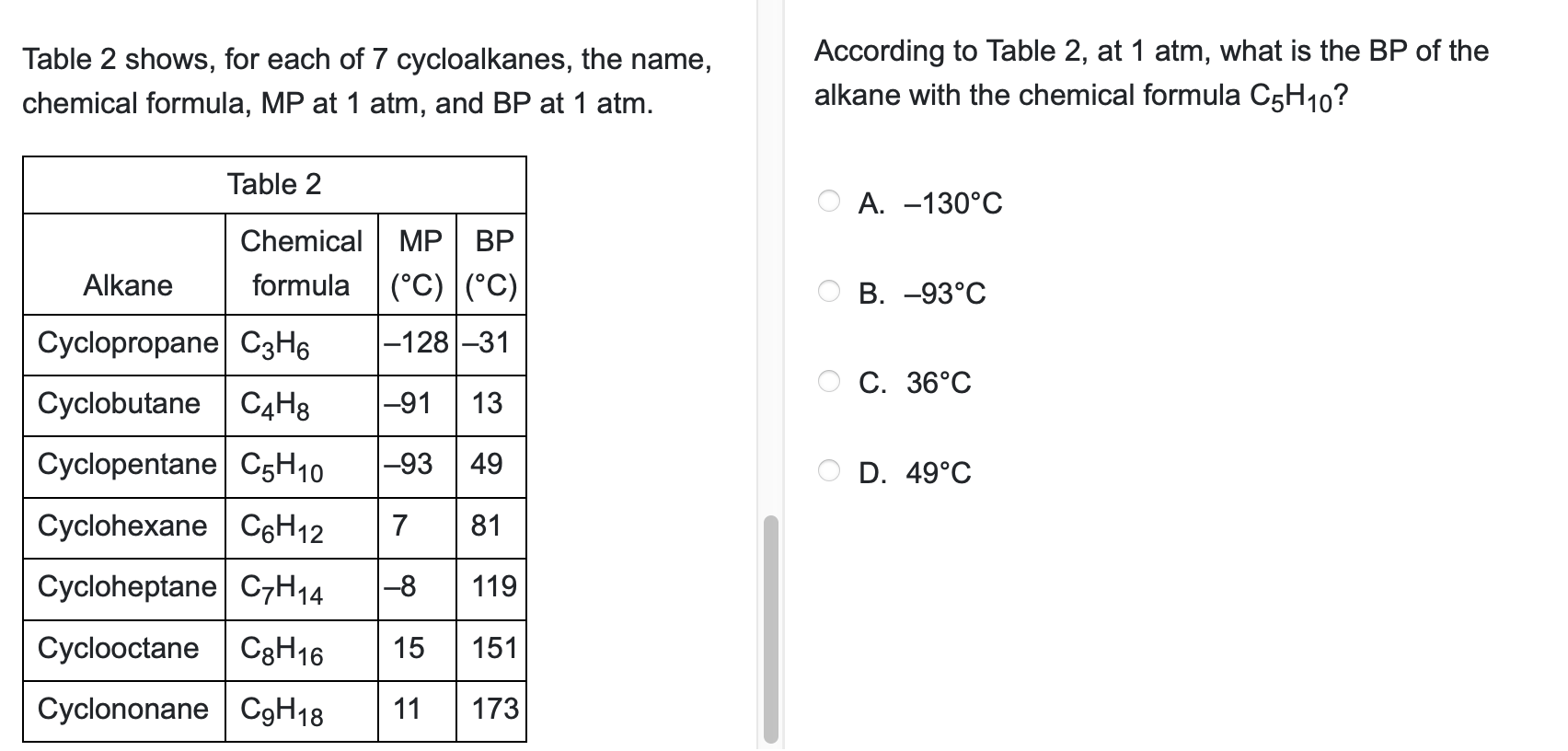
This is the simplest kind of question that a student is likely to see on the Science section of the ACT–all they have to do is find the line in the table for C5H10 and identify the value listed for BP, which is 49ºC, or D. The hardest part of these questions is ensuring that you’re looking at the correct data. In this question, for example, there are two tables. Students must ensure that they are looking at the correct one!
Now, let’s take a look at a Trends question:
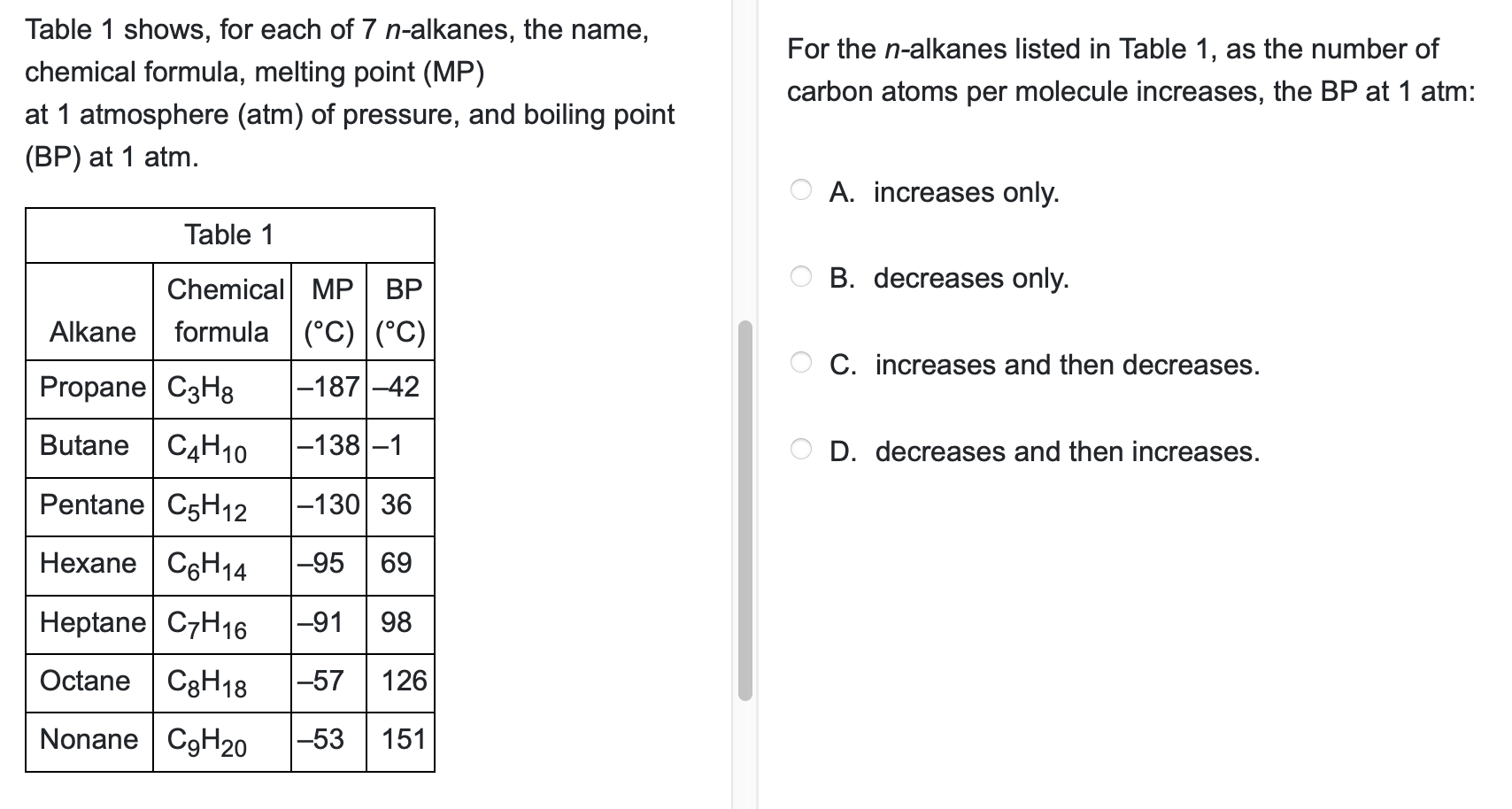
This question is a little more difficult than the previous one; students don’t just have to find a specific value, but have to look at a set of values and determine the trend. This question asks about the values in the last column, or the boiling point of the alkanes. Still, it’s a fairly simple matter to determine that these numbers only increase as the carbon molecules increase. Therefore, A is the correct answer.
For IOD questions, students rarely need to understand the actual science behind questions (aside from simple things, like knowing that the sub number after “C” indicates how many carbon molecules are in the alkanes). Rather, these questions test students’ ability to locate and analyze data in the charts. Students will rarely, if ever, have to refer to information in the passage in order to answer these questions.
It is not surprising then, in a section that is largely about data analysis, that this category appears the most of any of the reporting categories: across the two released practice tests, approximately 43% of all questions fell into this category.
Scientific Investigation
The next reporting category is Scientific Investigation (SIN). Unlike IOD questions which deal largely with data in charts, these questions deal with the design, implementation, and modification of experiments. Although these questions can be found across the test, they are perhaps more common “Study” and “Experiment” passages, the ones that impart the results of specific scientific inquiries.
Specifically, the questions that fall within this category include the following subtopics:
- Design: these questions deal specifically with the design of experiments, students might be tested on the function of certain elements or tools in the experiment or why something was done in the way it was.
- Hypothesis/Modify: these questions often ask students what will likely change in the results of an experiment if some element of it is changed, or to draw conclusions based on the passage/data.
Let’s take a look at a Design question:
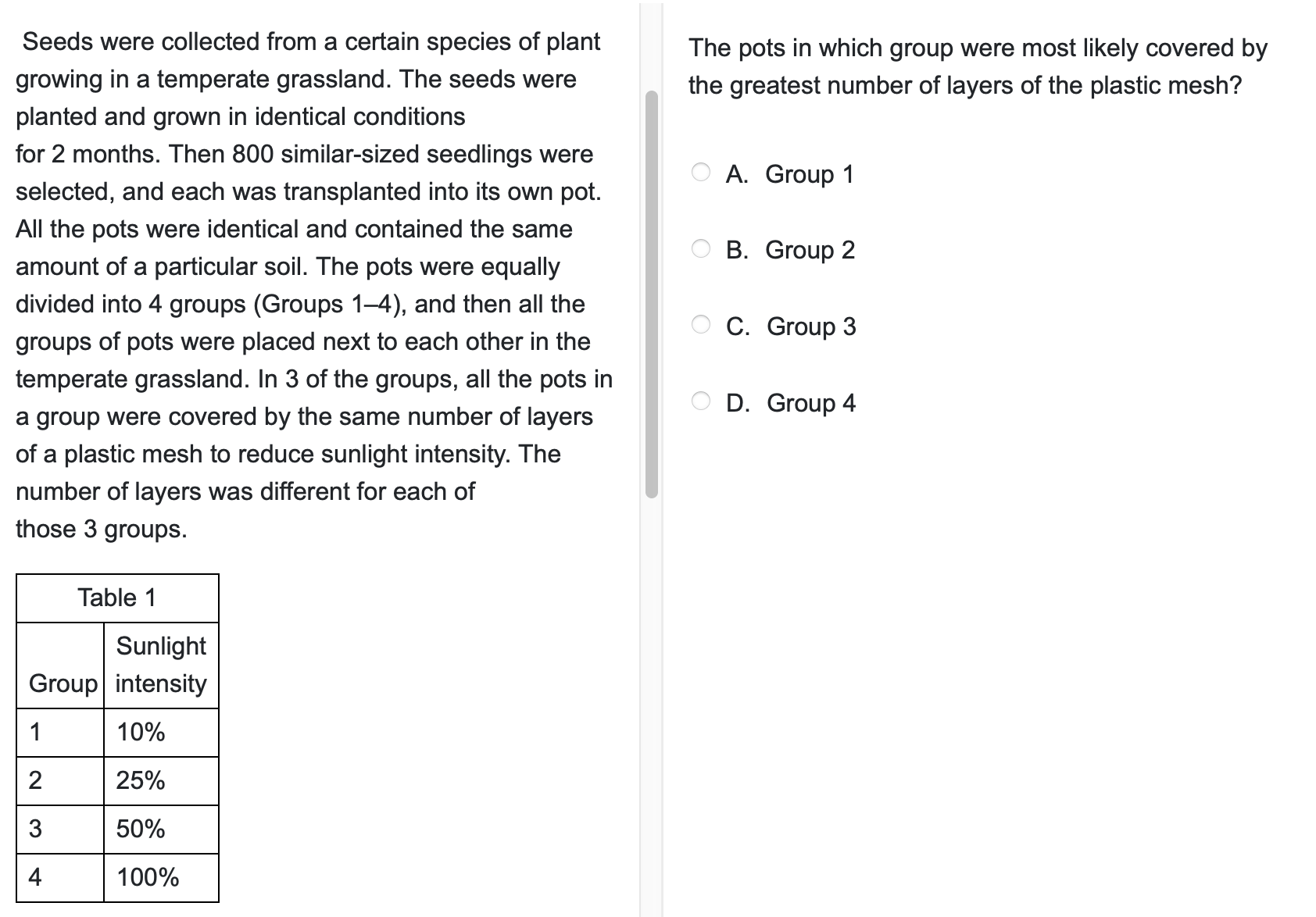
Unlike IOD questions where students can almost always disregard the text of the passage and focus instead on only the data presented in the charts, SIN questions almost always require students to pay attention to the passage. For example, in the question above, students must read the passage to know that the “layers of mesh” function to “reduce the sunlight intensity” the plants face. This tells us that the plants that were exposed to the lowest level of sunlight intensity are likely the ones with the most mesh layers. Therefore, looking at the data in Table 1, we can conclude that the plants in group 1 likely have the most mesh layers. So, the correct answer is A.
These questions require a level of critical thinking skills that go beyond that of most IOD questions. Students must understand the parameters and tools used in the experiment and studies enough to be able to make guesses about their function and what would change if certain parameters were modified. Unsurprisingly given the difficulty of these questions as well as their specificity, they are the rarest on the test. On the two released practice tests, only about 28% of all questions fell into this category.
Evaluation of Models, Inferences & Experimental Results
As mentioned above, EMI is a fairly broad category of question. It deals most intensely with analysis of data and information found within the passage and charts. Whereas SIN focuses specifically on the design and execution of studies/experiments, EMI questions deal mostly with the results of those trials.
In these questions, students are asked to interpret and predict the results of experiments, and to understand the relationships between different hypotheses and perspectives. Because of the focus on relational results, we tend to see a lot of EMI questions in “Conflicting Viewpoints” passages, or the passage type where students are presented with three different hypotheses or perspectives on some shared matter.
Some of the subtopics tested by EMI questions include:
- Comparing Viewpoints: most commonly seen in “Conflicting Viewpoints” passages, students must compare different hypotheses and sometimes pair them with plausible results.
- Consistency with Hypothesis: students will have to determine whether or not certain results and conclusions support or undermine hypotheses.
- Formulating Conclusions: students will have to analyze the results of experiments and form conclusions about what those results imply.
- Outside Knowledge: rarely, students are presented with questions that depend on some outside knowledge in order to answer. These questions almost always turn on very basic scientific principles that all students have likely encountered by the time they take the ACT.
Let’s take a closer look at a Comparing Viewpoints question:
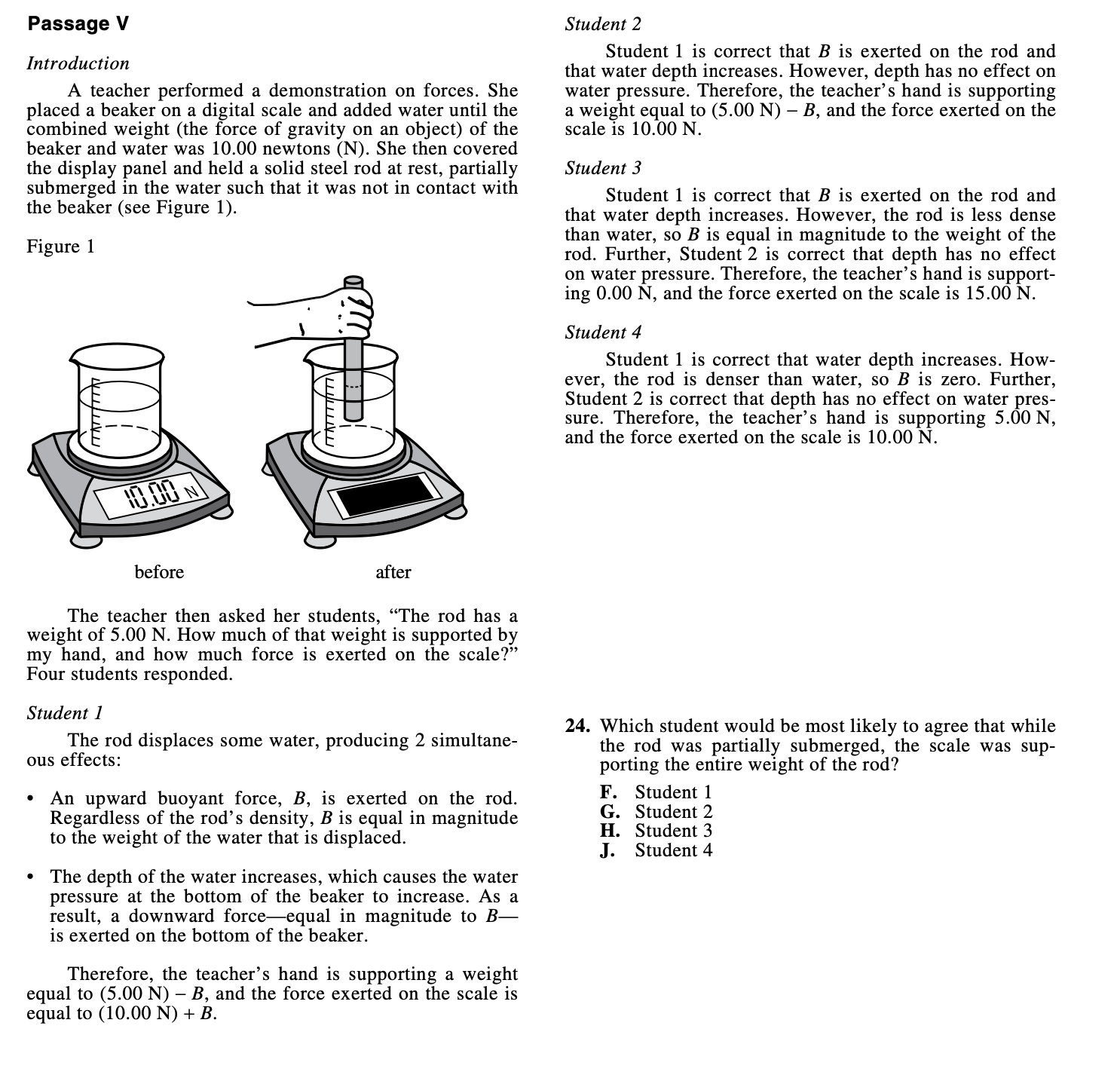
This question asks which of the four student perspectives recorded in the passage would most likely agree with the statement that “while the rod was partially submerged, the scale was supporting the entire weight of the rod.” In order to determine the answer, students must read the passage. We know that the weight of the water + beaker is 10.00 N and the weight of the rod is 5.00 N. This means that the student who thinks that scale is supporting the full weight of the rod will think that the scale will read 15.00 N with the partially submerged rod. Only one student suggests this weight: student 3. Therefore, the correct answer is H.
Now let’s take a look at an Outside Knowledge question:
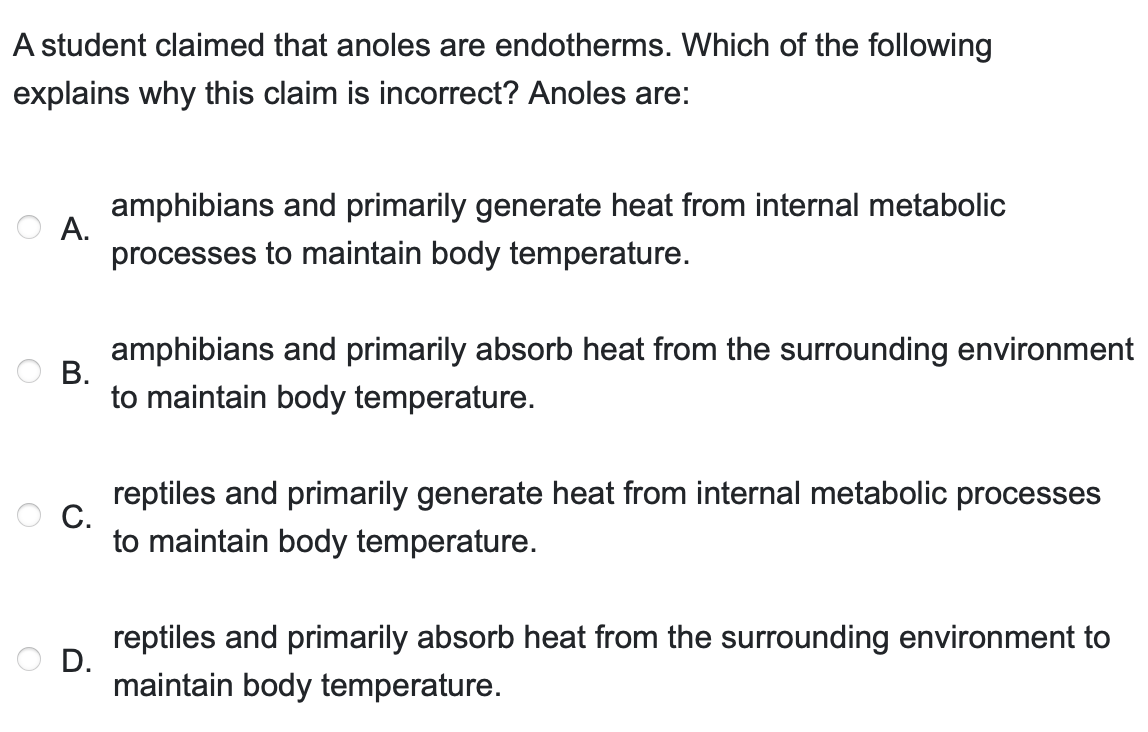
The passage is not included in this image, but the only relevant information from it is the fact that it refers to anoles as “reptiles.” In order for students to correctly answer this question, they must remember this detail (and thus exclude the first two answer options that incorrectly identify anoles as “amphibians”), and they must also know that reptiles are cold-blooded, or the definition of “endotherm.” Reptiles, of course, absorb most of their heat from their environment, not from internal metabolic processes. Therefore, the correct answer to this question is D: “reptiles and primarily absorb heat from the surrounding environment to maintain body temperature.”
Out of all the science questions on the ACT, EMI ones are likely the hardest for students to answer. These almost always require analysis of data, synthesis of information from the passage with data from charts, and/or a level of critical thinking that necessitates a fairly high-level understanding of the passage and charts. Like SIN questions, which also tend to require critical thinking on the part of students, EMI questions make up a much smaller portion of the ACT Science section than do IOD questions–only about 29% of questions across the two released practice exams fell into this category.
Uncertain Future of the Science Section of the ACT
Now that we’ve covered all the content that students are likely to encounter on the Science portion of the ACT, it is relevant to spend a little time considering the future of this section. Already, the section has been seriously downgraded. Not only is it now optional, but also if students do opt-in to take it, their scores for this section don’t count toward their overall composite score (1-36) on the ACT. Instead, students will receive an individual grade on the section (1-36, like the other three major sections), and also a STEM score, which is a composite of their Science and Math scores.
Although students are no longer required to complete the Science section if they sign up to take the ACT, many college programs, especially ones that are STEM focused, still expect prospective students to take and submit scores for the Science section.
Despite this, it is possible that the ACT is considering eliminating this section entirely. This suspicion is driven largely by the recent inclusion of some data analysis questions in the Reading section of the ACT. This puts the ACT more in-line with tests like the SAT, which has students complete data analysis questions in the Reading and Writing section. Although it’s hard to say anything for sure at this juncture, it’s important to bear in mind that the Science section of the ACT might be made obsolete in the next few years.
Piqosity Updates to the Science Section of the ACT
At Piqosity, we’re committed to always giving students the best study materials possible. Based off our analysis of the official ACT practice tests as well student feedback, we’ve significantly updated all of our 12 Enhanced ACT full-length practice tests to reflect the changes. This ensures that when students take a Piqosity test, they’re getting as close to the real thing as possible.
Since the Science section of the ACT has remained largely unchanged (aside from slight shifts in question ranges) there are no pressing updates to our tests, aside from making the section optional rather than required.


Leave A Comment
You must be logged in to post a comment.