


Writing is one of the most important skills for a student to acquire–it’s vital not only for higher education, but also to succeed in many workplaces. Despite this, according to national statistics from 2011, only about one-quarter of all students are writing at a “proficient” level for their grade or higher. In the post-pandemic world and with the influx of AI tools, it’s likely that this number has slipped even further. How can we increase writing proficiency in students? Well, very similar to reading, research indicates that the most efficient way for students to improve writing skills is to write daily. But what is a good daily writing goal for students of different grade levels?
This article considers statistics and expert recommendations to provide students with data-based daily writing goals, aiming to improve their writing skills.
Why Daily Writing Matters
Writing is about more than simply creating clear texts–it’s about developing critical thinking, the ability to analyze, and nuanced understandings of texts and subjects. These are skills that transfer into every aspect of academic life and beyond!
Links Between Daily/Weekly Writing and English Achievement
Research shows that students who spend more time writing per day in and out of class perform better on writing assessments. The National Center for Educational Statistics (NCES) collects data about student performance on the NAEP writing assessment and a wide variety of variables. This test, scored on a scale from 1-300, includes a number of writing tasks that must be completed by students, aimed toward three different goals: to persuade, to explain, and to convey experience. The most recent data available is from 2011. Below is a breakdown of how 8th and 12th grade students fared in the assessment, in comparison to daily/weekly writing time.
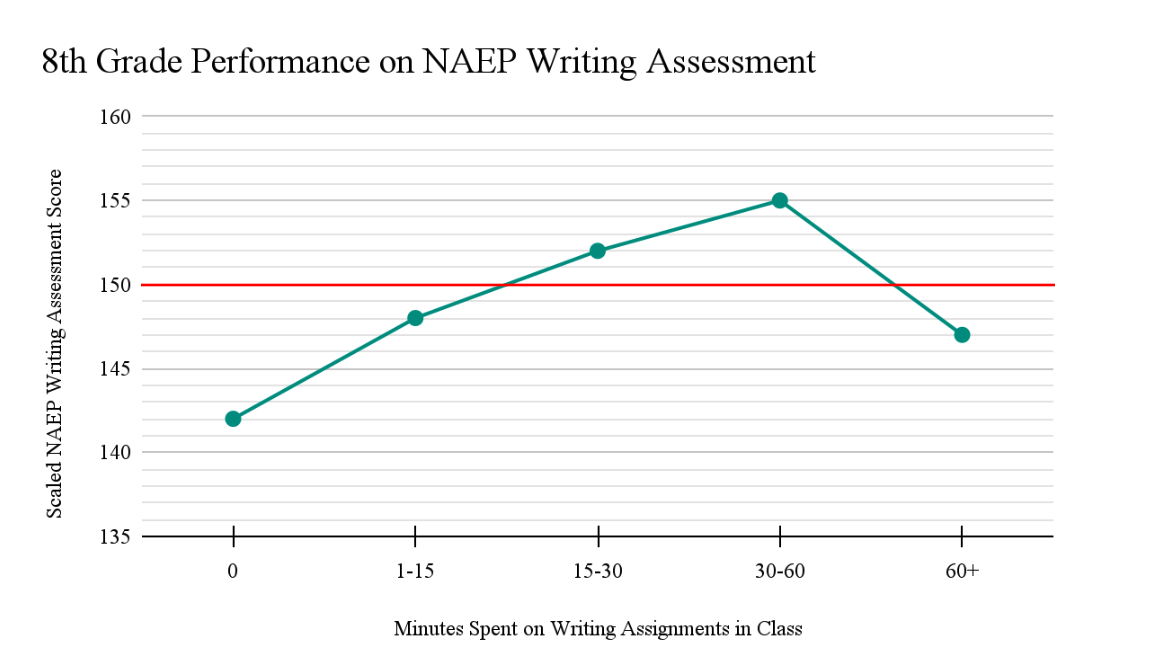
The NCES surveyed 8th graders about how much time they spent on writing assignments in English class. The highest scoring students reported spending between 30-60 minutes on writing assignments in an average day, which is 5 points higher than the average score (which was a 150, represented here with the red line). Statistically, students were likely to score over this average if they spent 15-30 minutes writing in class, and below average if they only spent 1-15 minutes writing in class.
The survey also looked at how much 12th graders wrote outside of class for homework, on a weekly basis.
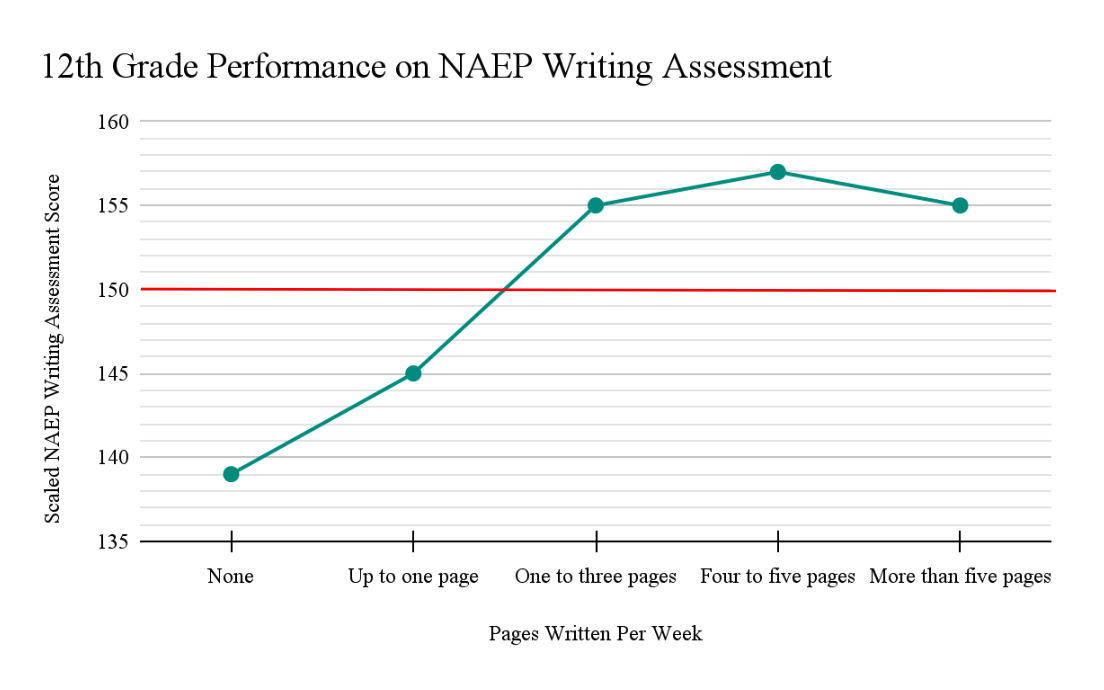
Like we saw with the results for 8th grade in-class writing time, the data generally indicate that the more pages students write per week, the better they score on the assessment. Students who achieved the highest score on average, a 157, wrote 4-5 pages for homework per week. These students scored 7 points above the average score of 150.
Links Between Writing and Other Academic Achievement
Studies have also shown that writing improves not only academic outcomes in English classes and on English/writing assessments, but can also the critical thinking skills of students, leading to benefits across subjects. For example, a 2007 study compared students who took a writing-based Biology lab versus those who took a more traditional quiz-based Biology lab and found that “the writing group significantly improved critical thinking whereas the nonwriting group did not.”
Piqosity’s Daily Writing Recommendations
Students across grades should aim to write for approximately one hour per day. This might initially seem like a lot, but much of this writing can and should be done in-class everyday. That being said, if students are not doing an hour of writing a day, the difference should be made up in homework or independent work, to ensure that students are acquiring and reinforcing the writing skills that they’ll need to perform well on assessments and to be successful in future careers.
Writing recommendations
| Grade | Daily Writing Time (Including Time In-Class) | Words Per Day | Pages Per Week |
| Kindergarten-2nd | 30-60 mins | 50-100 | 1-2 |
| 3rd-5th | 60 mins | 100-150 | 2-3 |
| 6th-8th | 60 mins | 200-300 | 3-5 |
| 9th-12 | 60 mins | 300-400 | 5-7 |
It’s important to remember that as students get older, the expectation will increasingly be that more of this writing is done outside of class. So although the actual writing time per day doesn’t change much from grade to grade, students will be doing more writing for homework as they grow and advance through grade levels.
Daily Writing for Students in Kingarten-2nd Grade
In kindergarten, students should be writing for about half an hour a day, but by first and second grade, they should aim to increase this to an hour.
Although this might seem like quite a lot of writing for younger students, research indicates that even children as young as 5-7 benefit greatly from increased writing time in class, and can even begin to incorporate basic aspects of the writing process (planning what to write, editing, etc.) if they are given enough instruction and practice.
Informal vs. Formal Writing
At this age, students are still learning the absolute basics of writing–everything from how to write individual letters, to how to put them together or form words and sentences. Because of this, much of the writing that will be done in the age range will be informal, or writing for fluency.
This means that many of the writing assignments will be low-stakes and directed toward increasing basic literacy rather than producing polished texts. This may take the form of journal entries, “quickwrite” assignments, etc.
There should be some formal writing instruction as well, however. This early focus on the process of writing (brainstorming, drafting, editing) will help these students create a strong foundation of these basic skills that will be built upon throughout the rest of their academic lives.
Daily Writing for Students in 3rd-5th Grade
By the time students are in the upper elementary grades–3-5–they should be writing for about an hour a day.
Students in this grade band are still writing for literacy, though they should also be starting to focus more on formal writing assignments as well. According to Common Core standards, this is when students should be learning some of the basic techniques like summarizing text, paraphrasing sources, and making basic claims and arguments that they will use for the rest of their academic careers.
Daily Writing for Students in 6th-8th Grade
Like our recommendations for other grade levels, students in 6th-8th grade should spend at least an hour writing a day, between in-class writing time and outside of class writing time.
By this point in their academic careers, students should practice more formal kinds of writing–short essays of 100-300 words and longer essays that are more than a page in length, about 300-500 words.
According to Common Core standards, students in this grade band should be following the steps of the writing process–brainstorming, drafting, and editing for their writing. Essays for these grades should include both summary and analysis, and students should begin learning to cite specific evidence and integrate quotes.
How Much Are Students in 6th-8th Grading Writing?
According to the NAEP data examined above, if students want to be in the 50th percentile, they should be writing at least 30 minutes a day, and if they want to be a high achiever, they should be writing at least an hour a day. But are students actually doing this much writing? Well, let’s take a closer look at some of the other data gathered in the NCES student survey for 8th graders. Below, is a breakdown of the percentage of respondents in each writing band.
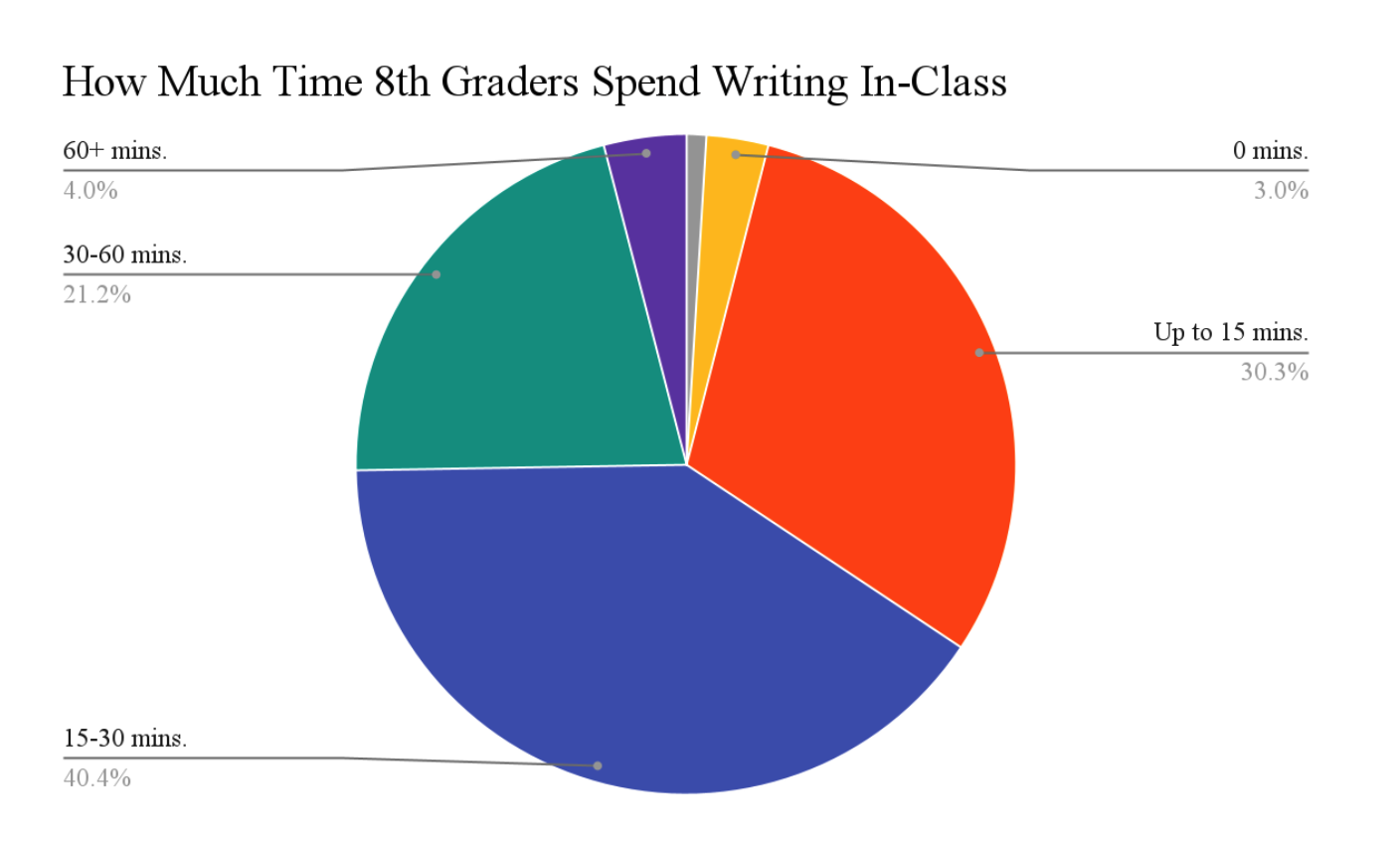
According to this data, the largest contingent of students, about 40%, spent between 15-30 minutes writing a day in-class. Only 21% of students spent 30-60 minutes writing in-class, though these were the higher scorers. About a third of students are spending 15 minutes or less writing per day in class. These were the worst scorers.
This data also helps to explain the dip we saw for the students who reported spending more than an hour writing in class a day–this group of students made up a measly 4% of respondents, meaning that this is a much smaller sample size and easily swayed by outliers.
Daily Writing for Students in 9th-12th Grade
Like our recommendations for other grade levels, students in 9th-12th grade should spend at least an hour writing a day, between in-class writing time and outside of class writing time.
By the end of high school, student writing practice should be organized largely around formal, extended essays of at least 5 pages (1,000-1,500 words), and for particularly advanced students, as many as 7 pages (about 2,000 words). Classes should be designed around students working on these essays for extended amounts of time: a few weeks, a month, or potentially an entire quarter or semester.
By this point, students should have intimate familiarity with synthesizing information from a variety of sources with their own thoughts and ideas as well as with standard citation practices in MLA format. This will give them a strong basis for college writing.
How Much Are Students in 9th-12th Writing?
Research shows that students who spend more time writing per day or week outside of class perform better on writing assessments. Let’s take a closer look at the NAEP data examined above.
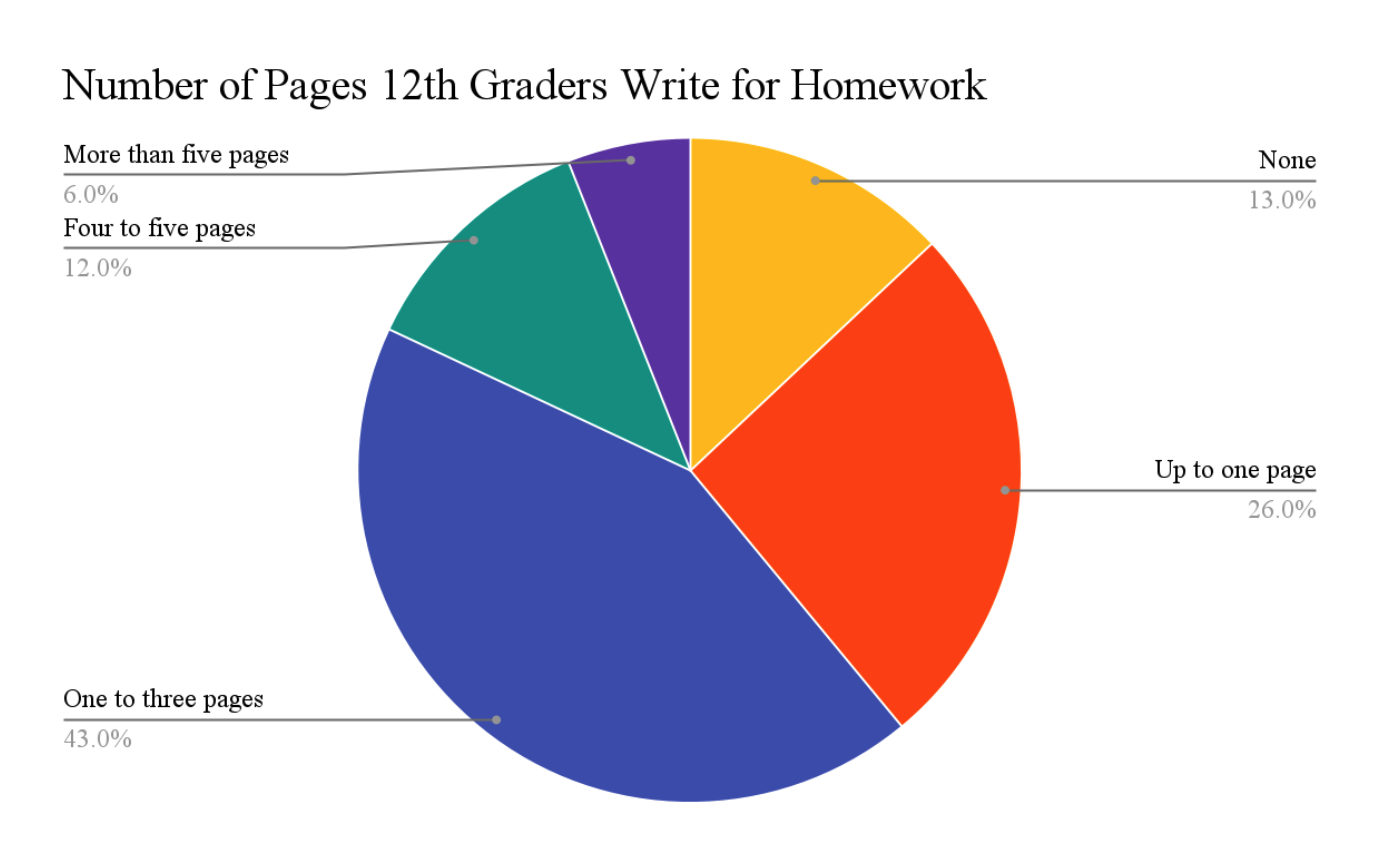
The majority of students surveyed, about 82%, write three pages or fewer per week for homework. Only 18% of students are writing four or more pages a week. If students in the largest group (1-3 pages per week) increased their weekly output by 1-3 pages, they would statistically improve by 2 points on the NAEP assessment, and be among the top achievers.
Areas to Focus On for Improving Academic Performance
We’ve discussed how much writing students do a week and how much they should be doing a week, but what areas of writing should they focus on specifically if they want to see improvement in academic assessments? Based on available data, students who want to see testing gains when it comes to writing should focus on increasing writing stamina and on the editing process.
Building Writing Stamina
Some data indicate that writing more in writing assessments is linked to higher scores. Two decades ago, the new 25-minute SAT essay was heavily criticized by researchers who found that increased response length correlated almost exactly with higher scores–the shortest essays (100 words or so) almost universally received the lowest score, whereas the longest essays (usually around 400 words) were very likely to have received the highest scores.
Regardless of the efficacy of this system of grading, it is seen across assessments and disciplines. A BYU study found that law students scored higher on law exams if they wrote more for each question. The researchers here cited the idea that professors felt they had to grade-inflate on the basis of effort, resulting in, on average, higher scores for students who wrote more.
With such a clear link between higher word counts and higher scores, the question arises: why don’t all students write more, regardless of the quality of that writing? Well, the short answer is that underperforming students simply can’t write more.
Some of this has to do with timing (a truth that can be compounded when students who aren’t strong typists take digital assessments), but much of it has to do with stamina. Students who have a hard time quickly generating ideas to write about or who lack the ability to focus long enough to write these ideas in essay form will always have lower scores.
Much of daily writing practice should be aimed toward increasing writing stamina–giving students the ability to write longer texts and develop and expand ideas in their essays to make them stronger and more complex.
The Importance of Editing Work
There are also clear links between students who edit writing completed for assessments and higher scores. This tells us that learning to properly edit work is a fundamental skill in the writing process, especially for students who aspire to be top performers.
A Closer Look at the Data
Since many writing assessments have moved to digital formats, it means that the word processing mechanics associated with editing can be carefully tracked. This was some of the information collected in association with the NAEP 2011 writing assessment. Below are some charts showing the data of student scores (for 12th graders) compared to use of different editing tools.
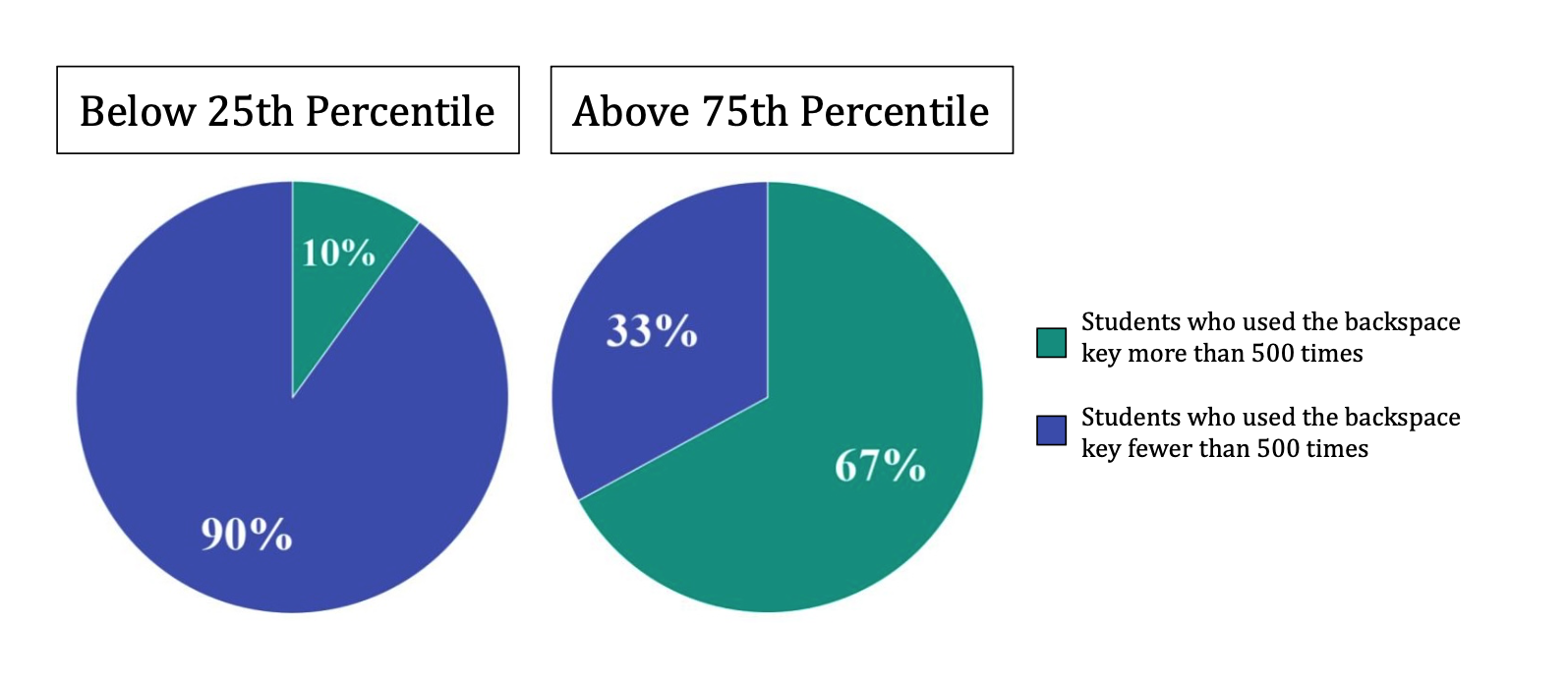
While only 10% of students who scored below the 25th percentile used the backspace key more than 500 times, 67% of students who scored above the 75th percentile did.
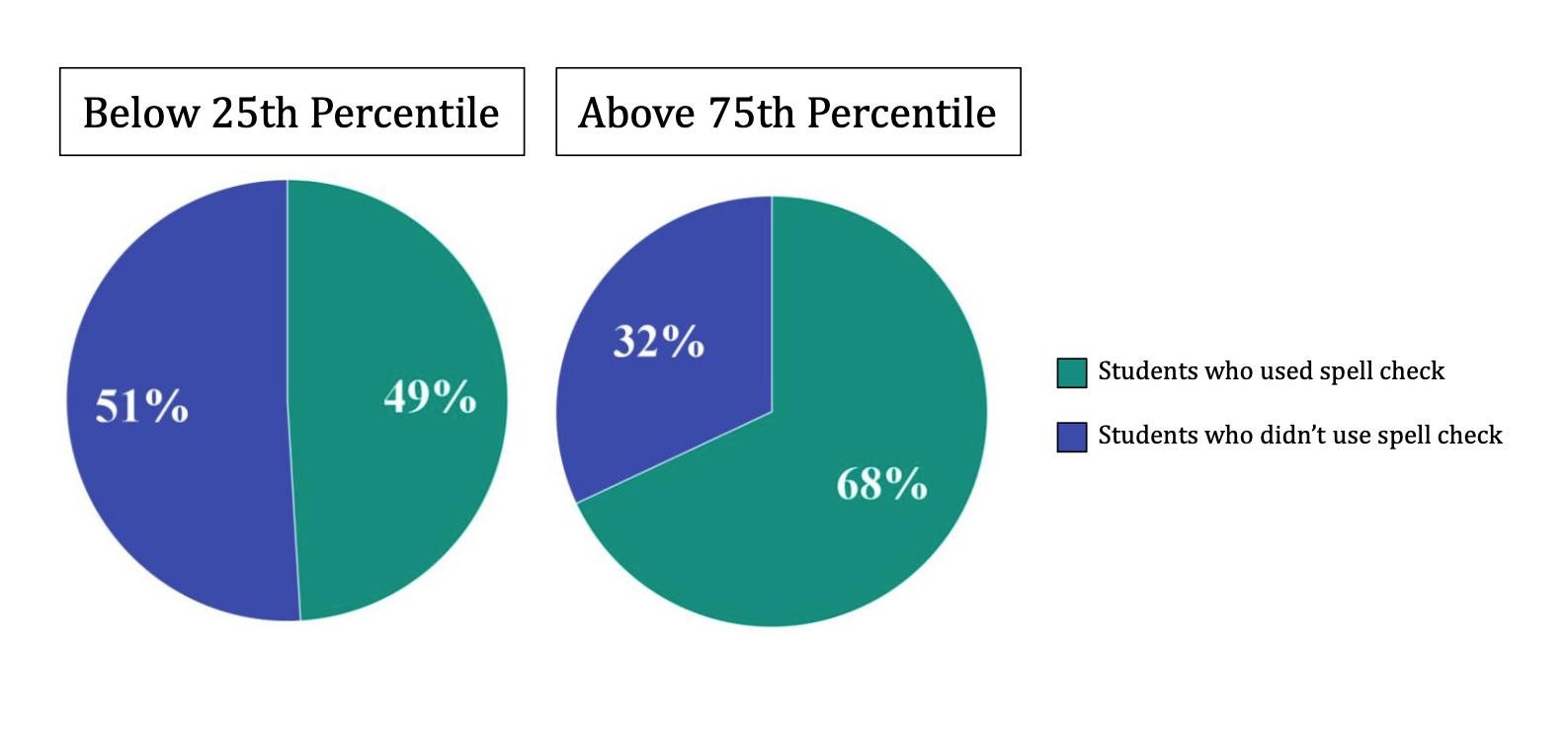
Slightly less than half of the students who scored below the 25th percentile used the spell check feature of the word processor, while 68% of those who scored above the 75th percentile did. This is a clear indication that use of the backspace button and spell check is correlated with higher scores.
The study also found links between how many times a thesaurus tool was used and higher scores:
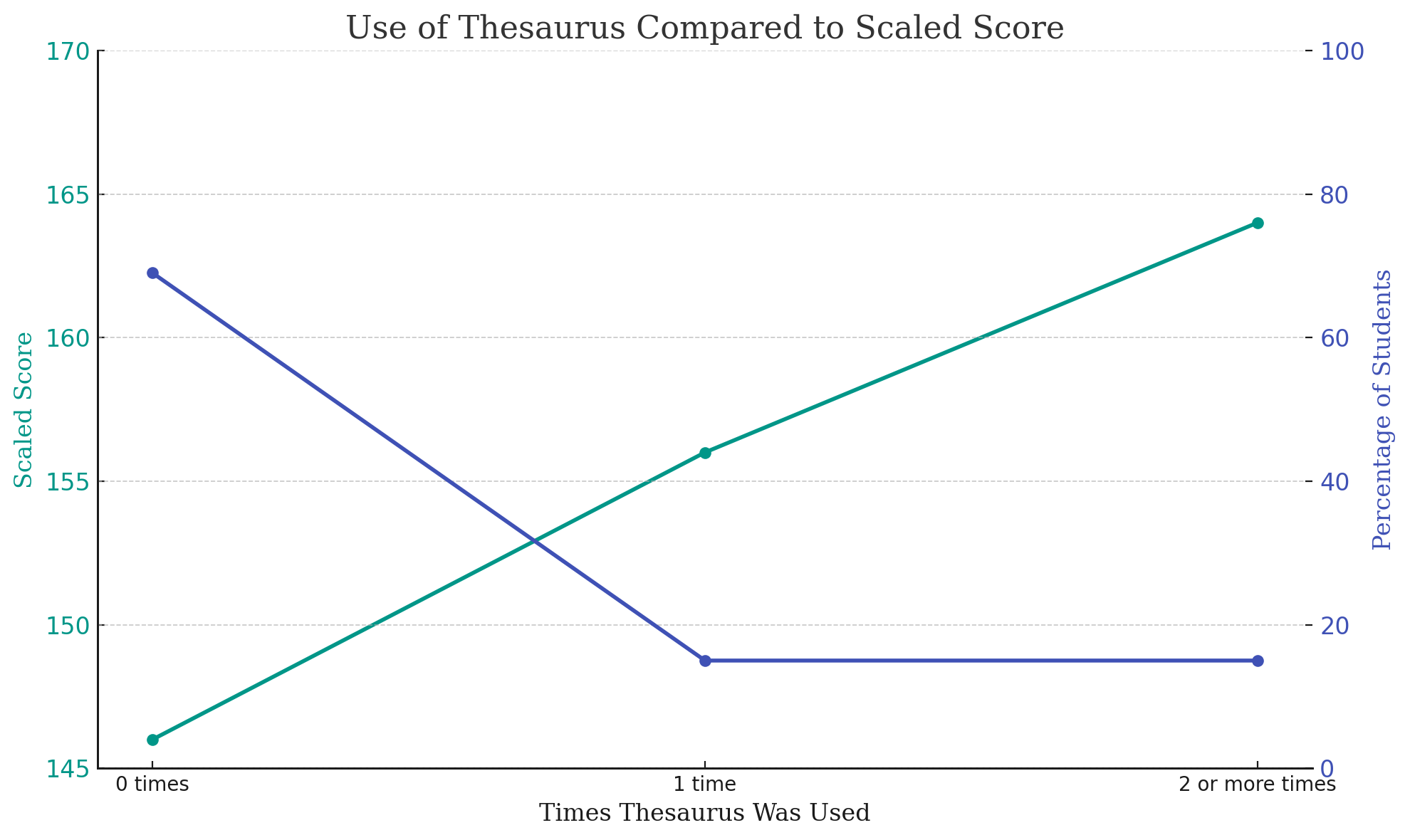
As with other data examined in this article, despite a clear correlation between using the thesaurus tool and higher scores, the majority of students (69%) don’t utilize this tool.
All this data tells us that students who are actively thinking about editing and improving their responses to writing assessments tend to score higher than students who don’t. If a student is interested in raising their scores on such an assessments, then, they should be familiar with the editing and drafting process, and how to improve on writing they’ve already done.
Strategies to Help Improve Writing
Piqosity has a number of resources to help students improve their English skills. In addition to our ELA courses, which include both ELA lessons and grade-appropriate texts, we also have a number of reading lists for students of all kinds.
Below are some free, standardized test-specific essay resources:
ACT:
- Should I Take the ACT With Writing?
- 2021-22 ACT Writing Practice Test Sample Essays
- Sample Essay Responses and Explanations to the Previously Released 2020 ACT Writing Test
- Sample Essay Explanations to the Previously Released 2015-2018 ACT Writing Test
ISEE:
- ISEE Essay
- How to Prepare for the ISEE Essay
- ISEE Sample Essay Prompts and Responses
- The Essay on the Upper Level ISEE
Other: