

Piqosity is a member of the Amazon Associates program, and any purchase made through the links below may earn us a commission.
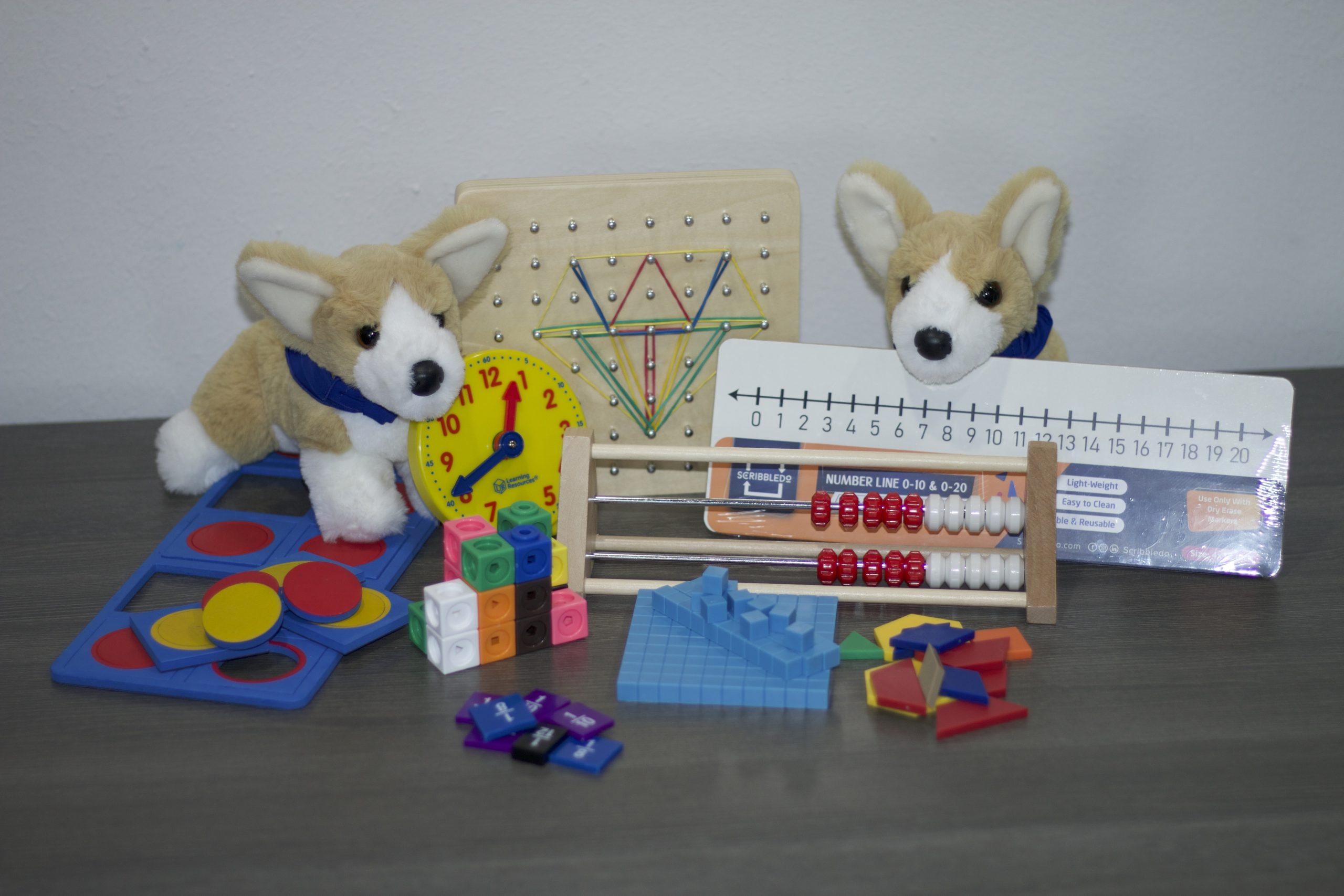
Math toys and math manipulatives give kids a hands-on way to build number sense, practice problem-solving, and understand abstract concepts. The tools below can make learning math more engaging and accessible at home.
Ask a preschooler what 7 − 3 means, and you may get a guess. If they’ve had some math lessons, they might parrot back the rote, memorized answer: 4. This doesn’t get to the heart of the math concept of subtraction.
On the other hand, if you place seven cubes on the table and ask the child to slide three away, the problem suddenly has a physical, tangible shape. The child can see the starting quantity, perform the subtraction, and count what remains. “Subtraction” is no longer an abstract word, but rather a simple action that the child likely performs everyday as she eats slices of an apple, as he removes toys from a basket.
That is the basic purpose of educational math toys, often called “manipulatives” by teachers: to make an invisible mathematical idea visible.
The best math manipulatives for kids are not necessarily the biggest, most colorful, or most expensive products. They are simple tools that help children represent quantities, notice patterns, compare numbers, build shapes, and connect physical actions to written mathematics.
Used properly, manipulatives can support early number sense, addition and subtraction, place value, geometry, measurement, and much more. Used poorly, however, they can become little more than toys scattered across the table.
So, which manipulatives are actually worth buying? And how should parents use them at home?
Math Toys and Manipulatives are not a new educational trend
Children have used stones, beads, blocks, and geometric pieces to learn mathematics for centuries. One important milestone came in the nineteenth century, when Friedrich Froebel—the creator of kindergarten—developed a sequence of educational materials known as the Froebel Gifts. These included spheres, cylinders, cubes, and divided wooden blocks intended to help young children explore shape, pattern, symmetry, parts, and wholes.
Milton Bradley later manufactured Froebel-style kindergarten block sets in the United States. In other words, educational manipulatives were being packaged and sold to schools long before plastic linking cubes appeared in modern classrooms.
The materials have changed. The basic principle has not: young children often understand a mathematical relationship more easily when they can act it out.
Do Math Toys and Manipulatives Really Work?
Generally, yes—but the answer comes with an important qualification.
A major meta-analysis examined 55 studies involving 7,237 students, ranging from kindergarten through college. Compared with instruction using only abstract mathematical symbols, instruction involving concrete manipulatives produced statistically significant, small-to-moderate improvements in mathematics learning.
That does not mean placing blocks in front of a child automatically produces better math skills.
Most expert guidance recommends using a well-chosen set of concrete and semi-concrete representations and explicitly connecting them to mathematical concepts and procedures. Its guidance also emphasizes teaching early number and operations through a developmental progression that builds on what a child already understands.
The key phrase is well-chosen.
A useful manipulative clarifies a mathematical concept–a poorly chosen one can distract from it.
Why Are Math Toys and Manipulatives Effective?
Education math toys reveal mathematical structure
Numbers exist in a complex web of relationships to one another that can be difficult for young learners to detect in numerals alone. For example:
- Eight can be separated into five and three.
- Ten ones can be exchanged for one ten.
- Seven is two more than five.
- Twelve can be arranged as three groups of four.
- A square can be divided into two equal rectangles.
- One-half is larger than one-fourth, even though four is the larger whole number.
A good math manipulative makes these latent, underlying relationships obvious.
A ten-frame organizes quantities around five and ten. A rekenrek separates beads into visually recognizable groups of five. Base-ten blocks make a ten physically ten times as long as a unit. Pattern blocks allow children to see how smaller shapes combine to make larger ones.
The color or texture is not the main benefit. The organization of the information is.
Math manipulatives connect physical experiences to abstract symbols
Researchers David Uttal, Kathryn Scudder, and Judy DeLoache offered an important warning: manipulatives are not alternatives to symbols. They are symbols themselves.
A plastic rod does not naturally mean ten. A row of seven counters does not automatically communicate the concept of seven. Children must learn what the objects represent and how that representation connects to numerals, equations, and mathematical language.
That is why the adult should continually connect the model to the mathematics:
- “What does each cube represent?”
- “Where do you see the six in the equation?”
- “How does this row show one more?”
- “Can you draw what you just built?”
- “Can you solve the next one without the counters?”
Math toys and manipulatives are most effective when children move among three forms of the same idea:
- Concrete: Build or act it out.
- Representational: Draw or diagram it.
- Abstract: Write the numeral, equation, or mathematical statement.
A useful shorthand for parents is:
Build it. Say it. Draw it. Write it.
Other Benefits of Math Toys and Manipulatives:
- They reduce the amount children must hold mentally: Beginning learners have limited working space for unfamiliar information. Manipulatives allow part of the problem to remain visible. A child does not have to remember how many counters have already been counted if the counters remain on the table. A base-ten model keeps the tens and ones organized. A movable clock preserves the relationship between the hands.
- They can strengthen number magnitude: In one study, preschoolers played a simple linear number-board game for roughly one hour. The children improved in numeral identification, counting, number-line estimation, and magnitude comparison, and the gains remained evident nine weeks later. Children who played an otherwise identical game using colors instead of numbers did not show the same improvement.
- They support spatial and patterning skills: Tools such as pattern blocks and geoboards are not just arts-and-crafts supplies, but can also help children compose and decompose shapes, investigate symmetry, recognize transformations, and reason about space.
What We Look for in the Best Math Toys and Manipulatives for Kids
A clear mathematical purpose
A parent should be able to answer this question: What does this tool help my child see? If the answer is only “It is educational” or “It keeps my child busy,” the product may be a fine toy, but it is not necessarily a high-value manipulative.
More than one use
The best purchases grow with the child. Connecting cubes can begin as counting tools and later support measurement, graphing, multiplication, division, fractions, and volume. Counters can model addition in kindergarten and probability several years later.
Simple setup
Parents are more likely to use a tool that can be pulled from a bag and placed on the table in 30 seconds. Elaborate kits with dozens of specialized pieces often remain in the box because nobody remembers how to use them.
Durability and storage
A good home manipulative should survive repeated use and fit into a drawer or small container. Loose pieces should come with a resealable bag or box for easy storage.
Limited distraction
Color can clarify categories and groups. Decoration can pull attention away from the mathematics. Clean, consistent designs usually have the highest instructional value.
One of the more surprising findings in manipulative research is that highly detailed, real-world materials can sometimes interfere with performance.
In a study involving money problems, students given realistic bills and coins solved fewer problems correctly than students who did not receive the objects. A follow-up found that students using the most visually rich materials made the most errors. The materials appeared to activate associations that competed with the intended mathematics.
The lesson taken from these studies is not that manipulatives should be dull. It is that every visual feature should serve a purpose. For example, plain two-color counters often make the mathematics clearer than tiny bears, cookies, dinosaurs, or race cars.
Alignment with school curriculum
We also considered how well each manipulative supports the skills children are expected to learn in school. For every item on our list, we identified the specific Common Core State Standards it can help reinforce in Kindergarten, first grade, and second grade.
These standards cover essential early-math topics such as counting, addition and subtraction, place value, measurement, time, data, equal groups, and geometry. The standards do not require a particular manipulative, but the right tool can give children a concrete way to model and practice the underlying concept.
This review helped us prioritize manipulatives with clear academic value and a useful place in the progression of elementary math skills.
The 10 Best Math Toys and Manipulatives for Kids
These rankings reflect versatility and usefulness for at-home learning. They are not claims that one commercial brand has been scientifically proven superior to another. Research usually evaluates instructional approaches and manipulative categories, not Amazon brands.
The 10 Best Math Manipulatives for Kids
| Rank | Manipulative | List Price | Best for: |
| 1 | Linking cubes | $12.59 | Counting, operations, patterns and measurement |
| 2 | Ten-frame and counters | $9.99 | Number recognition, making ten and number bonds |
| 3 | Rekenrek | $9.99 | Groups of five, mental addition and subtraction |
| 4 | Two-color counters | $10.89 | Operations, composing numbers and probability |
| 5 | Dry-erase number line | $5.69 | Number order, magnitude and operations |
| 6 | Base-ten blocks | $9.99 | Place value, regrouping and multidigit operations |
| 7 | Pattern blocks | $9.99 | Shapes, patterns, symmetry and spatial reasoning |
| 8 | Geoboard | $15.99 | Geometry, perimeter and area |
| 9 | Geared teaching clock | $9.09 | Telling time and understanding the clock hands |
| 10 | Fraction tiles | $7.99 | Fraction size, equivalence and comparison |
1. Learning Resources MathLink Cubes
Best overall math toy for young children
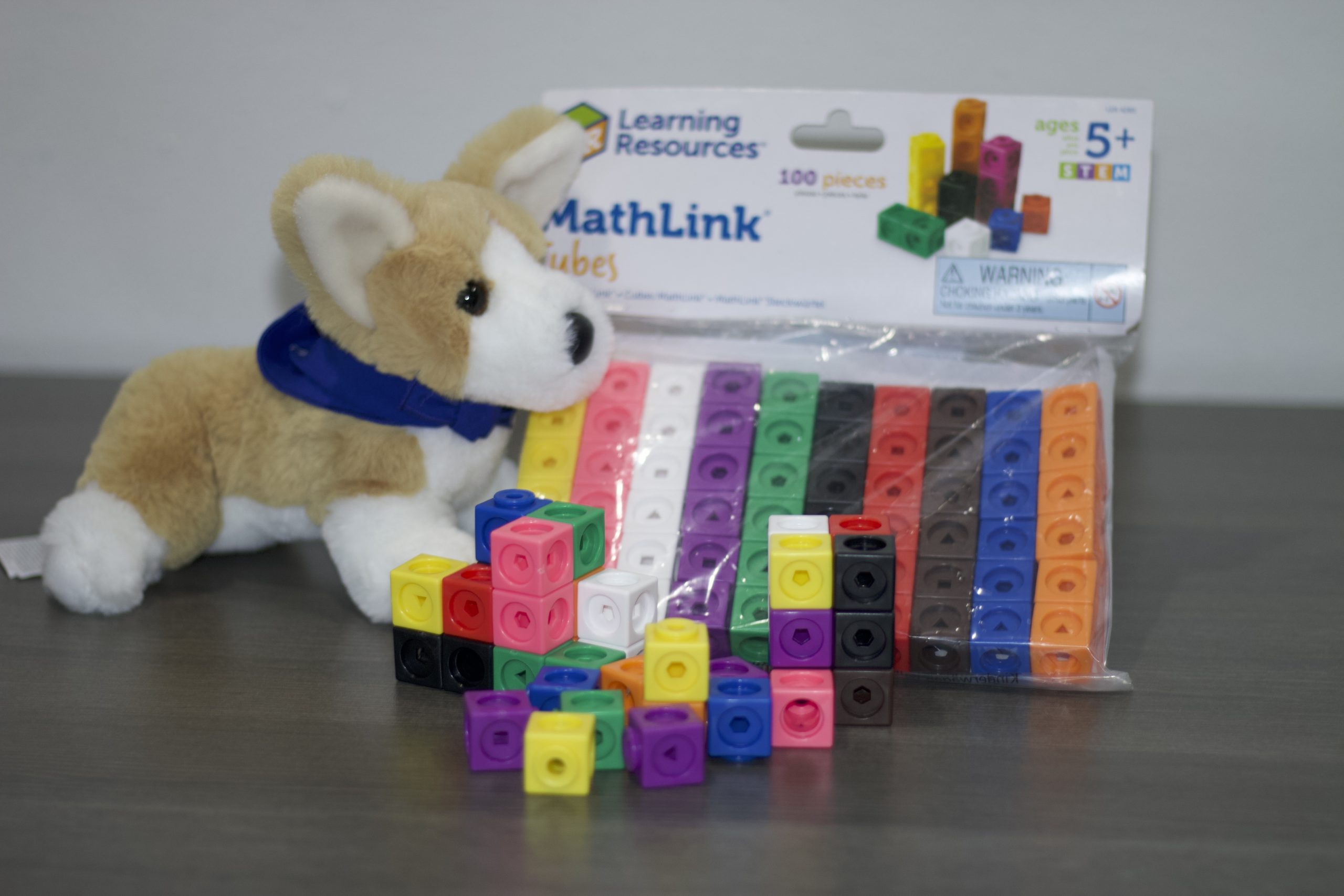
If a family buys only one set of math manipulatives, linking cubes are the most optimizable choice.
Children can connect them into trains, separate them, compare lengths, build patterns, model addition, create equal groups, form arrays, measure household objects, and construct simple graphs. The linked product contains 100 cubes, and the cubes connect on multiple sides, which expands their usefulness beyond basic counting.
Their biggest advantage is longevity. A preschooler can use the cubes to count to five. A first grader can model 8 + 6. An older child can arrange 24 cubes into equal rows and investigate factors.
Mathematical concepts: counting, comparing quantities, composing and decomposing numbers, addition and subtraction, patterns, equal groups, multiplication and division, nonstandard measurement.
Potential drawback: Connecting cubes can require more finger strength than parents expect. Some children initially need help snapping them together or pulling them apart. They are also small enough to become choking hazards, so they are not appropriate for unsupervised use by children under three.
Try this: Build a train of seven cubes. Ask the child to show seven as two smaller parts in as many ways as possible.
Common core standards: K.CC.B.4–5, K.CC.C.6, K.OA.A.1–4, K.NBT.A.1, K.MD.A.1–2, 1.OA.A.1–2, 1.OA.B.3–4, 1.OA.C.5–6, 1.OA.D.7–8, 1.NBT.B.2, 1.MD.A.2, 1.MD.C.4, 2.OA.A.1, 2.OA.B.2, 2.OA.C.3–4, 2.MD.D.10, 2.G.A.2
2. Ten-Frame and Counters
Best math toy for understanding five and ten
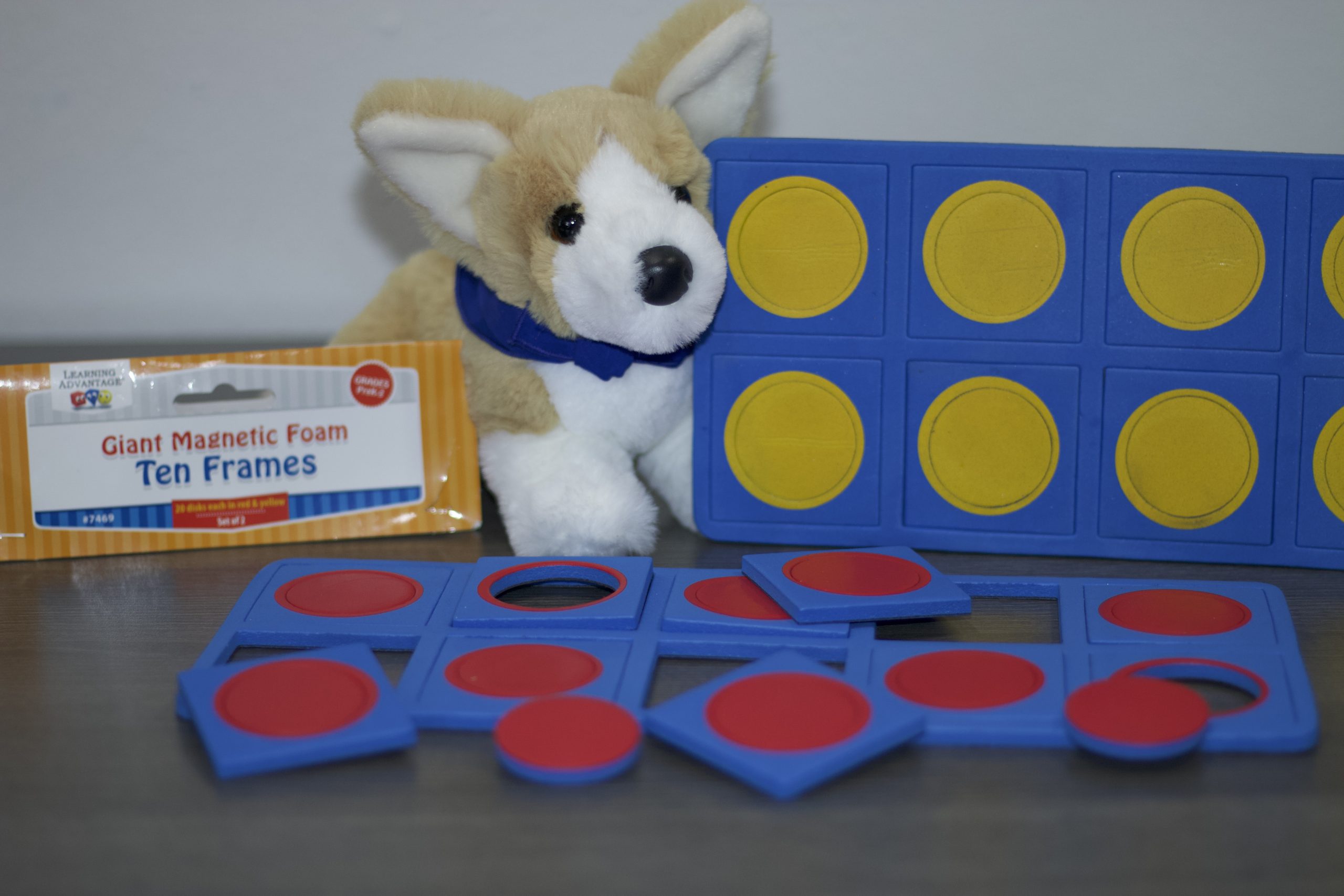
A ten-frame is simply a rectangle containing two rows of five spaces. That simplicity is exactly why it works.
Ten-frames help children recognize quantities without counting every counter. They make five and ten easy to see and help children understand numbers such as eight as “five and three more” or “two less than ten.”
This supports subitizing—recognizing a quantity or structured group without counting each object individually. The Institute of Education Sciences identifies subitizing as an important foundation for meaningful counting, addition, and subtraction.
Mathematical concepts: subitizing, counting, making five and ten, composing and decomposing numbers, addition and subtraction, number bonds, teen numbers, fact families.
Potential drawback: Many commercial ten-frame products are sold in classroom-sized sets. A family usually needs only one or two frames and about 20 counters. A printed and laminated ten-frame can work just as well.
Try this: Place seven counters on the frame. Ask, “How do you know there are seven without counting them one at a time?”
Common core standards: K.CC.B.4–5, K.CC.C.6, K.OA.A.1–5, K.NBT.A.1, 1.OA.A.1–2, 1.OA.B.3–4, 1.OA.C.5–6, 1.OA.D.7–8, 1.NBT.B.2, 2.OA.A.1, 2.OA.B.2, 2.OA.C.3
3. hand2mind 20-Bead Rekenrek
Best math toy for moving beyond one-by-one counting
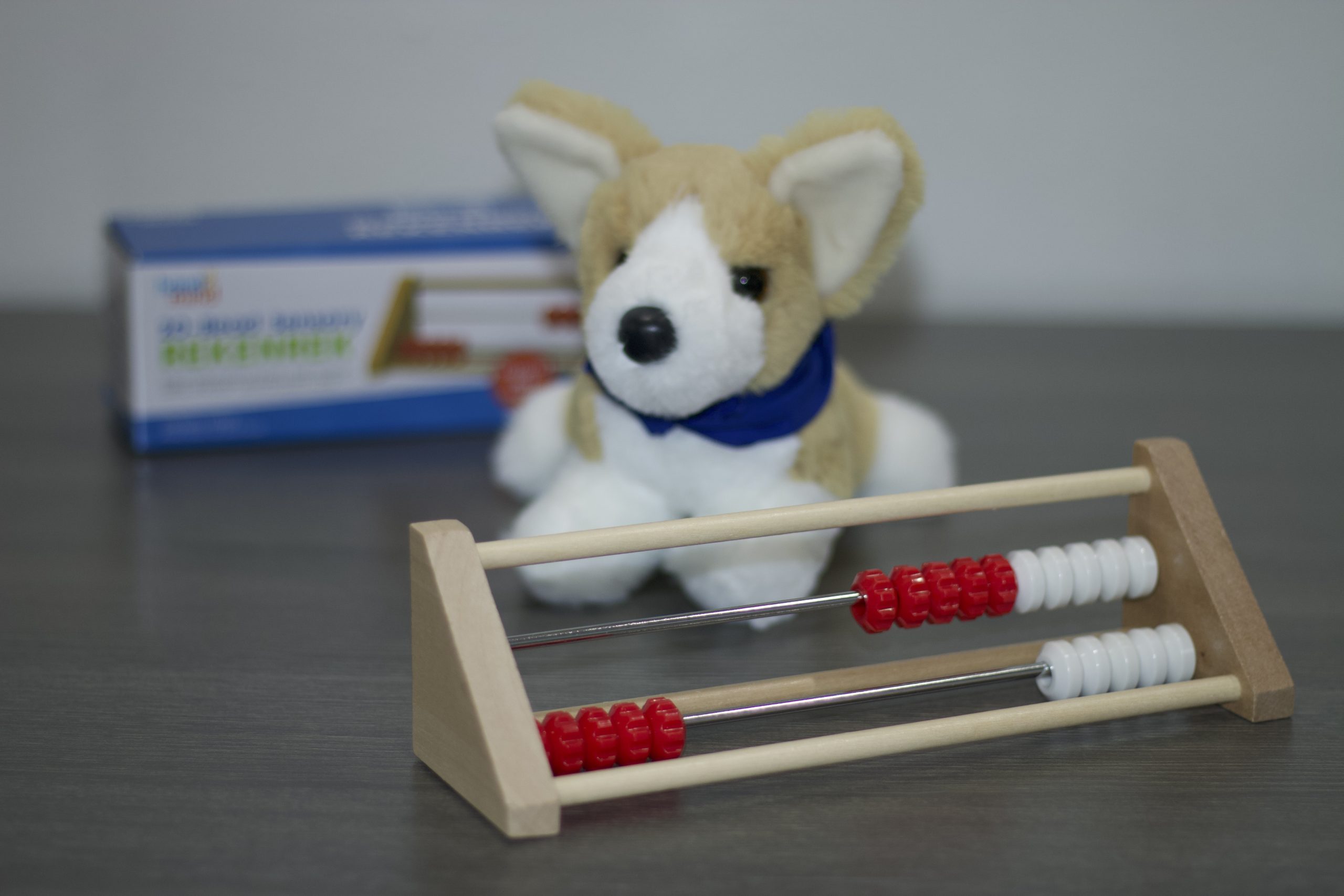
A rekenrek resembles a small abacus, but its bead pattern is designed specifically for early arithmetic. It contains two rows of ten beads, with each row divided by color into groups of five.
That five-structure encourages children to see eight as five and three rather than recounting all eight beads. It also supports combinations that make ten and mental addition and subtraction within 20.
A controlled study of 45 first-grade students with learning disabilities found that students taught with a rekenrek performed significantly better on an addition-and-subtraction assessment than students receiving instruction without it or no intervention.
Mathematical concepts: subitizing, groups of five and ten, composing and decomposing numbers, addition and subtraction, counting on and back, doubles and near doubles, missing addends, mental math strategies.
Potential drawback: The tool is less intuitive for adults than counters or cubes. Parents may need to learn a few routines before its value becomes obvious.
Try this: Ask the child to show nine without moving the beads one at a time. Then ask, “How far is nine from ten?”
Common core standards: K.CC.B.4–5, K.OA.A.1–5, K.NBT.A.1, 1.OA.B.3–4, 1.OA.C.5–6, 1.OA.D.7–8, 1.NBT.B.2, 2.OA.B.2, 2.OA.C.3
4. Learning Resources Two-Color Counters
Best low-cost math toy
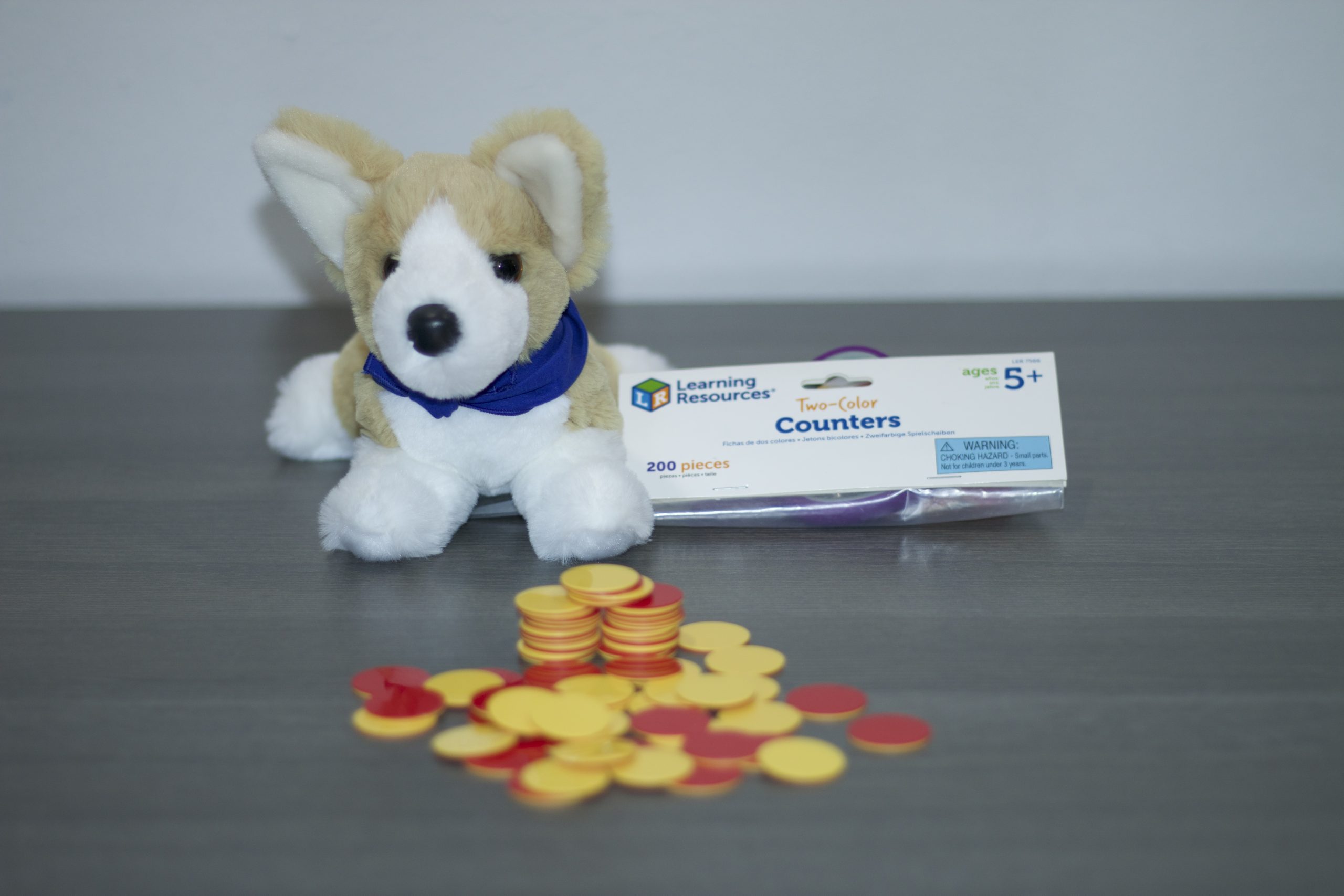
Two-color counters are plain circular chips with one color on each side. They are inexpensive, compact, and remarkably flexible.
Use them to model two addends, parts of a whole, two categories, even and odd quantities, equal groups, or probability outcomes. Paired with a ten-frame, they become one of the strongest early number-sense combinations available.
For example, flip ten counters and record how many land on each color. The child can then write an equation such as:
- 6 + 4 = 10
The same activity supports counting, combinations of ten, addition, data collection, and introductory probability.
Mathematical concepts: counting, composing and decomposing numbers, addition and subtraction, number bonds, even and odd numbers, equal groups, fractions of a set, probability.
Potential drawback: Counters roll, scatter, and disappear under furniture. A family set of 20 to 30 counters is usually plenty; store the extras elsewhere.
Try this: Show eight using two colors. Ask the child to find every possible pair of parts that makes eight.
Common core standards: K.CC.B.4–5, K.CC.C.6, K.OA.A.1–5, K.MD.B.3, 1.OA.A.1–2, 1.OA.B.3–4, 1.OA.C.5–6, 1.OA.D.7–8, 1.MD.C.4, 2.OA.A.1, 2.OA.B.2, 2.OA.C.3–4, 2.MD.D.10
5. SCRIBBLEDO Dry-Erase Number Line
Best math toy for addition, subtraction and number order
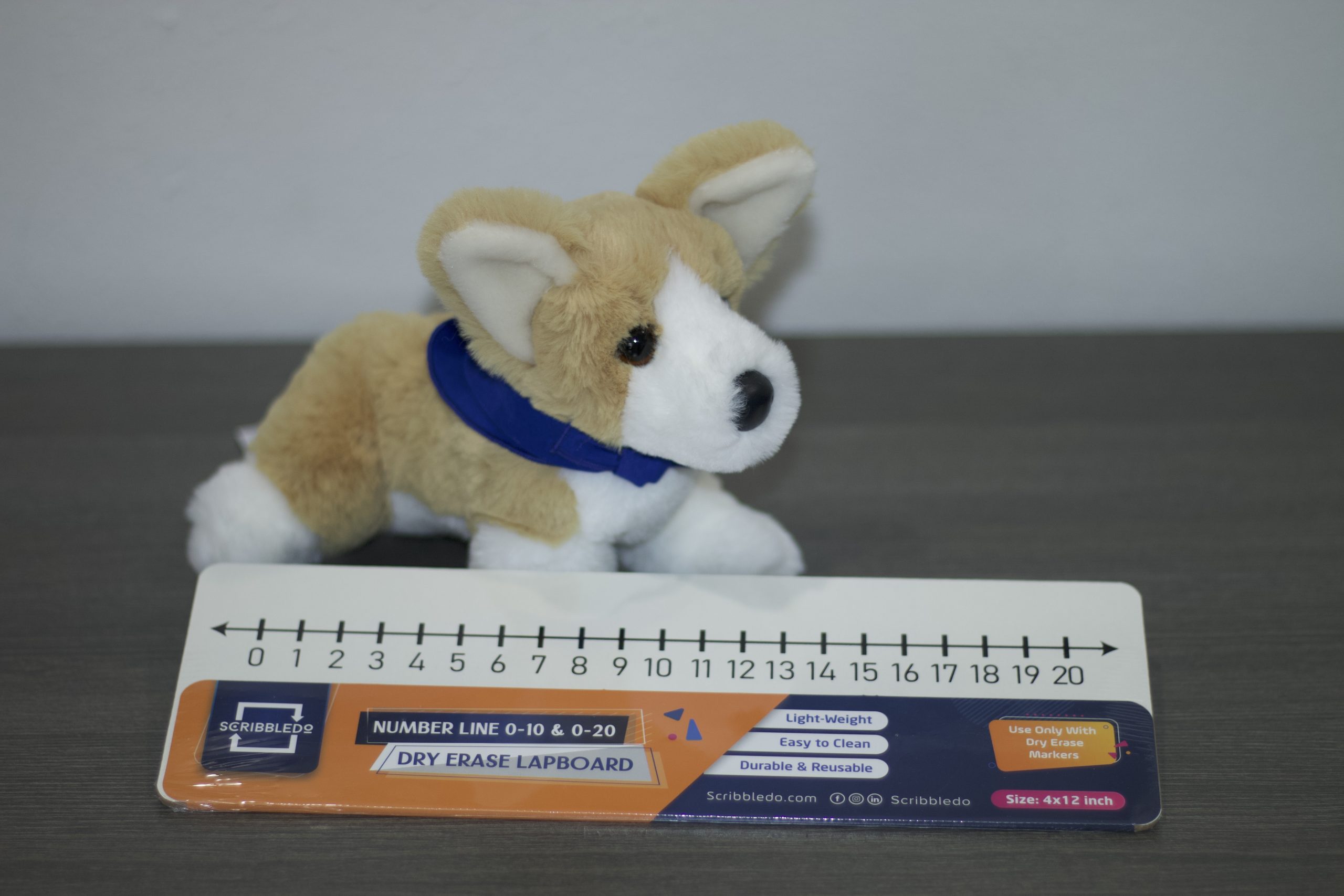
A number line represents numbers as ordered positions at equal intervals. That sounds simple, but it lays the groundwork for magnitude, addition, subtraction, measurement, fractions, decimals, and eventually negative numbers.
The selected board has 0–10 on one side and 0–20 on the other. That range is appropriate for many preschool, kindergarten, and first-grade activities.
The strongest reason to own a number line is its versatility. Children can:
- Locate numbers
- Compare which number is greater
- Identify one more and one less
- Count forward to add
- Count backward to subtract
- Find missing numbers
- Investigate distance between numbers
Research on linear numerical board games shows that repeated movement through a numbered path can improve counting, numeral identification, magnitude comparison, and number-line estimation.
Mathematical concepts: number order, number magnitude, comparing numbers, addition and subtraction, counting forward and backward, skip counting, fractions, negative numbers.
Potential drawback: A fixed 0–20 board has a limited life span. A blank dry-erase number line becomes more useful when a child progresses to larger numbers.
Try this: Start at six and draw a jump of four. Ask the child to write the equation that matches the movement.
Common core standards: K.CC.A.1–2, K.CC.C.7, K.OA.A.1–2, 1.OA.C.5–6, 1.NBT.A.1, 1.NBT.B.3, 1.NBT.C.5, 2.NBT.A.2, 2.NBT.A.4, 2.NBT.B.5, 2.NBT.B.8, 2.MD.B.6
6. Learning Resources Base Ten Blocks Smart Pack
Best math toy for place value and regrouping
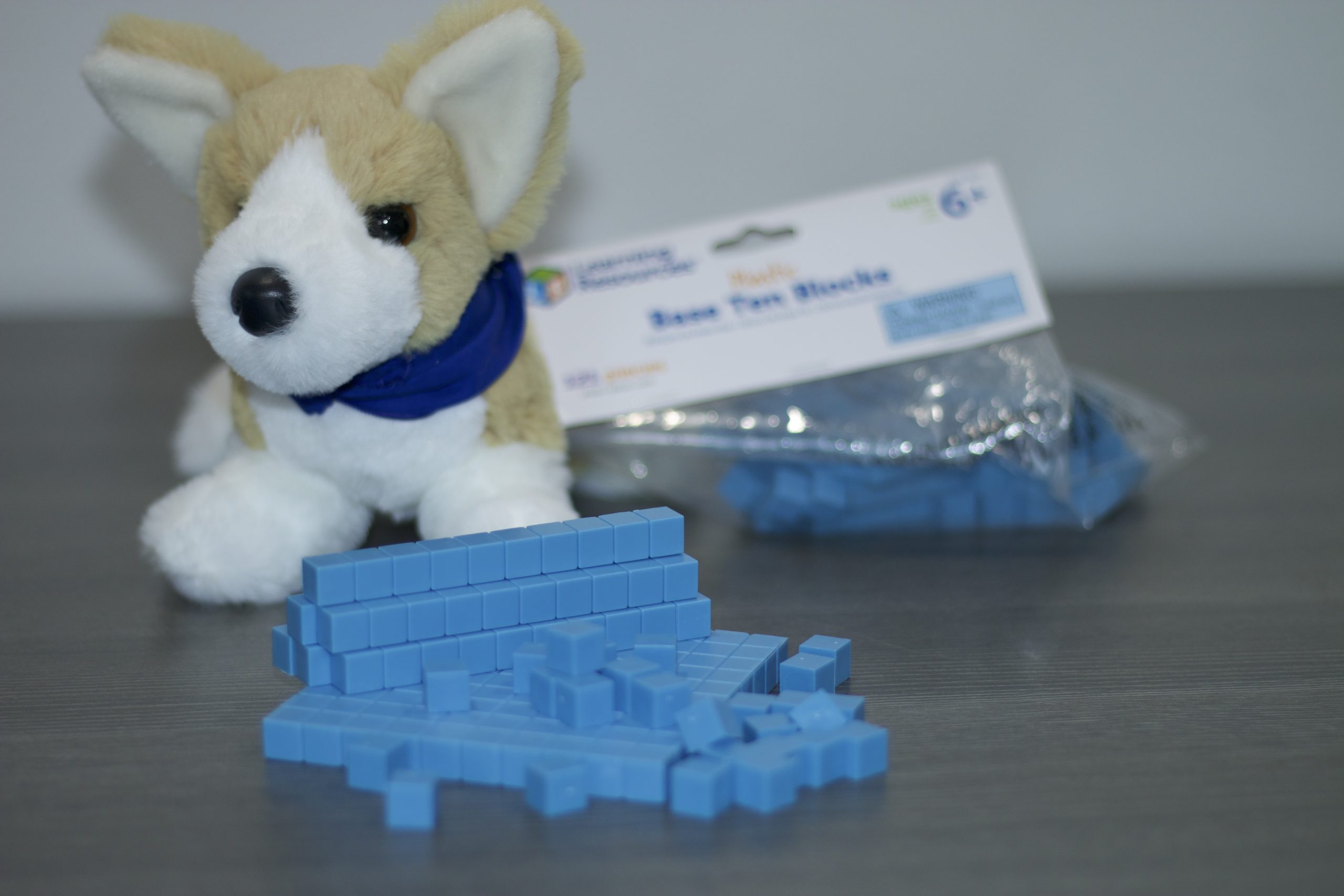
Base-ten blocks physically represent the structure of our number system:
- A small cube represents one.
- A rod represents ten.
- A flat represents one hundred.
The proportional sizes matter. Ten cubes match one rod, and ten rods match one flat. That allows children to see why ten ones can be exchanged for one ten.
A classroom study of first- and second-grade students used base-ten blocks alongside digit cards to connect number words, physical quantities, and written place-value notation. The approach supported students’ understanding of place value and multidigit addition and subtraction.
Base-ten blocks are especially valuable for children who can perform a written regrouping procedure but cannot explain why it works.
Mathematical concepts: place value, composing and decomposing multidigit numbers, expanded form, regrouping, addition, subtraction, multiplication, decimals.
Potential drawback: They become much less effective when used without a place-value mat or written numerals. A pile of rods and cubes can quickly turn into construction play.
Try this: Build 34 as three rods and four cubes. Trade one rod for ten cubes, and discuss why the total is still 34.
Common core standards: K.NBT.A.1, 1.NBT.B.2–3, 1.NBT.C.4–6, 2.NBT.A.1–4, 2.NBT.B.5–9
7. Learning Resources Plastic Pattern Blocks
Best math toy for spatial reasoning and shape composition
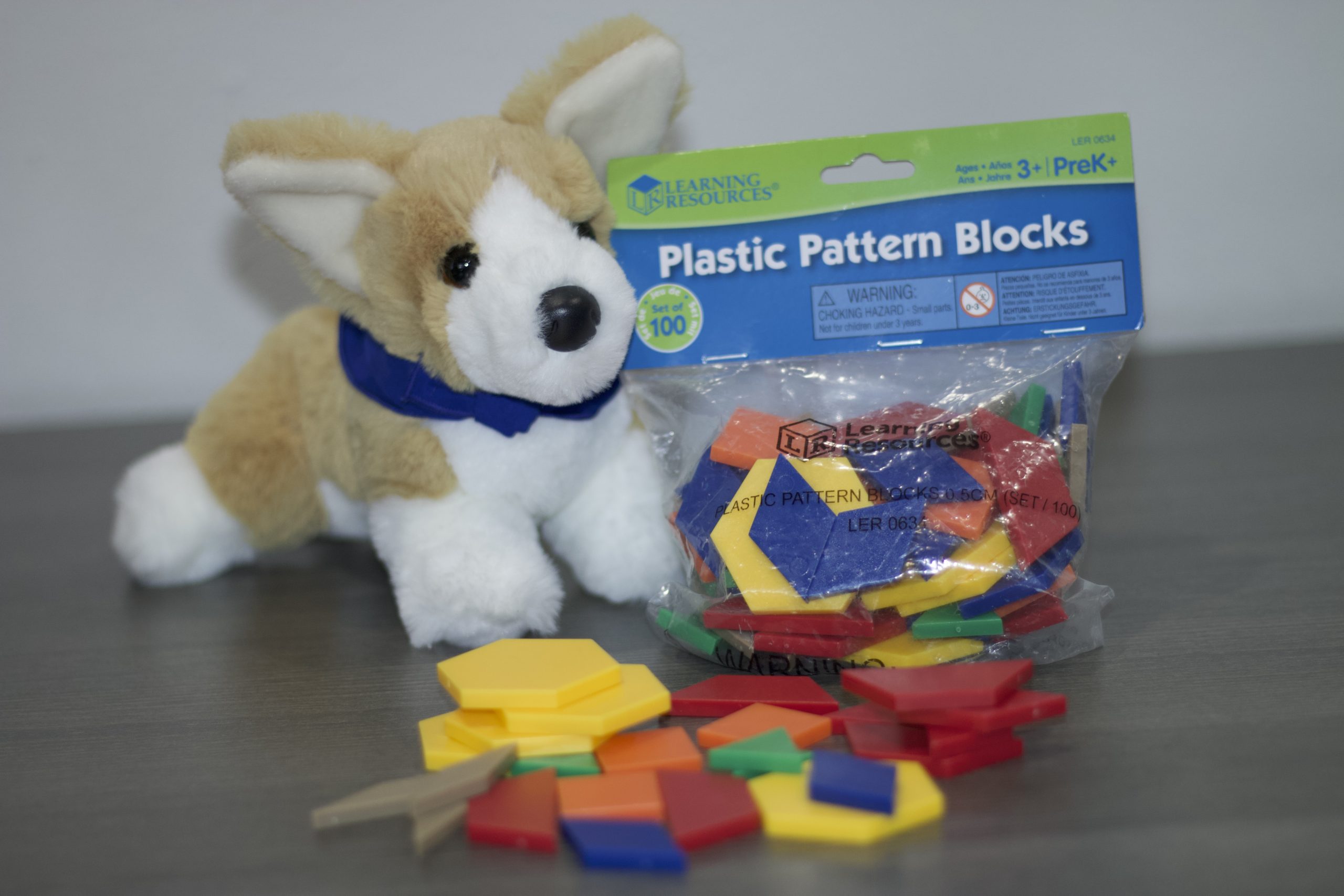
Pattern blocks are standardized geometric shapes that fit together in predictable ways. Children can sort them, copy designs, extend repeating patterns, build symmetrical pictures, and combine small shapes into larger ones.
These activities support several kinds of early reasoning:
- Shape recognition
- Part-whole relationships
- Rotation and orientation
- Symmetry
- Patterning
- Informal area comparison
They also encourage children to notice that a shape can remain the same shape after being turned. That is less obvious to young learners than adults often assume.
Mathematical concepts: shape identification, composing and decomposing shapes, symmetry, spatial reasoning, patterns, fractions, area, perimeter.
Potential drawback: Children may spend the entire activity creating pictures without discussing the mathematics. Open-ended building is valuable, but parents should add questions such as, “How many triangles cover this hexagon?” or “What changed when you rotated the block?”
Try this: Cover one yellow hexagon with smaller blocks in as many different ways as possible.
Common core standards: K.MD.B.3, K.G.A.1–3, K.G.B.4–6, 1.G.A.1–2, 2.G.A.1
8. Wooden Geoboard
Best math toy for hands-on geometry
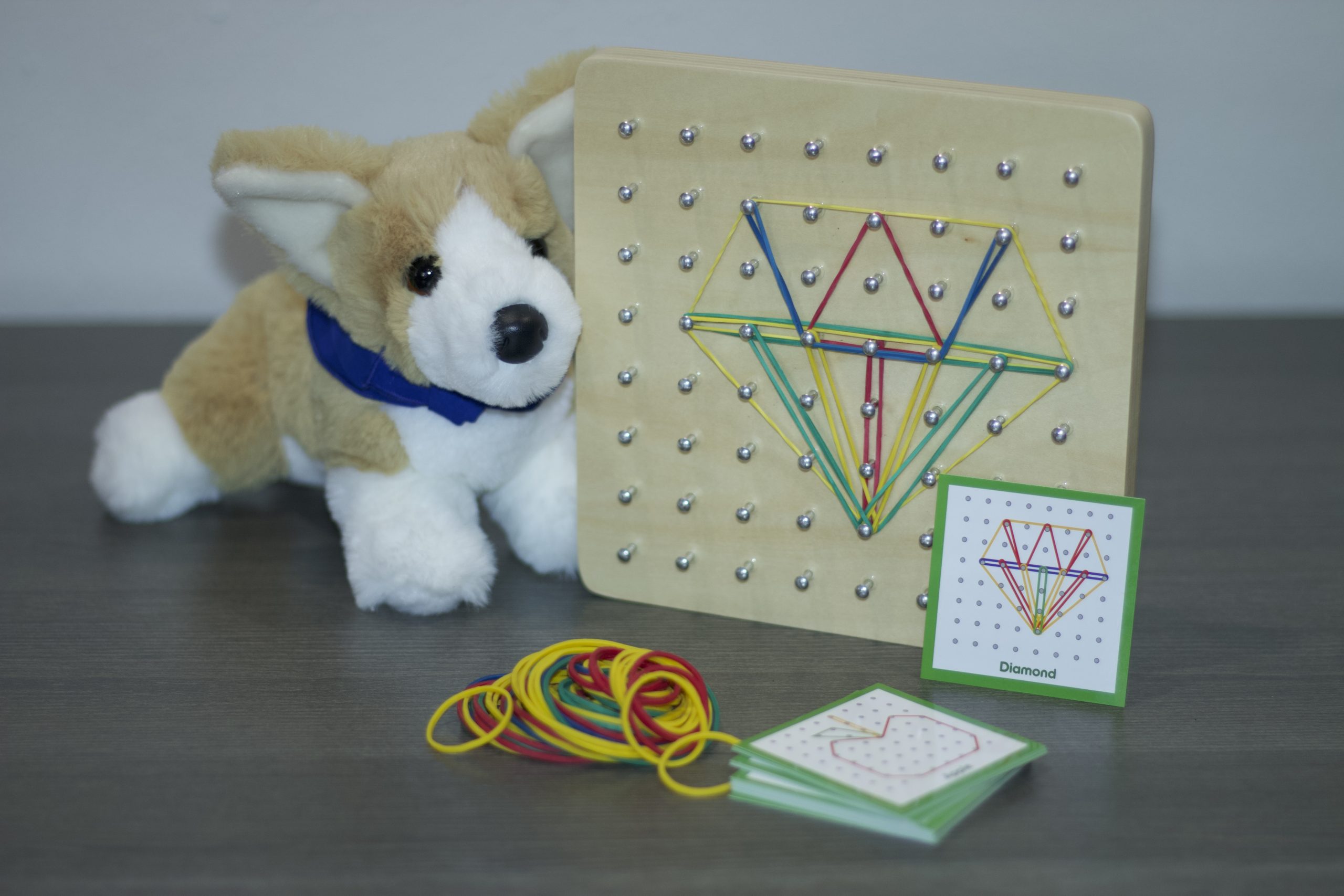
A geoboard is a grid of pegs around which children stretch rubber bands to create shapes.
For younger children, it supports shape recognition and spatial exploration. As children progress, it can be used for perimeter, area, symmetry, parallel lines, right angles, and composite figures.
The biggest benefit is that children must construct the shape. They are not merely pointing to a triangle in a workbook. They are deciding where its vertices go and how its sides connect.
Mathematical concepts: properties of shapes, angles, symmetry, perimeter, area, composite figures, coordinate-grid concepts, spatial reasoning.
Potential drawback: This is a more specialized tool than cubes or counters. Rubber bands can also snap, tangle, or become lost, so younger children require supervision.
Try this: Make two different rectangles with the same perimeter. Then compare their areas.
Common core standards: K.G.A.1–2, K.G.B.4–6, 1.G.A.1–3, 2.G.A.1–3
9. Learning Resources Big Time Mini Clock
Best math toy for learning analog time
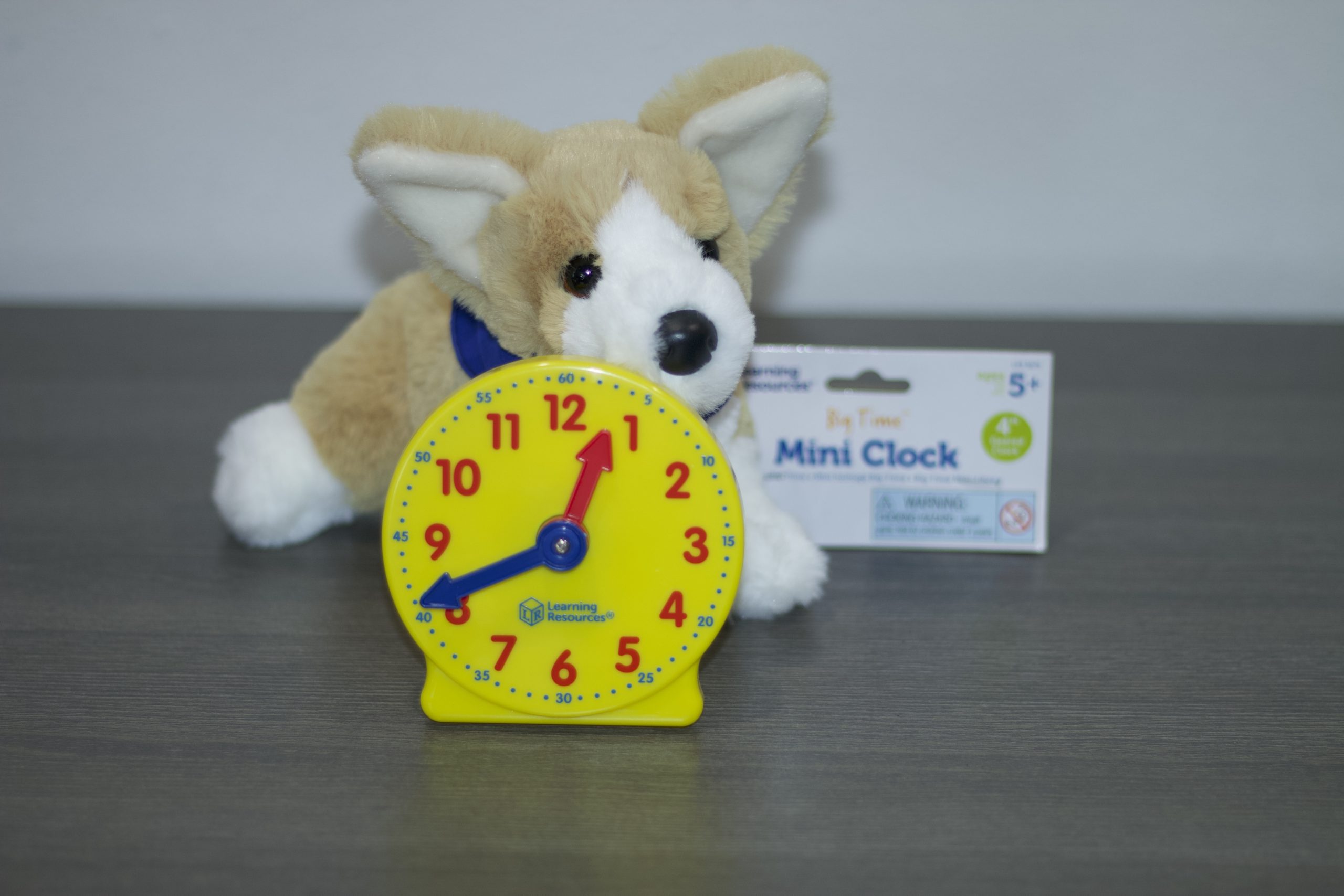
Reading an analog clock requires children to coordinate two related systems: hours and minutes. A geared clock makes that relationship visible.
The Learning Resources model contains hidden gears, so the hour hand moves gradually as the minute hand moves around the face. Its hands and corresponding markings are color-coded, and the clock includes a removable stand.
The gears are the most important feature. Cheap clocks with independently moving hands can accidentally teach an incorrect relationship between the two hands.
Mathematical concepts: reading analog time, hours and minutes, counting by fives, quarter-hours and half-hours, elapsed time, time intervals, converting hours and minutes, angles and rotations.
Potential drawback: A clock is highly specialized. It will not support the same range of skills as cubes or counters. The four-inch model is also intended for individual practice rather than group demonstration.
Try this: Set the clock to 3:00. Move the minute hand slowly to 4:00 and watch what happens to the hour hand.
Common core standards: 1.MD.B.3, 2.NBT.A.2, 2.MD.C.7
10. hand2mind Rainbow Fraction Tiles
Best future-proof math toy purchase
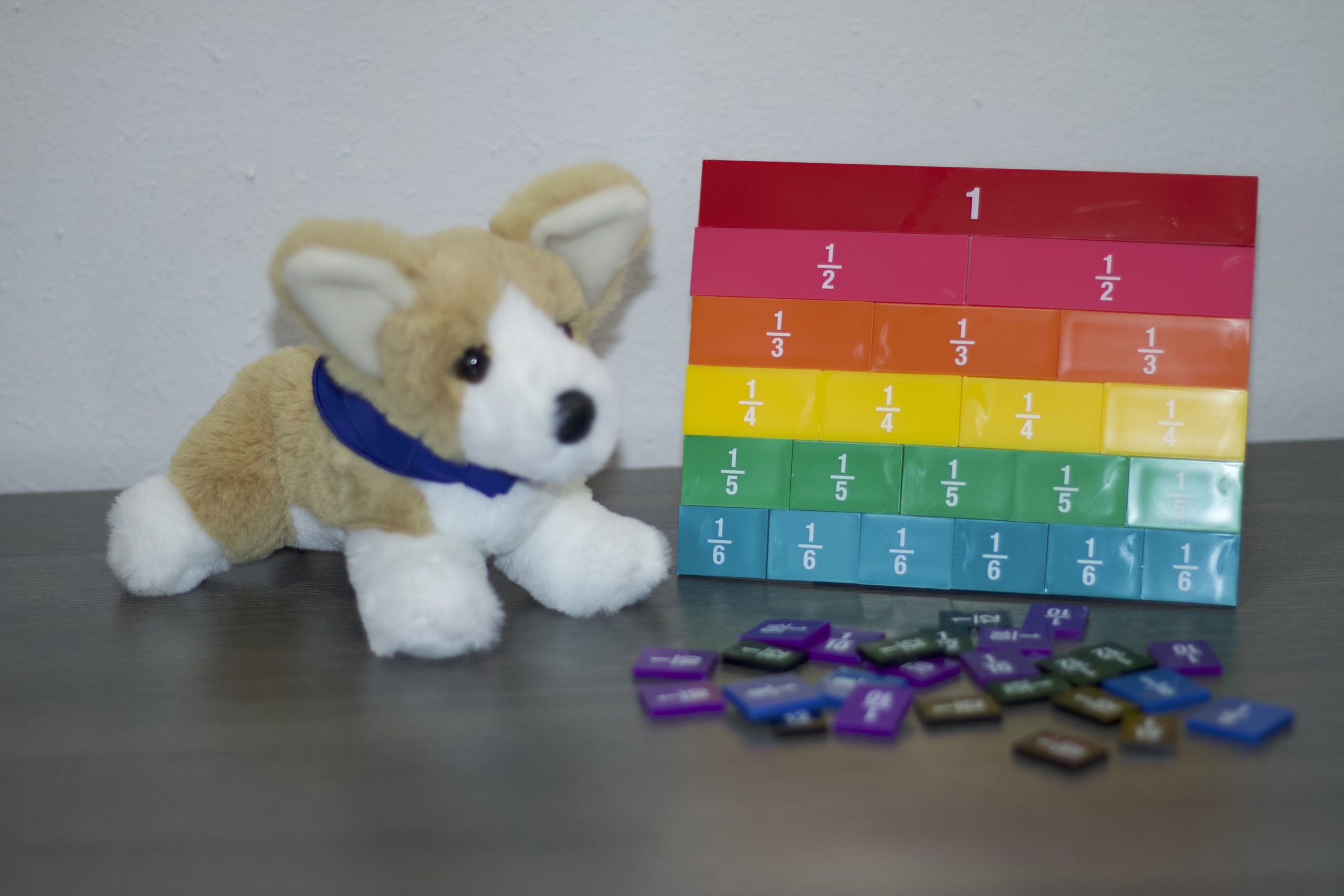
Fraction tiles are not essential for most preschoolers, but they become extremely useful as children begin working with halves, thirds, fourths, and equivalent fractions.
The linear format is particularly valuable. A child can place two fourths beside one half and see that the lengths match. This creates a natural bridge to fraction number lines.
The Institute of Education Sciences recommends number lines as a central representation for teaching fractions and specifically includes the use of fraction strips to demonstrate equivalence and density.
Mathematical concepts: unit fractions, numerator and denominator, fraction magnitude, comparing fractions, equivalent fractions, mixed numbers, adding and subtracting fractions, fraction-decimal relationships.
Potential drawback: The pieces are easy to lose, and a young child may simply sort them by color unless an adult introduces a clear task. For PreK and kindergarten, other tools on this list should come first.
Try this: Place one-half beside two one-fourth pieces. Ask what is the same and what is different.
Common core standards: 1.G.A.3, 2.G.A.3
How to Use Math Toys and Manipulatives at Home
Buying manipulatives is the easy part. The learning happens in the conversation around them.
- Start with a specific idea – Choose one specific goal and ask children pointed and directed questions that will help them understand the concept.
- Ex: “Find different ways to make ten” and “Make two shapes with the same perimeter.”
- Use fewer pieces – A child working on quantities to ten does not need 200 counters within reach. Excess materials create distraction and make cleanup miserable. Place only the pieces needed for the activity on the table.
- Ask for explanations – Check often for understanding. Ask questions that redirect the child’s attention to the abstract concept.
- Ex: “What does each piece stand for?” and “Can you show it another way?”
- Move toward drawings and symbols – After the child solves with objects, ask for a drawing. Then ask for an equation. The purpose of the manipulative is to develop understanding that eventually works without the manipulative.
- Stop before it becomes a battle – For preschool and kindergarten children, five focused minutes can be more valuable than 30 frustrated minutes. Short, repeated experiences are usually more productive than occasional marathon lessons.
The Bottom Line
Parents do not need to turn the living room into a classroom supply closet.
The best math manipulatives for kids are simple, versatile, and mathematically clear. Begin with linking cubes, counters, a ten-frame, a rekenrek, and a number line. Add base-ten blocks when the child begins formal place-value work. Bring in pattern blocks and a geoboard for geometry, a geared clock for time, and fraction tiles when fractions enter the picture.
Most importantly, remember that the product does not teach the child.
The adult teaches the child—by choosing the right representation, asking useful questions, connecting the model to written mathematics, and knowing when to put the pieces away.
A manipulative is not the lesson, but, used well, it can make the lesson click.
More Education Resources by Piqosity:
- 5 Strategies for Overcoming Math Anxiety
- Educational YouTube Channels That Can Help you with Math and Science
- Multiplayer Math Games You Can “Count” On
- Mental Math Strategies That Aren’t Just Gimmicks
- Think “I Suck at Math”? You Can Change That
- Making Math Fun: Hobbies that Improve Math Skills
- How to Help Your Child With Math
- 8 Renowned Mathematicians from Around the World and Their Contributions