


The ACT is a college-readiness exam administered to roughly 1.4 million students across the United States and internationality each year. Last year, the ACT massively changed its test, making it align much more closely with the SAT, which underwent a major overhaul in 2023. Both of the new tests are shorter, largely digital, and give students more time per question than previous iterations did. We’ve done previous breakdowns of the new ACT based on specification documents and other available information, but now that the ACT has released two official practice tests on their website, we can do a much more thorough analysis of the changes, especially the content changes, on the new ACT. This article delves into what is tested on the Math section of the ACT, and offers students tips for acing this portion of the test!
Format Changes on the ACT
Before we broach the subject of content changes, however, let’s briefly refresh the major format changes of the new ACT. Overall, there are fewer questions per section, fewer questions per passage (in the English and Reading sections), and shorter passages. The Science section, once considered emblematic of the ACT’s reputation as the “STEM” test, is now optional; students can decide whether or not they want to take it. The same is true for the Essay section. The result is a much shorter test that is more in line with competitors like the SAT.
| Test Section | Number of Questions | Time Limit (minutes) | Time Per Question (seconds) |
| English | 50 | 35 | 42 |
| Math | 45 | 50 | ~67 |
| Reading | 36 | 40 | ~67 |
| Science (optional) | 40 | 40 | 60 |
| Essay (optional) | 1 | 40 | n/a |
| Totals: | 131 + 41 optional | 125 + 80 optional | n/a |
But the real question on everyone’s mind is: how the content of the ACT has changed along with the new format? Although we have been given some hints as to what these changes might be in the specification documents released for the new format, the best strategy is to examine official tests, which is what we do below. Up until now, this has been a hard ask since there has only been one officially released digital practice test, largely made up of recycled material. Now, however, the ACT has released another digital practice test.
This article analyzes these two official practice tests in order to determine everything that’s tested on the Math Section of the ACT. In order to learn about the changes to the other sections of the ACT, check out articles about them: English, Reading, and Science.
Math Section of the New ACT
Like the English section of the ACT, the Math section has also undergone some pretty intense changes. First and foremost there are fewer questions in the section–only 45 instead of 60. In addition, questions now have only four answer options rather than five, as has long been a staple of the ACT Math Section. This makes the Math Section of the ACT align more closely with the SAT. Unlike the SAT, all math questions on the ACT are multiple choice; there are no fill-in questions.
Previously, there were “passages” on the Math section of the ACT, a shared paragraph of information or table or figure that groups of three-four questions would each refer to. All of these questions have been removed on the new ACT, meaning that all questions are individual and discrete from one another.
Format of Questions on the New ACT Math Section
Overall, the main change found in the content side of the ACT Math section is the minimizing of long, complex word problems. This isn’t entirely surprising given shifts in the reporting categories discussed in the next section, but it is notable given the fact that there has long been a stereotypical “ACT-style” math question that includes long word problems and multiple steps.
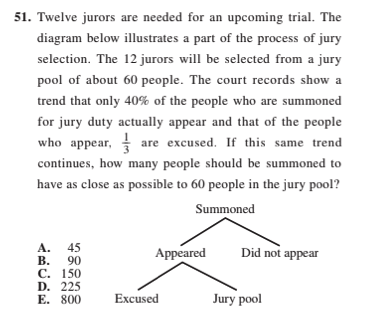
For example, let’s take a look at the longest word problem from the officially released 2021-2022 ACT:
Compare this to the longest question of the first released practice test:
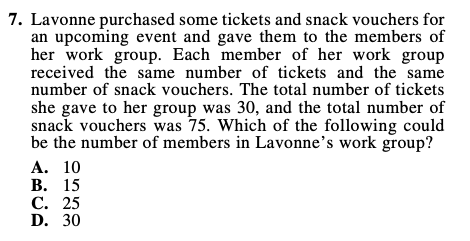
Not only is the old question literally longer (~85 words compared to ~75), but it is multistep and includes a diagram. The relative difficulties of the questions aren’t entirely surprising, given that the old question appears much farther in the test than does the new one, which is typically an indication that it’s harder. But, the fact that the longest word problem in the new practice test appears so early does indicate that the ACT has shifted away from relying on fairly long, complex word problems to elevate the difficulty of a question. Instead, harder questions in the newly released practice tests focus more on testing difficult concepts, rather than having students model complex scenarios and use a synthesis of skills from across the mathematical spectrum in order to arrive at the correct answer.
Overall, this is likely good news for students, especially ones who struggle with this kind of multistep, conceptual modeling question.
Reporting Categories of Questions in the New ACT Math Section
This brings us to our main discussion: the actual content of the math questions. The trickiness of analyzing the content in the Math section is partially related to the categorization of questions, which is more complicated than it is in other sections of the ACT. There are two overarching categories of math questions:
- Preparing for Higher Math (PHM) — This category tests more “recent” mathematical concepts–Algebra onward, encompassing much of high school math
- Integrating Essential Skills (IES) — This category tests two different skills together, multistep problems, and some pre-high school concepts, like rates, percentages, and proportions.
In practice, the actual division between these two categories is often a little fuzzy. Because of this, it is especially hard to sort the experimental questions, which have no official reporting category. To further complicate matters, PHM questions are divided up into additional subcategories:
- Algebra
- Functions
- Geometry
- Number & Quantity
- Statistics & Probability
Officially, the main content change in the ACT Math section is fewer questions in the IES category and more in PHM. In light of this, the percentages of PHM’s subcategories have also shifted, though not too much. Look at the table below to see the percentage of question that fall into each category.
ACT Math Section Reporting Categories
| Main Reporting Category | Subcategory | Percentage of Questions on Old ACT | Percentage of Questions on New ACT (Official) | Average Percentage go Questions on Practice Tests |
| PHM | 57-60% | 80% | 77% | |
| Algebra | 12-15% | 17-20% | 16% | |
| Functions | 12-15% | 17-20% | 18% | |
| Geometry | 12-15% | 17-20% | 16% | |
| Number & Quantity | 8-12% | 10-12% | 12% | |
| Statistics & Probability | 8-12% | 12-15% | 15% | |
| IES | 40-43% | 20% | 23% |
(Note: due to the difficulty of classifying experimental questions, they have been removed from these estimates. There are four experimental questions per test, meaning we treated each practice test as though it had 41 questions instead of 45.)
Question Content on the New ACT Math Section
Let’s take a quick look at the content tested the Math section of the ACT category-by-category, beginning with the PHM umbrella category.
Algebra
On average, there were ~7 Algebra questions per test. This category includes questions about equivalent expressions, rearranging expressions, and polynomials.
Let’s take a look at an example Equivalent Expressions question:
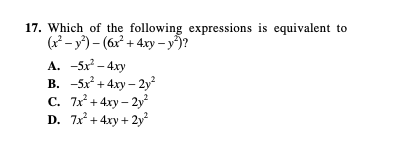
A fairly easy question, students simply need to complete the operations in order to find the correct answer. If we do the math and combine like terms, we’re left with -5x² – 4xy or answer A.
Functions
On average, there were ~8 Functions questions per test. This category includes a wide range of questions that have equations written in function notation. These include quadratic functions and exponential functions, and even questions about sequences.
Let’s take a look at an example Functions question:
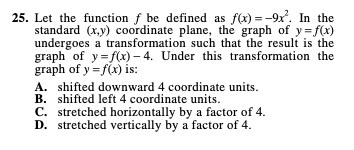
This question is asking about transformations. Students must know that -4 being added after the function itself results in the line being shifted down 4 units on the coordinate plane. This means that the correct answer is A.
Geometry
On average, there were ~7 Geometry questions per test. This category includes questions about the perimeter and area of shapes, as well as angles, Pythagorean Theorem, similarity and congruence, right triangle trigonometry, circles, and more.
Let’s take a look at a question that incorporates a number of these skills:
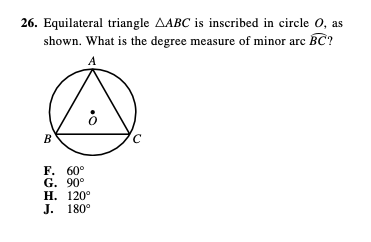
In order to answer this question, students have to know about the properties of triangles and circles to know that the triangle separates the circle into three equivalent arc lengths. Since a circle is 360°, we just have to divide this number by 3 to get 120°, or H.
Number & Quantity
On average, there were ~5 Number & Quantity per test. This categories includes questions about mathematical operations and word problems, matrices, units and unit conversions, and complex numbers. Overall, this tends to be an easier question type, appearing more in the front half of the math test than the latter half.
Let’s take a closer look at a Number & Quantity question:
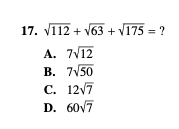
This is a fairly simple question: in order to answer it, a student must simply complete the operations: the square roots and addition. √112 = 4√7, √63 = 3√7, and √175 = 5√7. Since these are all like terms, we can now simply complete the addition: 4√7 + 3√7 + 5√7 = 12√7, or answer C.
Statistics & Probability
On average, there were ~6 Statistics & Probability per test. Unsurprisingly, this category is largely made up questions about probability and statistics, though it also covers questions about percentages and Venn diagrams.
Let’s take a look at a simple statistics question:
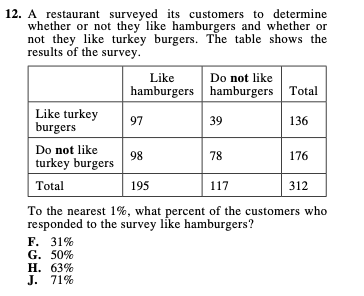
In order to answer this questions, students need to find ALL the respondents who liked hamburgers. This means everyone includes in the second column. The total row at the bottom tells us that 195 participants out of 312 said that they liked hamburgers. In order to find what percentage this is, we simply need to divide 195 by 312 and multiply that by 100. When we do this, we’ll get 62.5, which rounds up to 63%, or answer H.
Integrating Essential Skills
On average, there were ~10 IES questions per test. As mentioned previously, this category is hard to quantify, since it is not limited by topic. Many of these questions might seem to slot into one of the PHM topics, but they are generally testing skills that were covered before high school, or also utilize skills from additional PHM category. For example, IES questions can be about linear equations, simple geometry (like sum of the interior angles of a triangle), measures of central tendency (mean, median, mode), probability, etc.
That being said, just because a question is easy does not mean it is necessarily classified as IES. Plenty of IES also appear in the latter half of the math test, alongside questions of a higher difficulty. As was noted in the sections above, many of the ACT’s most complex word problems fall under the IES category. To an outside observer, what exactly separates these questions from PHM is not always obvious. This means that we largely have to depend on the ACT to classify these questions.
Let’s take a look at an IES question:
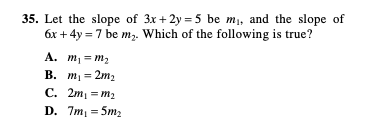
This is a linear equations question, testing students about slope of a line. In order to solve this problem, students have to rearrange the two equations into slope intercept form. Once they do this, they’ll find that the coefficient in front of the x is -3/2 for both equation. Since this number represents the line’s slope, the two slopes are equal to one another, or answer A.
Piqosity Updates to the Math Section of the ACT
At Piqosity, we’re committed to always giving students the best study materials possible. Based off this analysis of the official ACT practice tests as well student feedback, we’ve significantly updated all of our 12 Enhanced ACT full-length practice tests to reflect the changes. This ensures that when students take a Piqosity test, they’re getting as close to the real thing as possible. Some of our updates to the Math sections of our ACT practice tests include:
- Removing passage-based questions: to match the new ACT, Piqosity has removed all of our passage-based math questions from our practice tests.
- Limiting IES questions: in shortening our tests to match the new ACT format, Piqosity prioritized removing IES questions, especially ones that present complex, multistep word problems. The questions in our tests are tending shorter and toward testing a single discrete skill rather than many at once.
- New questions written from official practice tests: in addition to removing questions that no longer fit within the specs of the ACT Math section, Piqosity has also rewritten a number of questions in each of our practice exams, drawn directly from ones in the newly released practice tests. This ensures that when students take a Piqosity ACT practice test, they are getting questions similar to ones they will see on the actual ACT!