


If you’re a non-native English speaker, taking college admission exams like the ACT can be pretty intimidating—luckily, there are a number of ACT Accommodations for English Language Learners available that help ELLs (or ELs—English Learners) attain equal ground to their native-speaking peers.
Since most of us, when possible, avoid activities that cause stress, EL students (sometimes also called international students) are often reluctant to focus on preparing for standardized tests. This creates an additional challenge for teachers, who often wonder how to motivate students for standardized tests. In addition to employing general strategies for reducing foreign language anxiety for test takers, there are also some ACT-specific tips.
In this article, we’ll explain the various ACT accommodations for English language learners that are available, help you understand how to request specific accommodations, and leave you with some helpful resources to prepare for the ACT.
For ELL students planning to take the SAT, don’t forget to check out our post on how to approach SAT Prep for ESL Students.
What’s on the ACT?
The ACT is a standardized test typically taken by high school juniors and seniors as part of the college application process. It assesses students’ knowledge and understanding in four subject areas: English, Math, Reading, and Science. In addition, students have the option of adding the Writing section, which consists of a single essay question.
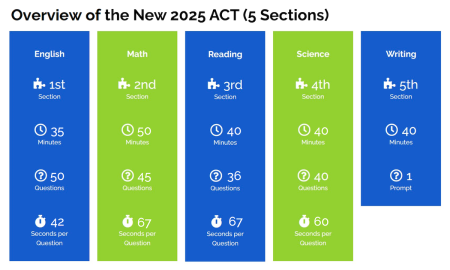
As you can see, the ACT as a whole asks students to answer 131 multiple-choice questions in just over 2 hours—a total of 171 multiple-choice questions and 1 essay in 3.5 hours for those taking both optional sections.
What Are English Language Learning Supports for the ACT?
The ACT offers one centrally-approved support for English Learners: extended time up to time-and-a-half. This accommodation requires an advance request by the posted deadline (usually about 3-5 weeks before test day).
Other accommodations are locally authorized without ACT’s approval, meaning test coordinators can authorize EL students to use:
- Word-to-word bilingual dictionaries, which must appear on the ACT’s approved list. Note that these dictionaries do not provide definitions, just the equivalent word(s) in a student’s native language. These dictionaries must be brought in by the student on test day, as testing centers will not have them available.
- Test directions in a student’s native language. Native language test directions for the ACT are available in 19 different languages. Translated test directions should be available to students on test day and do not require advance request.
The ACT also offers a variety of accommodations for accessibility purposes, including written versions of verbal instructions, preferential seating, and the use of earplugs, to name a few.
Eligibility for ACT Accommodations
In order to receive EL accommodations that require ACT approval, students need to meet a few different criteria. Along with being enrolled at a school within the United States or a U.S. territory, they must also meet the following stipulations:
- The student must have limited English proficiency.
- The student must be actively participating in an English language acquisition program.
- The student must be using similar English language supports in the classroom and during other tests and assessments.
How to Request Accommodations for the ACT
Requesting accommodations for the ACT as an English language learner is quite simple, but you will need to work with a school official to address your needs. This is helpful because the official will handle the difficult part of the process for you.
Your first step will be to create an account on the ACT website and sign up for your desired test date. The online registration page will ask you for your high school, and you will need to select “yes” when asked if you need accommodations.
After submitting your information, you’ll receive an email that you have to forward to your school official. Along with the email, you’ll have to submit a completed Consent to Release Information ACT form to them. Once you submit these documents to your school official, they will handle the rest of the process for you.
To be approved, the ACT will look for answers to the following questions:
- Do the desired accommodations offer a fair shot compared to standard test takers?
- Are the accommodations appropriate to the student’s level of English language proficiency?
- Does the student meet the requirements for receiving English language learning supports?
Preparing for the ACT as an English Learner
Although ACT accommodations for ESL students can offer you a more pleasant test-taking experience, the most effective way to have an excellent ACT test day is to practice the content that will be tested on the exam!
ACT prep for ESL students is broadly similar to the type of prep a native English-speaking student would complete. Taking practice tests and brushing up on ACT vocabulary words are the best way to ensure you’re ready for the real deal. With that said, it’s helpful to keep a few things in mind to keep your anxiety level down and your confidence level up. Consider some of these helpful ACT tips for ESL students:
- Create a study plan. Staying organized will keep your stress levels down and you’ll be able to focus on the content you’re studying. Without a plan, it’s easy to feel aimless during your prep sessions; this makes them less efficient. With a plan, you can optimize whatever time you have available.
- Improve your grammar. Mastering the grammar rules that are commonly tested on the ACT will help you better prepare yourself for understanding the content in the Reading, English, and Writing portions of the test.
- Focus on your weaknesses. Make a mental note of which areas you feel the least confident about. These should be the concepts and skills you work on the most in the weeks leading up to your ACT test day.
- Keep track of your progress. This is a helpful motivational strategy for those days when you feel like you aren’t getting anything right. Note your studying on a calendar, or use a habit tracker to Seeing a visual representation of the progress you’re making will boost your morale.
- Take plenty of practice tests. Using practice tests, like the official ones offered by the ACT or Piqosity’s full-length ACT practice tests, helps you become familiar with the test’s format. This in turn reduces test anxiety. Additionally, since most students improve their scores the second or third time they take the ACT, having taken practice tests in advance means that a student’s “first” ACT is not, in fact, their first experience of the test.
Particularly for English learners, studying vocabulary is crucial to building standardized test confidence. Piqosity has you covered, with extensive FREE vocabulary practice at three levels:
Although these lists were designed to help students preparing for the ISEE, they work just as well for general vocabulary-building. To practice these words, consider making flashcards, grouping them by definition, and using them in sentences. These activities will help you familiarize yourself with what each one means and how to identify context clues too.
Prepare for the ACT With Piqosity!
For students, utilizing at-home courses, like the ones offered here at Piqosity, are an important tool for language enrichment and test prep. These courses are a great way for ELL students to gain familiarity with the English language and the nuances of the ACT from the comfort of their own home.
Along with our full-length, online ELA and Math courses for grades 5-11, we offer full SAT, ACT, and ISEE test prep courses, each of which includes 12 practice exams, dozens of concept lessons, personalized practice software, and more. Our ACT course is designed around the new enhanced ACT, equipped with the scoring, content, and format of the real thing.