


The ACT is a college-readiness exam administered to roughly 1.4 million students across the United States and internationality each year. Last year, the ACT massively changed its test, making it align much more closely with the SAT, which underwent a major overhaul in 2023. Both of the new tests are shorter, largely digital, and give students more time per question than previous iterations did. We’ve done previous breakdowns of the new ACT based on specification documents and other available information, but now that the ACT has released two official practice tests on their website, we can do a much more thorough analysis of the changes, especially the content changes, on the new ACT. This article delves into what is tested on the Reading section of the ACT, and offers students tips for acing this portion of the test!
Format Changes on the ACT
Before we broach the subject of content changes, however, let’s briefly refresh the major format changes of the new ACT. Overall, there are fewer questions per section, fewer questions per passage (in the English and Reading sections), and shorter passages. The Science section, once considered emblematic of the ACT’s reputation as the “STEM” test, is now optional; students can decide whether or not they want to take it. The same is true for the Essay section. The result is a much shorter test that is more in line with competitors like the SAT.
| Test Section | Number of Questions | Time Limit (minutes) | Time Per Question (seconds) |
| English | 50 | 35 | 42 |
| Math | 45 | 50 | ~67 |
| Reading | 36 | 40 | ~67 |
| Science (optional) | 40 | 40 | 60 |
| Essay (optional) | 1 | 40 | n/a |
| Totals: | 131 + 41 optional | 125 + 80 optional | n/a |
But the real question on everyone’s mind is: how the content of the ACT has changed along with the new format? Although we have been given some hints as to what these changes might be in the specification documents released for the new format, the best strategy is to examine official tests, which is what we do below. Up until now, this has been a hard ask since there has only been one officially released digital practice test, largely made up of recycled material. Now, however, the ACT has released another digital practice test.
This article analyzes these two official practice tests in order to determine everything that’s tested on the Reading section of the ACT. In order to learn about the changes to the other sections of the ACT, check out articles about them: English, Math, and Science.
Reading Section of the New ACT
Officially, the reading section had far fewer changes than the English section on the new ACT. It still has four passages, the main change is that instead of 10 attached questions, each passage now only has nine questions–so 36 questions in all instead of 40.
Passage Length & Difficulty on the New ACT Reading Section
The length and difficulty of the passages on the Reading sections of the two released ACT practice tests is largely in-line with previously released ACTs. The average length of a passage is just about 750 words and the Flesch Kincaid grade level score (a readability score that considers average length of sentences as well as average syllables per word in order to assign a grade level to a text) is 13.66. This is a little skewed by one passage in the second test, which will be discussed more fully later.
Official ACT Reading Passages
| Test | Average Word Count | Total Words Per Test | Average Flesch Kincaid Score |
| Practice Test 1 | 783 | 3,132 | 13.69 |
| Practice Test 2 | 715 | 2,860 | 13.63 |
| 2021-2022 Released ACT Test (old format) | 782 | 3,129 | 11.29 |
These numbers are very similar to previous ACTs. For example, in the 2021-22 released ACT test, the average words per passage were about 782 and the average Flesch Kincaid score was 11.29.
Overall, a reading section will ask students to read about 3,000 words total across all the passages. This translates to about 10 pages in a standard book.
Format of Questions on the New ACT Reading Section
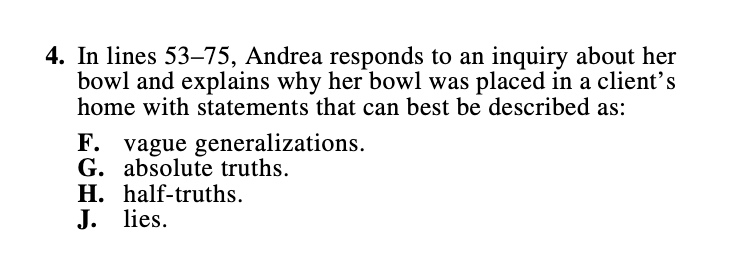
The format of questions in the Reading section has largely remained the same from the old ACT to the new, enhanced ACT, with a few notable exceptions. On the old paper-and-pencil test, the passages had numbered lines. These line numbers were referred to in questions in order to point students toward specific words, phrases, sentences, or whole paragraphs of text that corresponded to the question.
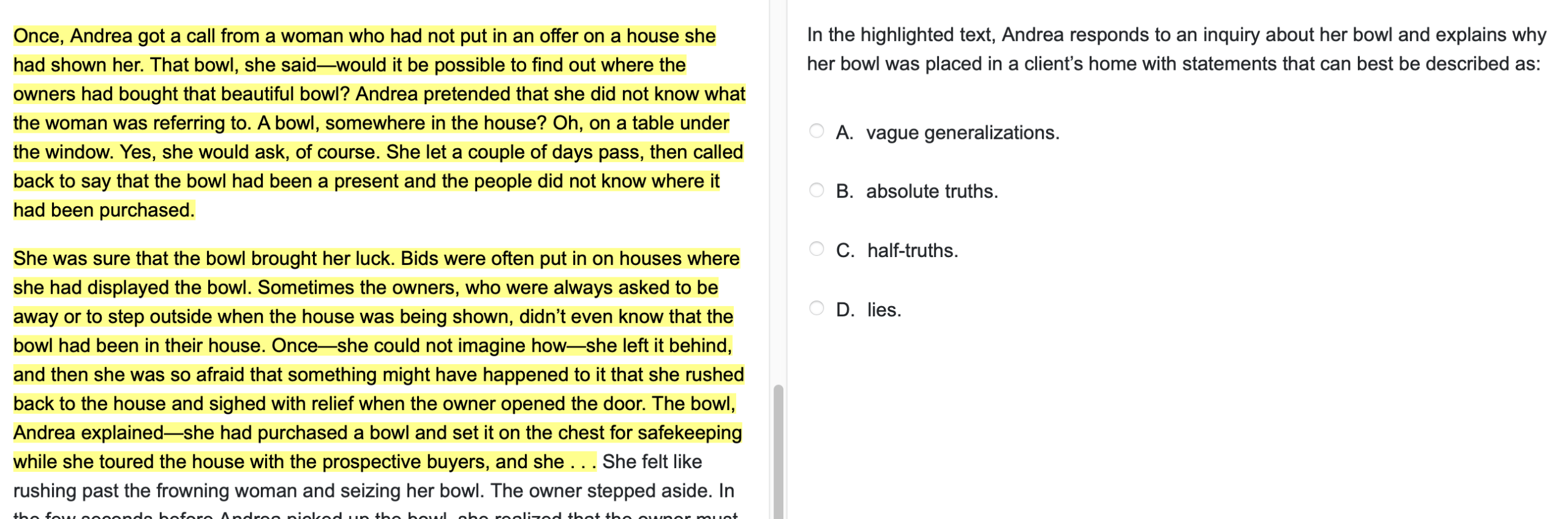
Like the English section, the new online format of the exam has resulted in some changes. Passages no longer have line numbers; instead, if a questions asks about some portion of specific text, that portion is highlighted and automatically scrolled to when a student clicks on the question. While this likely won’t change much about how students take the test, it might help them answer questions a little quicker, since they’ll no longer have to count line numbers (especially considering that line numbers were given every five lines, meaning that students almost always had to do some counting to locate the specified text).
The differences between the two formats can be observed in the examples below.
Old Question:

New Question:
Reporting Categories on the New ACT Reading Section
Like the previous sections examined, there have been slight changes to the content tested in the Reading section. Similar to English, there are three official reporting categories for questions:
- Key Ideas and Details (KID) — Reading Comprehension questions
- Craft and Structure (CS) — Organization and Purpose questions
- Integration of Knowledge and Ideas (IKI) — Claims and Evidence questions
Below is a table detailing how the ranges of these questions has shifted with the new ACT.
ACT Reading Section Reporting Categories
| Reporting Category | Percentage of Questions on Old Test | Percentage of Questions on New Test | Average Percentage of Questions on Practice Tests |
| Key Ideas and Details | 53-60% | 44-52% | 49% |
| Craft and Structure | 25-30% | 26-33% | 30% |
| Integration of Knowledge and Ideas | 15-23% | 19-26% | 21% |
There have been no major shifts here, just slightly fewer KID questions, in favor of the other two categories.
Question Content on the New ACT Reading Section
With one rather large exception, there has not been much change in the actual content of the questions in the reading section either. Let’s briefly go through each of the reporting categories.
Key Ideas and Details
- Close Reading/Details: ~9 questions per test
- Central Ideas, Themes, and Summaries: ~6 questions per test
- Relationships and Sequences: ~3 questions per test
This is the category of questions that is usually understood as “reading comprehension” questions. These are usually straightforward questions that ask students to reproduce information more or less directly from the text–that is, they focus on the content of the passage rather than its organization, its arguments, etc. These questions mostly just check that students are paying attention to and understanding what they’re reading.
Here’s an example of a Close Reading or Detail question:

These questions are often the easiest type seen in the Reading section of the ACT, simply asking students to reproduce details exactly as they are found in the text of the passage. The fact that these kinds of question appear more than any other single type implies that the overall difficulty of the Reading section has likely dropped since previous tests, even if the passages are, on average, a little longer and a little more complex.
This category also includes Central Ideas, Themes, and Summary questions. These are a little more difficult; they ask students not to just reproduce specific details, but rather to summarize or make general statements about the text as a whole or portions of the text. These kinds of questions require a little bit of thinking on the student’s part, but are still extremely content-oriented.
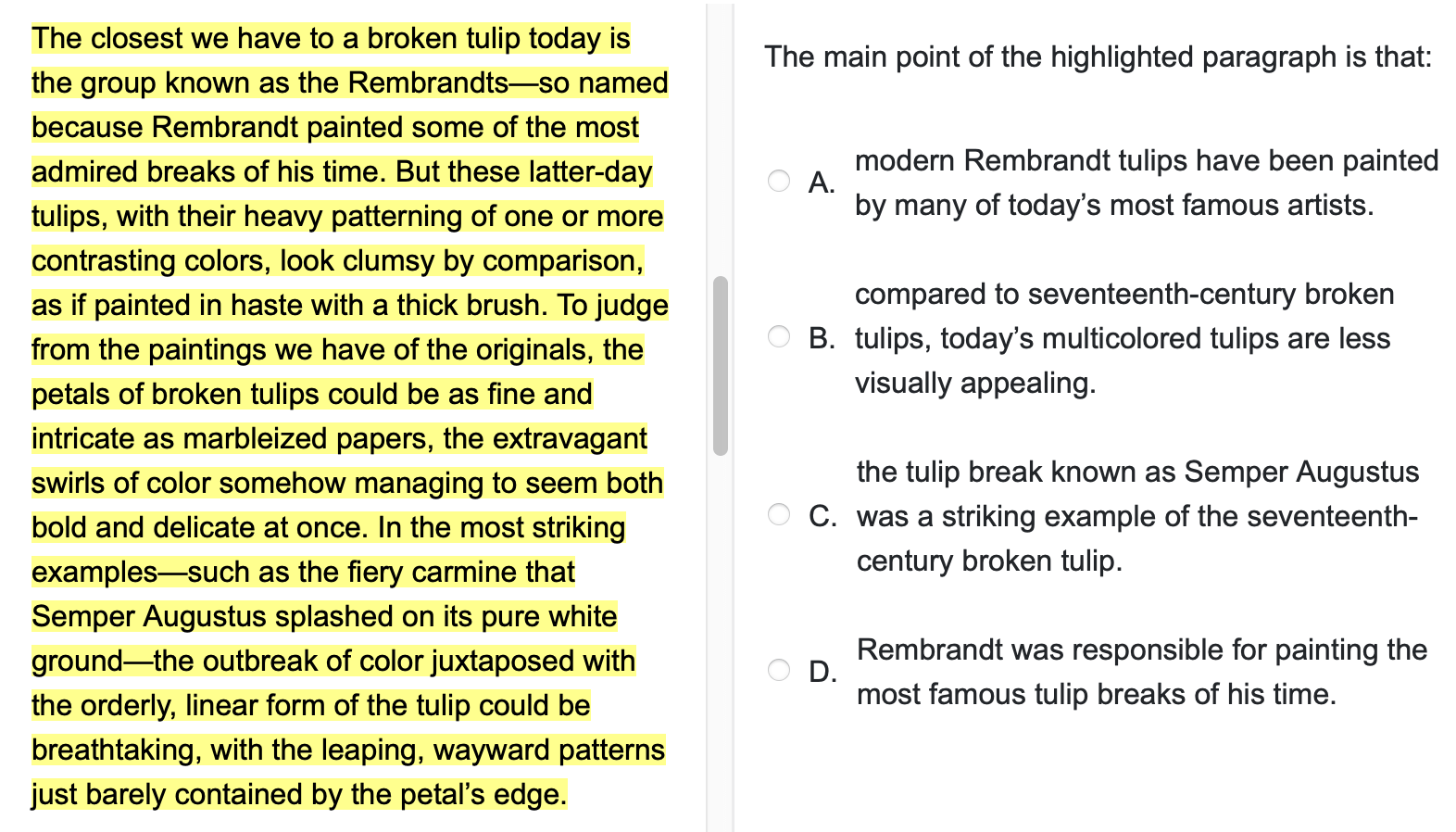
Here, students must read the paragraph and identify its “main point.” When doing this, it’s important to distinguish between main ideas and details. Many of these answer options deal with details in the text, for example, Rembrandt’s painted tulips. This is mentioned in the first sentence, but not again. The correct answer is “compared to seventeenth-century broken tulips, today’s multicolored tulips are less visually appealing,” since this covers the entirety of the paragraph, rather than focusing on a specific detail.
Craft and Structure
- Purpose and Point of View: ~6 questions per test
- Word Meanings and Choice: ~3 questions per test
- Text Structure: ~2 questions per test
Unlike questions in the KID category, questions in CS are largely about the function of elements in the text. These questions tend to focus on authorial intent–why did the author include this and not that?–and the effect of certain choices on the reader. Overall, these questions require a more sophisticated understanding of how a text works than KID questions, and for that reason, are often harder for students to answer.
Here’s an example of a Purpose question:
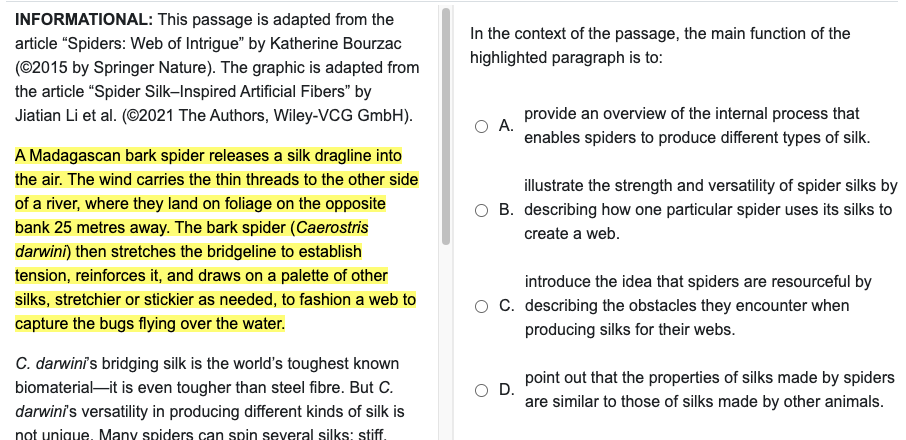
In order to answer this question, students must read the highlighted paragraph, and not just understand the information it contains, but also what its function is in the context of the passage as a whole. While this skill is similar to identifying the main idea of paragraph, it’s a little more difficult, since it requires the student to place the paragraph in a the larger context of the passage. Here, the paragraph focuses largely on how Madagascar bark spiders spin their webs. This most closely resembles the answer option: “illustrate the strength and versatility of spider silks by describing how one particular spider uses its silks to create a web,” which is the correct answer.
Let’s take a look at a vocabulary questions. These can always be identified by the question stem: “As it used in the passage, the highlighted word [word] most nearly means:”.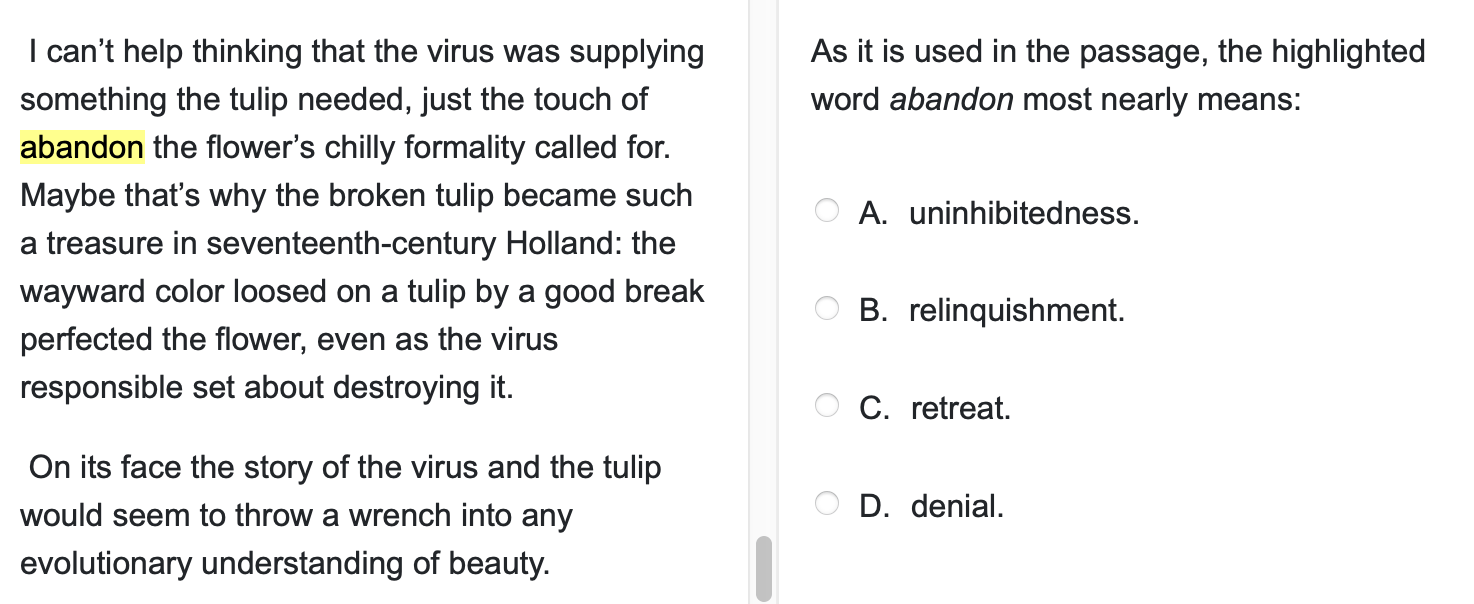
It’s important to remember that these are not just simple definitional vocabulary questions, but rather questions that are asking words in context. This means that sometimes the correct answer might not resemble the most widely used definition of the word, but rather a lesser used one.
This is the case for the above question. When you think about what “abandon” means, you will likely think something like “cease to support or look after,” but none of the potential answer options really match with this definition. This is because abandon is being used slightly differently in the text, to mean “a lack of restraint.” One of the answer options, “uninhibitedness” relates to this usage, and is the correct answer.
Integration of Knowledge and Ideas
- Claims and Evidence: ~4 questions per test
- Text Connections: ~3 questions per test
These questions are similar to CS questions, but they deal very narrowly with the argument of texts and the evidence authors use to support that argument.
Here’s an example of a Claims and Evidence question:
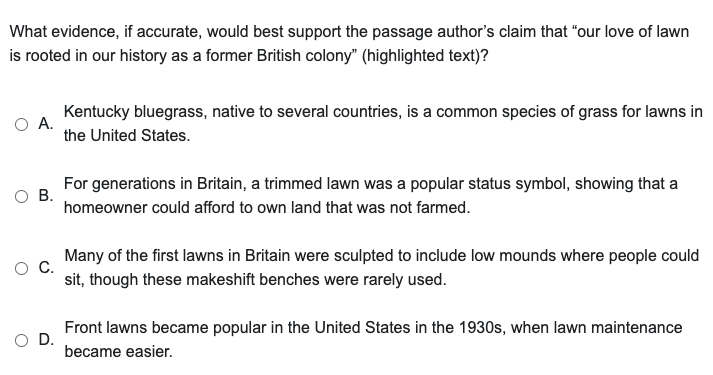
Each ACT Reading section has one paired passage, that is, a passage that is made up of two shorter texts about the same subject, often with contradictory theses. Many of the IKI questions found in the ACT Reading section appear alongside a test’s paired passage, as students are asked to compare the arguments and evidence of each text to one another. These are the “Text Connections” type of IKI questions.
The second released ACT practice test also (likely) revealed a new fertile location for IKI questions: reading passages with attached data charts. This is change is discussed more fully in the section below.
Data Analysis in Reading Section of the New ACT
The largest question mark for the Reading section of the new ACT has to do with the inclusion of data charts in the second released practice test. In this test, the third passage of the Reading section includes a table that would be more traditionally seen in the Science section of the test. Four of the questions attached to the passage (just shy of half of them) explicitly refer to data found within this table.
The table in question:
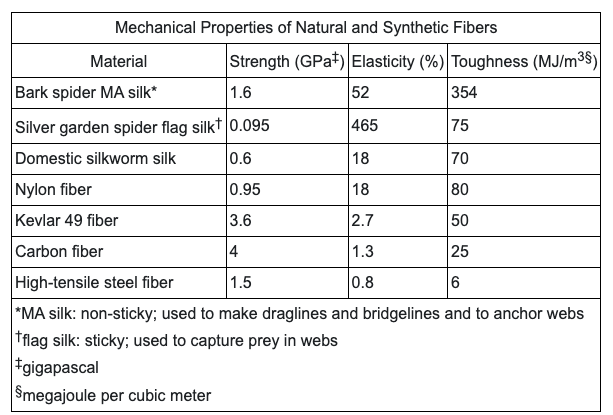
The final four questions of the passage are not able to be answered without looking at the table. Here’s an example question:
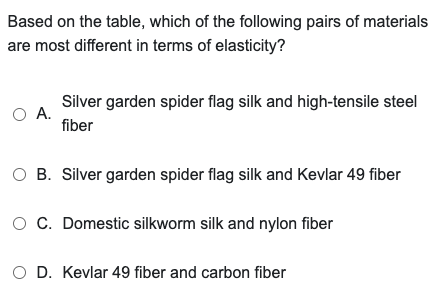
This is the first time this type of data analysis has been tested in the Reading section of the ACT, and it’s important to note that on the released practice test, this is an “experimental passage,” meaning a passage that is unscored while the ACT collects data on how students perform on the questions. It’s unclear at this point whether or not these types of questions will eventually appear as scored portions of actual tests.
This also means that we can’t know for sure the reporting categories of the questions attached to this passage. That being said, since many of these question refer explicitly to the evidence found within the data table, it is likely that they fall into the Claims and Evidence category of questions, which is in the IKI reporting category.
Even without an official word on data charts, the inclusion of this passage in one of two official digital practice tests tells us that the ACT is seriously considering their inclusion on future tests. This change is likely being done as fewer and fewer students opt to take the science portion of the ACT, which is where data analysis questions like this are typically housed. If the ACT does move toward the inclusion, it will put their reading section more in line with the Reading & Writing section of the SAT, which asks students to do similar data analysis.
Piqosity Updates to the Reading Section of the ACT
At Piqosity, we’re committed to always giving students the best study materials possible. Based off this analysis of the official ACT practice tests as well student feedback, we’ve significantly updated all of our 12 Enhanced ACT full-length practice tests to reflect the changes. This ensures that when students take a Piqosity test, they’re getting as close to the real thing as possible. Some of our updates to the Reading sections of our ACT practice tests include:
- Adding in charts and data-analysis questions: in light of the table seen in one of the reading sections of the second official practice test, Piqosity is updating half of our 12 ACT practice exams to include similar data charts and questions that ask students to analyze said data.
- Software updates to better reflect online ACT format: Piqosity ACT tests have gotten a facelift so that the English and Reading sections more closely reflect the view that students will see when they take the official test online. Like the official ACT, the passage text that corresponds to a question will be automatically scrolled to and highlighted as a student clicks on the question. See below for an example Reading question on a Piqosity practice ACT: