


If you thought the SAT was a typical standardized test, that’s no longer the case! For the second time in a decade, College Board has implemented a major overhaul of their famous college entrance exam. Additionally, the Preliminary SAT (PSAT) got a makeover.
The last time the SAT was changed in 2016, we saw the end of the mandatory essay section, fewer answer options for multiple choice questions, and the abolition of the penalty on incorrect answers. Officially implemented across the US in Spring 2024, the most recent change to the SAT similarly seeks to optimize the test-taking experience.
Understanding a test like the SAT is vital for performing well on it, so it’s important for students to acquaint themselves with the new digital SAT format. Luckily, you’ve come to the right place! We at Piqosity have broken down everything students, parents, and educators need to know about the new SAT!
Why is the SAT Changing?
Before we get into the specifics of what exactly has changed on the SAT, let’s go over the reasons behind the changes. College Board has cited these four points as the benefits of the new digital SAT:
- Easier to take – the new digital SAT format means that students can take the exam on their own personal devices, not to mention the test is significantly shorter. According to internal surveys, College Board found that 80% of students prefer the new digital SAT format to the paper-and-pencil one!
- Easier to administer – students aren’t the only ones benefiting from the digital model of the new SAT, but proctors are as well. No longer do boxes of testing booklets have to be shipped across the country and organized and kept track of by proctors.
- More secure – without stacks of booklets and scantron answer sheets, there are fewer opportunities for tampering with test information or answers.
- More relevant – the new digital SAT has mini-passages for each English question rather than traditional reading passages. This increases the likelihood that students find material on the test engaging.
Overall, these changes are largely in response to recent criticism of college entrance exams and questions about whether or not they’re still relevant for students.
What’s Changing on the SAT?
Now that we’ve covered why things are changing, let’s tackle the biggest question of the day: what is changing on the new digital SAT?
Well, in brief—everything. Now, before anyone starts to panic, this is a bit of an over-statement, but there have been significant changes that range from how the test is being administered and scored to the content tested and question formats.
Digital Format
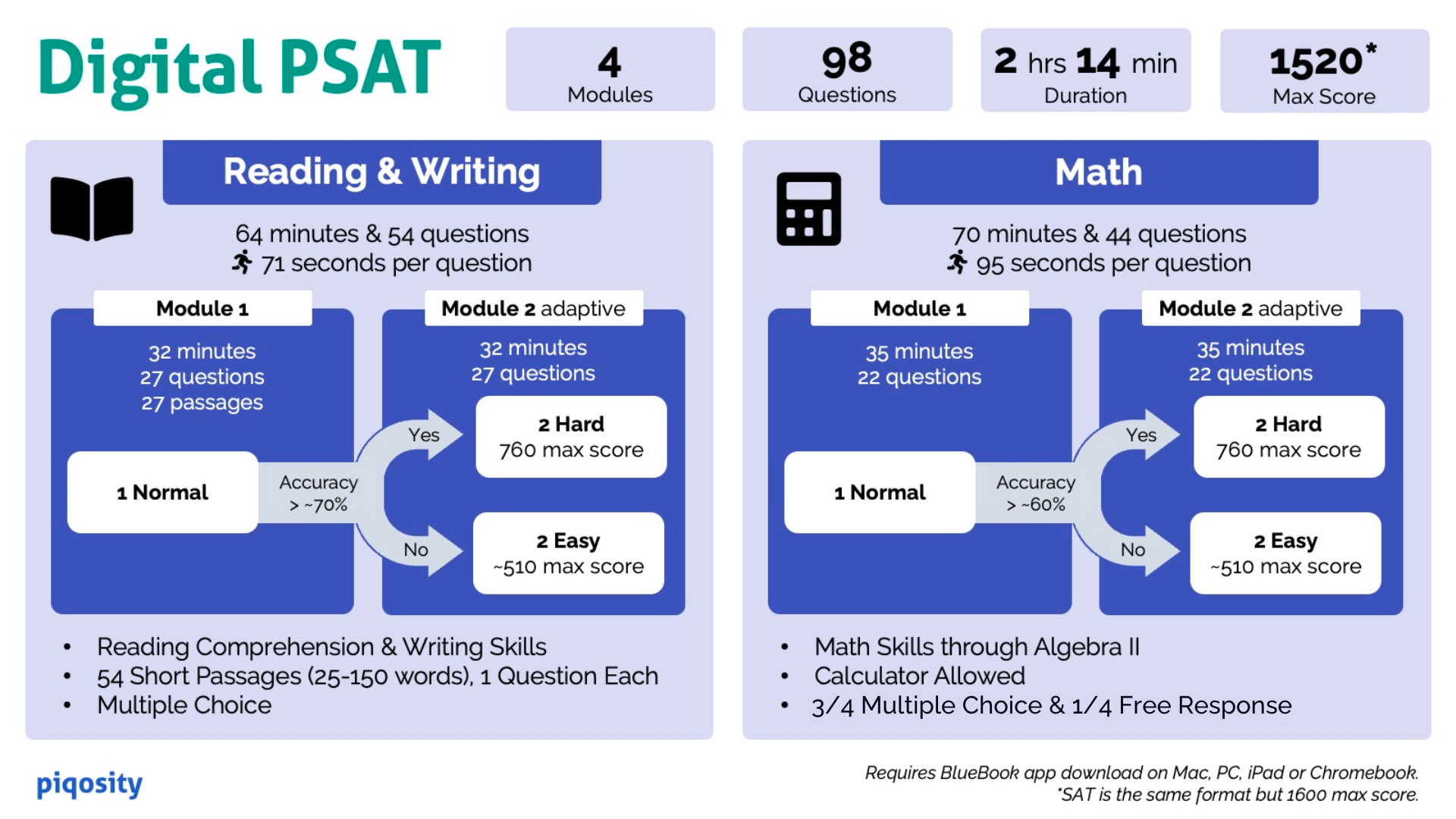
First, the elephant in the room: put down your erasers and number 2 pencils because the new SAT is administered digitally!
We know, we know, it’s the end of an era. No longer will testing rooms be full of the sounds of lead scratching against paper as students frantically finish bubbling as the clock starts to count down!
Instead, the new digital SAT is administered on an app developed by College Board called Bluebook.
Before anyone gets too excited at the prospect of taking the SAT in their bed and PJs though, it’s important to note that students still have to go to specific testing centers at pre-set times and dates to take the test. They are also able to take the digital SAT on approved personal devices—for students who don’t have access to personal computers, College Board will provide one if requested when registering for the test.
Shorter Length
For those sorry to retire their trusty Ticonderogas, hopefully they’ll at least be happy to hear that the digital SAT is also significantly shorter than the previous one–clocking in around two hours instead of three.
Adaptive Design
Unlike a traditional pencil-and-paper test where everyone in the testing room is given the same stack of questions, which questions students receive on the new SAT is now based on their performance on previous questions. This isn’t a fully adaptive test where each individual question is dependent on performance, but rather an adaptive test in modules.
In both the math and English portions of the test, there are two modules. The first module is the same for all students taking the test on that day. If they get roughly two-thirds of the questions in that section correct, their next module for that portion of the test will be harder. If they don’t get roughly two-thirds of the questions correct, they will be given an easier module.
Scores take into account which second module the student received. This means that if a student is given the easier module, there’s a cap on how high their score can be, even if they answer every question in that module correctly.
One of the benefits of an adaptive test is that it can gauge a student’s ability in a subject with fewer questions. Because the new digital SAT is adaptive, it contains significantly fewer questions than did previous versions of the SAT.
Quicker Results
The final overall change worth noting is that because the test is now digital, students receive scores much faster than they used to. Instead of anxiously waiting for weeks to see how they did, students are able to view their scores a few days after the test is completed.
What’s not Changing on the New Digital SAT?
Now that we’ve gone over the multitude of differences between the previous SAT and the digital one, know that many aspects of the test are staying the same:
- Scoring – perhaps most importantly, the test is still scored on a 400-1600 point scale. How this score is calculated is a little different with the adaptive test, but the breakdown of 800 possible points on each the math and English sections remains the same (although students no longer get subscores in each section).
- Testing times/locations – as was mentioned earlier, the digital SAT is still administered at official testing locations during specific times. This means that students still need to register in advance for their desired testing date and location!
- Pretest questions – just like previous versions of the SAT, in each of the modules there are two “pretest” questions which do not count towards the student’s score. These are questions that College Board is testing for inclusion on future tests. There’s no way of knowing which of the questions are pretest ones, though, so students should put their full effort into every question that they see.
- Accommodations – students who need certain accommodations, like extra time, extended breaks, human readers, etc. are still able to register for them ahead of time (assuming the student meets College Board accommodations criteria).
Is the New Digital SAT Easier?
The answer to this question is obviously subjective, but there are many indications that the new digital SAT is, in some ways, an easier exam. Most of these simply have to do with endurance: since the new digital SAT is significantly streamlined, students only have to remain focused for two hours instead of three.
Similarly, having no long reading passages helps students combat burnout as they take the test. This is true even for math questions, where College board has instituted a new cap on the number of words that can be used. In addition, calculators are now allowed for the entire math section, instead of just on certain questions. Students typically have a much easier time with the new digital SAT than they would have had with the paper-and-pencil one.
It is important to note that College Board seems to have tweaked the SAT in 2025 to be more difficult than the original digital SAT by lengthening the “easy” math questions and making the “hard” reading questions harder. There are no doubt more changes to come with this exam—but whatever those changes are, the best way to prepare for them is by practicing real test questions.
How Should Students Study for the New Digital SAT?
To get the best possible scores, it’s vital for students to study for the new digital SAT—and one of the best ways to prepare is by taking practice tests ahead of time.
College Board has released four practice digital SAT tests which can be taken by students through the Bluebook app, and Piqosity is offering a new digital SAT course that includes 12 full-length SAT practice exams! Together with 2 PSAT practice tests, 600+ personalized practice questions, topic lessons, and more, this makes Piqosity the best destination for digital SAT test prep.
You can try out all of Piqosity’s features with our free community account! When you’re ready to upgrade, Piqosity’s year-long accounts start at only $89.