

If you’ve taken the ACT before and are planning to take it again, you’re likely trying to figure out how to improve your ACT score. Without question, the best way to improve your ACT score is to take practice tests and study practice questions. However, not all study strategies are made equal; you can get more out of your ACT practice if you approach your studies strategically.
Discover how to improve your ACT score with minimum stress when you follow these 6 steps.
1. Get your Baseline Score
If you are going to learn how to improve your ACT score, you first need a score to improve upon. If you’ve already taken the ACT, you can use the score report you received, which probably looks something like the below. (If you haven’t yet taken the ACT, you can get a baseline score by taking a free ACT practice test when you sign up with Piqosity.)
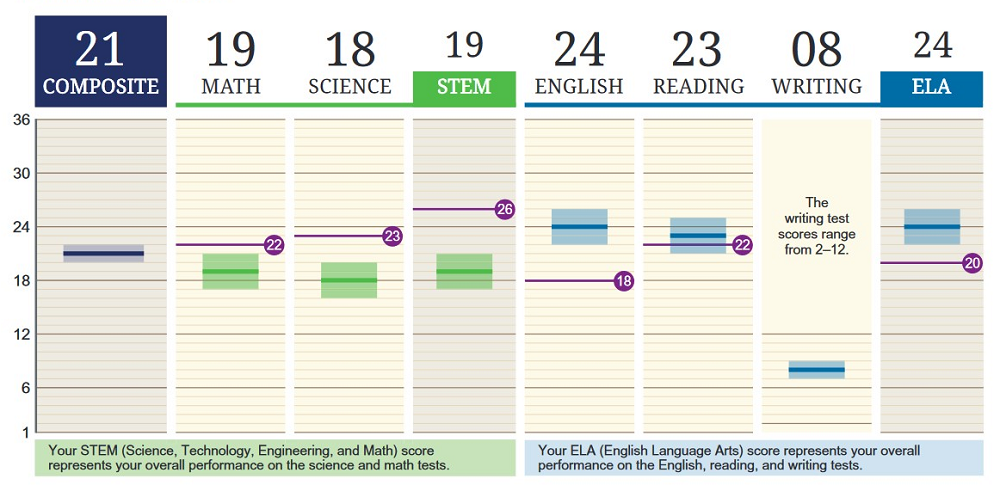
Note: As of the 2025 Enhanced ACT, the ACT Science test is no longer required on the SAT; therefore, the composite score is the average of only your Math, English, and Reading scores. The ACT Science & Writing scores (plus the STEM & ELA scores) will still be sent to colleges.
A quick scan of your baseline scores can tell you several things, including:
- Your strengths and weaknesses by test subject areas (we will come back to this later)
- How much room you have for improvement in each area
- How difficult or easy it may be to improve your score
This last point is especially important if you’re on a tight deadline. If your baseline scores are on the low end, you may be able to improve your score significantly by covering the basics and getting a better feel for how the test is taken. If your scores are above average, however, you probably have the basics covered and need to focus on mastering the skills needed to answer harder ACT questions.
The former is typically less time-intensive; the latter takes more effort.
In addition to reviewing your ACT score report, you can also request a copy of your ACT test questions and answers. You will receive a copy of the multiple-choice test questions used to determine your score, the answer key, and a copy of your graded answer sheet. You will also receive a copy of your graded essay (including the prompt and rubric) if you took the writing test. If you have the time to do so, this is a great opportunity to see exactly what kinds of questions you were most confused by (and which ones you aced!).
2. Set Realistic Expectations and Goals
Now that you know your baseline ACT scores, you can move on to the next step: setting goals for how to improve your ACT score. However, this next step is often the hardest for students to follow. That’s because students are typically wondering things along the lines of “How can I improve my ACT score quickly?” and “Can you improve your ACT score in a week?”
These questions have merit and, by following these steps, you may still be able to improve your ACT score in a short amount of time. But to be blunt, these questions are also often indicative of a student with unrealistic expectations. If you want to want to improve your ACT score significantly, doing so takes time.
So, let’s explore what realistic expectations and goals for improving your ACT score might look like for you. To do so, you’ll need to answer a few questions:
- By how many points do you want to improve your score?
- How much time do you have before you take your next ACT exam?
- How much of that time are you willing and able to commit to ACT prep?
With your answers to these questions in mind, set a specific goal for score improvement. Do you have only one week before your next test? Study as much—and as efficiently—as possible, but keep your score improvement expectations reasonable. Do you want to improve your score by 10 points? Allot more time to test prep.
So, your new goal might look something like this: “I have one month before I take my next ACT. My goal is to increase my Composite score by about 3 points. I will study for two hours a day, five days a week.”
Remember: While this may all feel daunting at first, the nice thing about setting specific, realistic goals is that doing so changes how you might answer a question like, “How hard is it to improve ACT scores?” Where you might once have said, “Impossible,” you can now say, “Just hard enough.”
A quick note on average ACT score improvements
Students are often curious about the average increase in ACT scores with prep and/or the average improvement on ACT the second time you take the test. In 2016, the ACT released a report stating that, “Repeat-testers’ latest scores had an average Composite score 2.9 points higher than their single-test counterparts.” Unfortunately, this data doesn’t tell us what percentage of those repeat-testers participated in test preparation or additional study, nor does it adequately address other factors that might have influenced these numbers (such as how much time had passed between taking each test or how many total tests the “repeat-testers” had taken).
In general, any claims stating that you can gain “x” number of points by studying for “y” amount of hours should be taken with a grain of salt. While there are estimates you can use to make an ACT study plan, there isn’t enough data or rigorous analysis available to support those figures with certainty.
3. Make a Study Plan
After you set your goals, another key to knowing how to improve your ACT score is knowing how to create a study plan. Let’s take a look at the basic considerations you’ll want to keep in mind when creating your study plan.
Your study plan for retaking certain sections of the ACT
If you’re planning on retaking the ACT, look over your scores to determine your strongest and weakest subject areas.

Let’s imagine that you scored the highest in English and Reading and the lowest in Math. Although you will want to spend time studying in each subject area, it’s a good idea to focus your energy on your weaknesses. In our example, that would mean spending more time working on Math questions.
Of course, you want to make sure not to lose ground in your strongest subject areas. One helpful strategy is to divide your time more equally the closer you get to the test day. If, in our ongoing example, you had a month of prep time, you might spend the first week working exclusively on Math and Science questions and the second week working mostly in those areas. But, by the end of the month, you would spend equal time preparing for all three (or four… or five) sections.
Four or five? As of 2025, two sections of the ACT are optional: Science & Writing. While the main focus of college admissions offices is on the core ACT subjects, having a Science and/or Writing test score doesn’t hurt.
4. Learn the ACT Format
You’ve set your goals, so now it’s time to start working on ACT practice questions, right? Well, not quite. Although studying ACT-specific subjects is indeed a key part of how to improve your ACT score, it’s important not to overlook the fact that taking a standardized test like the ACT is a skill in and of itself that needs to be practiced.
As mentioned above, students who take the ACT more than once tend to see significant score improvement. One big reason for these improvements is that by the second (or third, or fourth…) time you take the ACT, you are more familiar with the format, structure, and style of the test.
Of course, taking practice ACT tests helps build this level of familiarity, but it’s helpful to take a step back and see the structure of the test when you’re not in the middle of taking it. The graphic below offers a helpful overview of the entire test: the order of the subject tests, how many questions are in each part, and how long you have to complete them.

Since the ACT doesn’t deduct points for incorrect answers, it’s best to try and answer each question on the test. Knowing how long you should spend on each test question is a helpful strategy for making sure that you budget your time appropriately.
It’s also a good idea to familiarize yourself with the instructions for every ACT section, because they’re always the same! (Obviously, the questions on each version of the ACT are different.) If you already know what you’ll be asked to do, you’ll save time and reading effort when you’re actually taking the ACT. Get familiar with the ACT instructions by reading this free official ACT practice guide.
5. Begin Taking Practice Tests and Studying Practice Problems
ACT practice tests are a great way to work through ACT topics and get accustomed to the test’s format and style. There are several tests available for you to use, including post-2025 versions (reflecting all ACT changes; samples of what you’ll be taking on ACT test day) and practice tests for the pre-2025 ACT (they aren’t completely up-to-date with the current ACT but still provide a great resource for working through ACT concepts).
Be strategic about how you incorporate these practice tests into your studying. It’s a good idea to spend much of your prep time working through individual practice problems tailored to your needs. (If your weakest area is Reading, for instance, you don’t want to waste prep time taking a practice test on which 4/5 of the material is *not* Reading.)
Take a full-length practice test only after you’ve spent some significant time strengthening your weakest areas. And when you do, be strict with yourself—try to imitate real-life testing conditions. Clear your workspace of everything except your testing materials. Set a timer for each section, and stop when the time’s up, even if you’re not done. Only take the breaks that will be allowed on the real ACT. (You might even adjust the temperature of your room, since test sites are often unnaturally hot or cold.)
After you’ve finished the test, you’re done for the day. The next time you study, carefully grade each section, and go over every missed problem in detail to understand why you got it wrong. This collection of missed problems can then be the focus for your prep sessions going ahead.
6. Ace Test Day
After preparing diligently and following our advice for how to improve your ACT score, test day is finally here — all of your great preparation is about to pay off! Here are a few things to remember in those last hours before you take your ACT:
- Don’t stay up late cramming the night before. Instead, do something fun and low-stress, and try to get to bed at a reasonable hour. You want to be fully rested so you have maximum energy and can focus on your test.
- Double-check that you have all your necessary testing materials, including:
- Pencils
- An approved calculator (with fresh batteries)
- A water bottle and healthy snack for test breaks, etc.
- A silent digital or analog watch as a personal method of keeping time (optional)
- Review Piqosity’s guide to ACT test strategies for helpful hints about how to maximize your efficiency on each section of the ACT.
Good luck on the test! Remember that as long as there’s time left before your college application due dates, you can still retake the exam for more score improvement.
How to Improve Your ACT Score with Piqosity
If you now know HOW to improve your ACT score but still need support getting there, Piqosity can help! Along with our full-length, online ELA and Math courses for grades 5-11, we offer full SAT, ACT, and ISEE test prep courses, each of which includes 12+ practice exams, dozens of concept lessons, personalized practice software, and more.
Whatever your weakest ACT area is, Piqosity can help you improve it with 10 full-length ACT practice tests, over 70 distinct concept lessons, and personalized practice software— you’ll be on the path to your goal ACT score in no time.
Piqosity also offers free ACT practice tests with answers and explanations, available to the public! Click through the links below to access the answer explanations to the ACT’s recently published practice tests:
- 1st full-length Enhanced ACT 2025 test (PDF test link)
- 2nd full-length Enhanced ACT 2025 test (PDF test link)
For the new 2025 ACT, we’ve created an enhanced ACT course that includes over 10 ACT practice tests. Our free community account allows you to access these practice tests and try out all of Piqosity’s features—no credit card required! When you’re ready to upgrade, Piqosity’s year-long accounts start at only $89.