


As National Poetry Month comes to an end, there’s no better time to round out your knowledge of poetic principles. Most students find meter difficult when they first encounter it, but it’s one of the most rewarding principles to understand, whether you’re reading or even writing poetry. This deep dive into poetic meter and the accompanying poems that have meter make an excellent resource for learning what meter is, the different types of meter, and how to identify it in poetry.
What is the Meter of a Poem?
Together with rhyme, meter is the way words that are read aloud develop melody. Think of your favorite music—lyrics in a song usually have a certain number of “beats” per line that align with the instrumentals’ tempo.
While many modern & contemporary poets write in free verse—which does not use meter (and/or does not have rhyme scheme)—meter is still one of the most important aspects of poems written throughout history, as it is what defined poetry as its own category of literary art that is separate from prose. A poet’s use of meter gives their work of writing a “flow”, and it establishes a complexity or richness that texts without meter don’t have.
In poetry, meter is the arrangement of its words in rhythmic structure. The meter of a poem is the number of syllables and the pattern of stress in a line.
Aspects of Poetic Meter
A poetic meter is measured in feet. One poetic foot is a set of syllables (usually 2-3) following a pattern of stress (and unstress). Here’s a breakdown of these basics and how to use them in determining meter.
A syllable is one “beat” in a word. “Cat”, “heat”, “fast”, and “through” all have one beat/syllable. “Brother”, “ahead”, and “covered” have two. “Everything” has three, “absolutely” has four, and so on.
A stressed syllable is a syllable with more emphasis—it’s louder or carries more weight than the other syllables around it, which are unstressed. In “apple”, the “a” is the stressed syllable—”AH-pul”. In “banana”, the middle “na” is the stressed syllable. If it’s hard to distinguish which syllable is stressed, say “ba-NA-na” and “BA-nana” aloud and compare how they sound (one will sound normal, one won’t!).
A line of metered poetry will have a pattern of stressed and unstressed syllables—one unit of this pattern is called a foot.
How to Find the Meter of a Poem
Keeping track of syllables in your head can be challenging, so read poems aloud and tap along or count on your fingers to measure the number of syllables. If a poem is printed on a physical page you can write on, take the more organized approach of scanning the poem—graphing the meter by marking each syllable to be stressed (with an x above it) or unstressed (with a / above it).
To find the meter in a poem:
- Pick a line of a poem.
- Break down the words into syllables.
- Identify which syllables are stressed and unstressed.
- Pair up the stressed and unstressed syllables into feet.
- Count the feet, and you have the length of your meter.
Example:
Let’s find the meter of Emily Dickenson’s “Because I Could Not Stop For Death” in line 3:
“The carriage held but just ourselves”
There are eight syllables in this line.
“The ca-rriage held but just our-selves”
The first syllable is unstressed, the second is stressed, the third is unstressed, and so on.
“The ca-rriage held but just our-selves”
There are four feet in this line, following an “unstressed—stressed” pattern.
“(The ca) (rriage held) (but just) (our-selves)”
Now that you know what makes up this poem’s meter, what would you call it?
How Meter is Classified
The meter of a poem is determined by the type of feet it uses and the number of feet it has in each line.
Most poems written with meter have the same types of feet throughout, but while some poems use the same meter in every line, others alternate the meter by line.
Types of Poetic Feet
Poetic feet are groups of two or three syllables. The most common types are:
- Iamb. Two syllables; Unstressed → Stressed. Ex: “agree”
- Trochee. Two syllables; Stressed → Unstressed. Ex: “never”
- Spondee. Two syllables; Stressed → Stressed. Ex: “armchair”
- Pyrrhic/Dibrach. Two syllables; Unstressed → Unstressed.
- Anapest. Three syllables; Unstressed → Unstressed → Stressed. Ex. “understood”
- Dactyl. Three syllables; Stressed → Unstressed → Unstressed. Ex. “elephant”
Types of Poetic Meter
Poetic meter—the number of feet per line—is described with Greek prefixes:
- Monometer. One foot per line.
- Dimeter. Two feet per line.
- Trimeter. Three feet per line.
- Tetrameter. Four feet per line.
- Pentameter. Five feet per line.
- Hexameter. Six feet per line.
- Heptameter. Seven feet per line.
- Octameter. Eight feet per line.
The Most Common Poetic Meters
The fun behind poetic meter is that poets can combine types of feet and the number of feet per line in so many different ways. Here are some common examples poets have used throughout history.
Common Variations in Meter
In poetry, all rules can be broken to serve a rhythmic or symbolic purpose. Meter is a strict format to adhere to, and many poets subvert that format in certain ways by integrating variations into a poem with an otherwise standard meter order to achieve a unique effect.
- Catalexis: an incomplete metric line of verse, starting or ending with an incomplete foot.
- Anacrusis: one or two unstressed syllables added to the beginning of a line.
- Spondaic or Pyrrhic Substitution: one foot is replaced with a spondee or pyrrhic foot. Spondees and Pyrrhic feet are rarely used throughout an entire poem since most words have both stressed and unstressed syllables, so this is a way for poets to use them.
Poems to Teach Meter
This collection of poems that use meter features acclaimed works set to iambic pentameter, different meters of trochees, combinations of feet or meters, and more.
“Sonnet XII” by William Shakespeare (Or Any Shakespeare Sonnet)
Shakespeare’s poetry took the form of sonnets, which are made up of three quatrains and a couplet (with the rhyme scheme ABAB, CDCD, EFEF, GG) and written in iambic pentameter. His 150+ sonnets are rich in drama and figurative language, spanning all kinds of subject matter (but mostly love and romance).
While we’re featuring “Sonnet XII” for its precise meter and thematic messaging, each of Shakespeare’s sonnets is a tremendous resource for understanding meter and how it works with rhyme to weave words into melody.
“When I do count the clock that tells the time,
And see the brave day sunk in hideous night;
When I behold the violet past prime,
And sable curls all silver’d o’er with white;”
(Lines 1-4)
Note: Like rhyme, meter can inform us how the poet intended certain words to be pronounced, or how they were pronounced in their time. Because we know that “Sonnet XII” is in iambic pentameter, we know that “violet” in line 3 must have three syllables to fit with the syllabic structure of the rest of the sentence. This contrasts with the modern American English spoken today, where it’s often pronounced “VYE-let” instead of “VYE-o-let”.
“The Tyger” by William Blake
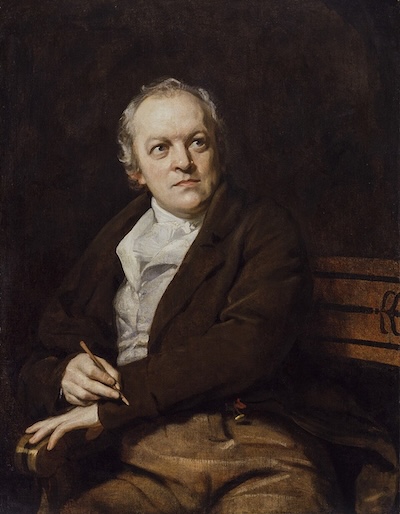
William Blake
Together with an AABB rhyme scheme, William Blake uses a modified trochaic tetrameter to create an intense rhythm in “The Tyger”. The first three lines of each stanza exhibit catalexis, where the final syllable of the meter is omitted. The fourth line contains anacrusis, where an unstressed syllable is added to the beginning of the line, before the first stressed syllable.
The catalexis creates unexpected pauses through the first rhyme pair, but then the missing syllable at the end of the third line is introduced at the beginning of the fourth. Blake subverts the expectations of the rhythm by creating a different one.
“Tyger Tyger, burning bright,
In the forests of the night;
What immortal hand or eye,
Could frame thy fearful symmetry?”
(Lines 1-4)
“Before I got my eye put out – (336)” by Emily Dickinson
Another poet with an impressive repertoire of metered poems, Emily Dickinson was known for writing many of her poems in Common Meter—a form consisting of four-line stanzas, where each line alternates between iambic tetrameter and iambic trimeter. The variation in line length adds dimension to the rhythm and an opportunity for poets to differentiate the shorter lines if they wish to.
All of Dickinson’s poems are excellent resources for learning common meter and how it accompanies rhyme, but we’re highlighting her poem #336 to show how she picks a meter but customizes it to her needs, substituting syllables with pauses and adding an extra line.
“Before I got my eye put out –
I liked as well to see
As other creatures, that have eyes –
And know no other way –”
(Lines 1-4)
“Cardiology” by Rafael Campo

Rafael Campo
Most poetry with meter also has rhyme—both were standard conventions of poetry before the 1900s. Few poets writing today use either; but doctor and poet Rafael Campo is one modern poet who uses both! In “Cardiology” and many other of his poems, you can see how he juxtaposes a traditional meter (iambic pentameter) with modern subject matter, a lack of rhyme (called “blank verse”, where there is precise meter but no rhyme), and other stylistic aspects of modern poetry.
“You said that at its heart rejection was
impossible to understand. “We send
our heartfelt sympathy,” was written in
the card your mother sent, in flowing script.”
(Lines 9-12)
“In a Disused Graveyard” by Robert Frost
Robert Frost used meter in most of his poems. His style of writing and diction tends to be on the simpler side, making his entire body of work ideal for people first learning about poetry. “In a Disused Graveyard” showcases his mastery of simple imagery and effortless sociopolitical messaging. It follows iambic tetrameter throughout but includes some extra unstressed syllables at the end of certain lines (often called a “feminine ending”).
“The living come with grassy tread
To read the gravestones on the hill;
The graveyard draws the living still,
But never any more the dead.”
(Lines 1-4)
“The Raven” by Edgar Allen Poe
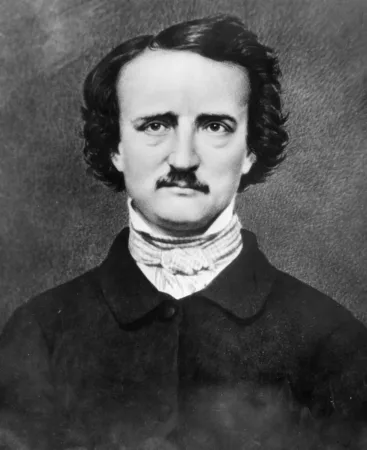
Edgar Allan Poe
Edgar Allen Poe is known for his poetic horror stories, and he uses all the poetic tools at his disposal to create an ominous ambiance. His poem “The Raven” is the most famous work in trochaic octameter, as the form is so fast-paced that it can be difficult to read and write. Poe uses his variation on this rapid rhythm (five lines of trochaic octameter (with an added stressed syllable on lines 4 & 5) followed by one line of trochaic tetrameter with catalexis) to fester a frightening, uneasy mood to fit the spooky subject matter.
“Ah, distinctly I remember it was in the bleak December;
And each separate dying ember wrought its ghost upon the floor.
Eagerly I wished the morrow;—vainly I had sought to borrow
From my books surcease of sorrow—sorrow for the lost Lenore—
For the rare and radiant maiden whom the angels name Lenore—
Nameless here for evermore.”
(Lines 7-12)
“Annabel Lee” by Edgar Allen Poe
Learners of poetic meter are in for a mind-blowing treat when scanning “Annabel Lee”, another eerie poem from Poe that produces the effect of a haunting melody with variable meter. It can be described as Anapestic–Iambic Tetrameter: each line has four metric feet, but each line has a distribution of anapests and iambs that differs from the other lines in the stanza. Challenge yourself by breaking down the types of poetic feet in each line of this poem about obsessive love and vengeful angels.
“It was many and many a year ago,
In a kingdom by the sea,
That a maiden there lived whom you may know
By the name of Annabel Lee;
And this maiden she lived with no other thought
Than to love and be loved by me.”
(Lines 1-6)
How Poetic Epics & Plays Use Meter
Poets are able to use meter in an even more impactful way in longer works of verse, as they can sustain a tone for a great length of time or switch between meters for strategic emphasis. These two examples are excellent teachers of meter, showcasing how masters of verse can wield this tool.
A Midsummer Night’s Dream by William Shakespeare

William Shakespeare
Set in an enchanted forest near Athens, A Midsummer Night’s Dream is a whimsical comedic play following a vast set of characters through their unusual plots—romantic pursuits, intense quarrels, a play within the play, and mischievous magical happenings. As in most of William Shakespeare’s plays, verse and prose create more than a rhythm for actors to follow; rather, they convey greater meanings about characters’ status and relationships with one another.
In Shakespeare’s pen, prose is used to signify the informal, “common” speak of lower status individuals or familiarity in a relationship. Blank verse, on the other hand, is the way upper-class characters speak—specifically iambic pentameter:
“You do impeach your modesty too much
To leave the city and commit yourself
Into the hands of one that loves you not,
To trust the opportunity of night
And the ill counsel of a desert place
With the rich worth of your virginity”
(Act 2, Scene 1, Lines 221-226)
Rhyme is used when characters’ lines veer to the poetic side, and trochaic verse is used to set a character’s lines apart from the rest. In A Midsummer Night’s Dream, the fairies in the forest chant spells in trochaic tetrameter, creating fast-paced, sing-song-y lines:
“Weaving spiders, come not here.
Hence, you long-legged spinners, hence.
Beetles black, approach not near.
Worm nor snail, do no offence.”
(Act 2, Scene 2, Lines 20-23)
Evangeline by Henry Wadsworth Longfellow
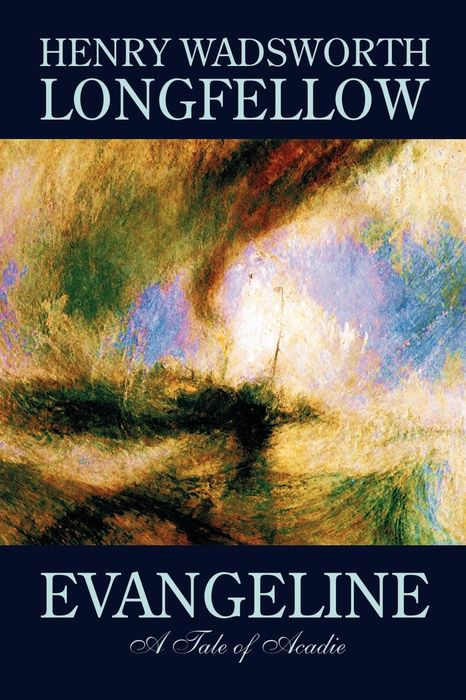 Dactylic hexameter (six feet of stressed → unstressed → unstressed) is most commonly used in Ancient Greek and Latin poetry, including epics like Homer’s Odyssey. It’s not as prevalent in English poetry, but the most well known is Evangeline by American poet Henry Wadsworth Longfellow (1807-1882). It has no rhyme and takes liberties with adding or removing syllables, but it has brought this archaic meter into the future (and the English language).
“In the Acadian land, on the shores of the Basin of Minas,
Distant, secluded, still, the little village of Grand-Pré
Lay in the fruitful valley. Vast meadows stretched to the eastward,
Giving the village its name, and pasture to flocks without number.”
(Part 1, Lines 1-4)
The story follows an Acadian girl during the Expulsion of the Acadians, where inhabitants of the New France colony Acadia (today, the area is parts of north Maine and Canada) were forcibly removed from their homes.
Improve Reading and Writing Skills with Piqosity
We hope this deep-dive into verse and collection of poems that have meter were informative and entertaining! Celebrating national poetry month by reading and learning about what makes poetry unique is a wonderful way to exercise ELA skills while enjoying the rhythm of songlike poems.
If you’re struggling with concepts like figurative language or looking for ways to improve your English skills, Piqosity’s here to help! Along with our Digital SAT and ACT test prep courses, we also offer full online English courses—each includes dozens of concept lessons, personalized practice software, and over 100 reading comprehension passages.
- 5th Grade English Course
- 6th Grade English Course
- 7th Grade English Course
- 8th Grade English Course
- 9th Grade English Course
- 10th Grade English Course
- 11th Grade English Course
The best part? Try out all of Piqosity’s features with our free community account, which feature a free mini diagnostic exam to evaluate your current ELA skills. When you’re ready to upgrade, Piqosity’s year-long accounts start at only $89.